
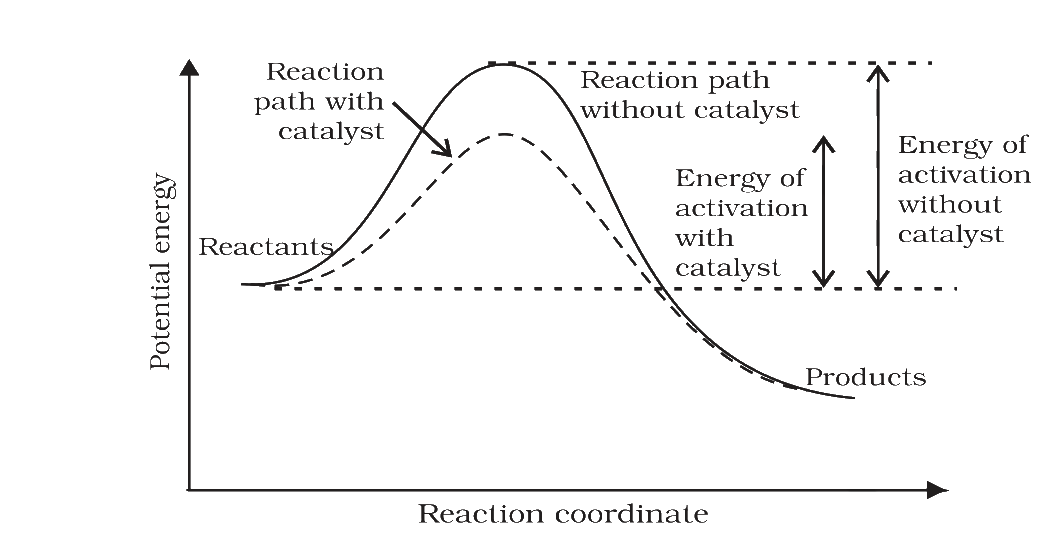
The figure shows the potential energy of a reacting system plotted against the reaction coordinate, for the reaction with and without a catalyst.
What does the figure show about the effect of the catalyst?
Answer & explanation
Correct answer: option 3
The correct answer is Option (3) → It lowers the activation energy, and the reactants and products stay at the same energy levels.
A catalyst provides an alternate pathway for the reaction. The figure compares the two paths on the same energy scale.
Activation energy — Lowered. The dashed path with catalyst has a lower hump, and the arrow for the energy of activation with catalyst is shorter than the arrow without catalyst.
Energy levels — The same. Both curves start at the same Reactants level and end at the same Products level; only the height of the hump changes.
Why the other options are incorrect
Option (1) It raises the activation energy, and the products lie at a lower energy than without the catalyst. — Incorrect. Both parts are wrong: the arrow with catalyst is the shorter one, and the two curves end at the same Products level.
Option (2) It lowers the activation energy, and the products lie at a lower energy than without the catalyst. — Incorrect. The activation energy is lowered, but the two curves end at the same Products level; the catalyst does not change the energy of the products.
Option (4) It raises the activation energy, and the reactants and products stay at the same energy levels. — Incorrect. The energy levels stay the same, but the hump of the path with catalyst is lower, so the activation energy is lowered, not raised.
NCERT (2026-27 edition):
3.4.1 Effect of Catalyst – “It is believed that the catalyst provides an alternate pathway or reaction mechanism by reducing the activation energy between reactants and products and hence lowering the potential energy barrier as shown in Fig. 3.11.”
“It is clear from Arrhenius equation (3.18) that lower the value of activation energy faster will be the rate of a reaction.”
Fig. 3.11: Effect of catalyst on activation energy