Gel electrophoresis
Read the following passage carefully and answer the given questions.
The cutting of DNA by molecular scissors results in fragments of DNA. These fragments can be separated by a technique known as gel electrophoresis. Since DNA fragments are negatively charged molecules, they can be separated by forcing them to move toward electrode under an electric field through a matrix. Nowadays, most commonly used matrix is agarose, which is a natural polymer. The DNA fragments resolve according to their size through sieving effect provided by agarose gel. Hence, smaller fragment size, farther it moves. The separated DNA fragments can be visualized only after staining DNA with a dye followed by exposure to radiation. The separated bands of DNA are cut out from agarose gel and extracted from gel piece. The DNA fragments purified in this way are used in construction recombinant DNA by joining them with cloning vectors.
In gel electrophoresis, the separated DNA fragments can be visualised after staining with:
Answer & explanation
Correct answer: option 3
The correct answer is Option (3) → Ethidium bromide
The separated DNA fragments can be seen only after the DNA is stained with ethidium bromide, and the gel is then exposed to UV radiation. The dye binds to the DNA, and the DNA then glows as orange bands.
(1) Crystal violet — Incorrect. It is a dye used to stain bacteria. It is not used to stain DNA in a gel.
(2) Bromophenol blue — Incorrect. It is a tracking dye that is mixed with the sample to show how far the run has gone. It does not make the DNA bands glow.
(3) Ethidium bromide — Correct. This is the stain used for DNA in gel electrophoresis.
(4) Eosin — Incorrect. It is a dye used to stain the cytoplasm of cells in tissue sections.
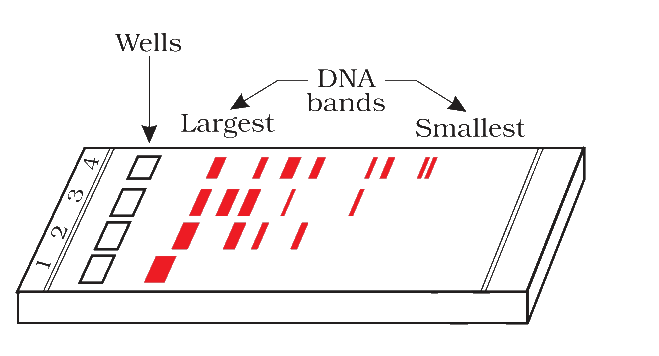
Figure 9.3 A typical agarose gel electrophoresis showing migration of undigested (lane 1) and digested set of DNA fragments (lane 2 to 4)
Note 1: The passage is taken from NCERT. NTA has put lines of the NCERT text together to make it. Most CUET (UG) questions come straight from NCERT, so study the book line by line, including figures and their titles.
Note 2: A similar question was also asked in CUET (UG) 2026 on 31-05-2026 (Slot 2) and on 25-05-2026 (Slot 1), and in CUET (UG) 2025 on 20-05-2025 (Slot 2), on 16-05-2025 (Slot 1) and on 14-05-2025 (Slot 1).
NCERT Extract:
Restriction Enzymes – “… The separated DNA fragments can be visualised only after staining the DNA with a compound known as ethidium bromide followed by exposure to UV radiation (you cannot see pure DNA fragments in the visible light and without staining).”