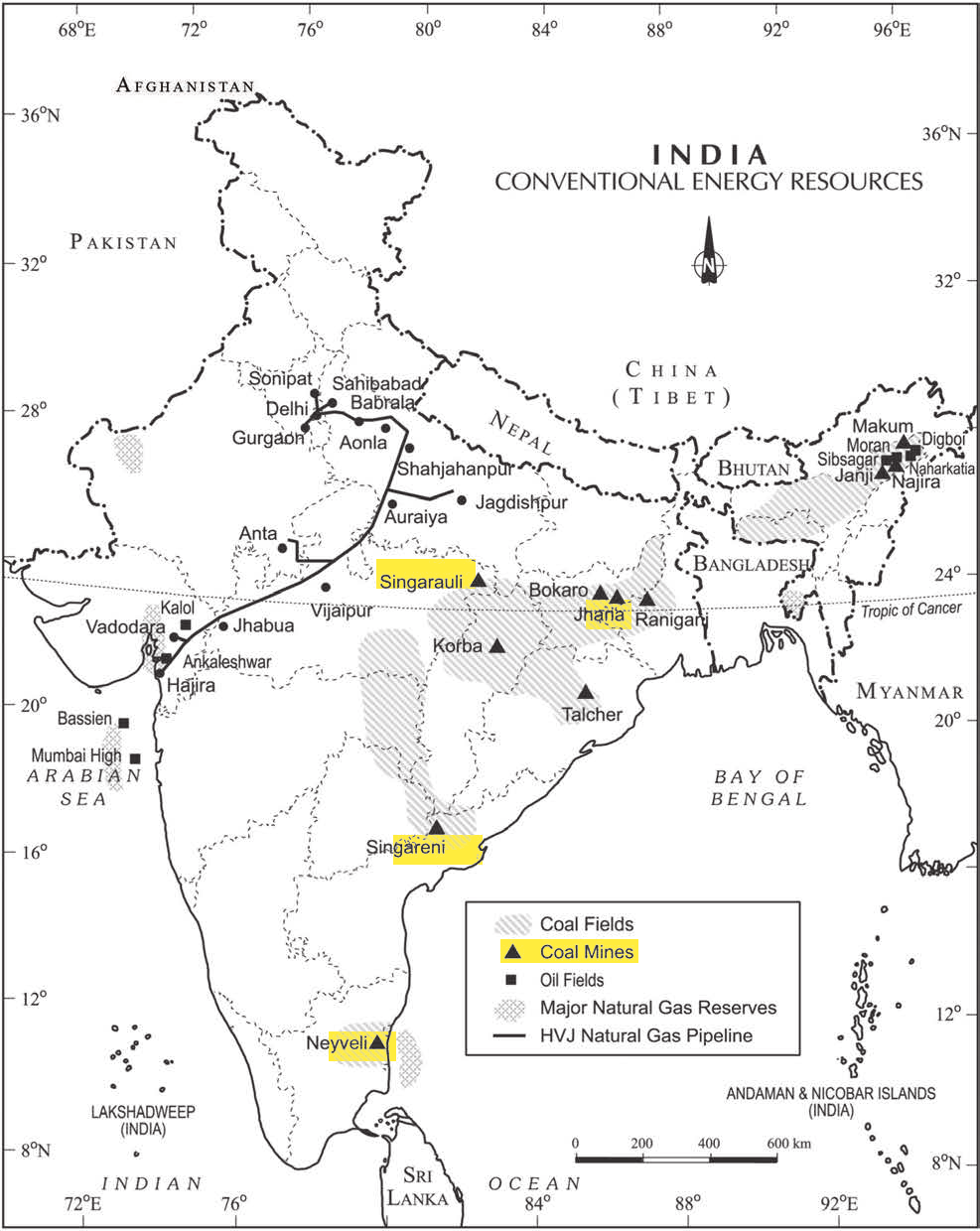
Match List-I with List-II
| List-I (Coal Mine) | List-II (State) | ||
| (A) | Singarauli | (I) | Tamil Nadu |
| (B) | Singareni | (II) | Jharkhand |
| (C) | Neyveli | (III) | Madhya Pradesh |
| (D) | Jharia | (IV) | Andhra Pradesh |
Choose the correct answer from the options given below:
Answer & explanation
Correct answer: option 4
The correct answer is Option (4) → (A)-(III), (B)-(IV), (C)-(I), (D)-(II)
(A) Singarauli — this matches (III) Madhya Pradesh. It is also spelt Singrauli; part of its coal field lies in Uttar Pradesh.
(B) Singareni — this matches (IV) Andhra Pradesh.
(C) Neyveli — this matches (I) Tamil Nadu. Neyveli has lignite, a brown coal.
(D) Jharia — this matches (II) Jharkhand. It is the largest coal field of India, in the Damodar Valley.
Note: It seems that there is a mistake in the original NTA paper, which prints Singareni in Andhra Pradesh when it should read Telangana. The answer does not change.
NCERT (2026-27): “Coal … The most important Gondwana coal fields of India are located in Damodar Valley. They lie in Jharkhand-Bengal coal belt and the important coal fields in this region are Raniganj, Jharia, Bokaro, Giridih, Karanpura.” “Jharia is the largest coal field followed by Raniganj. The other river valleys associated with coal are Godavari, Mahanadi and Sone. The most important coal mining centres are Singrauli in Madhya Pradesh (part of Singrauli coal field lies in Uttar Pradesh), Korba in Chhattisgarh, Talcher and Rampur in Odisha, Chanda–Wardha, Kamptee and Bander in Maharashtra and Singareni in Telangana and Pandur in Andhra Pradesh.” “Besides, the brown coal or lignite occur in the coastal areas of Tamil Nadu, Puducherry, Gujarat and Jammu and Kashmir.”
Fig. 5.4 : India – Conventional Energy Resources |