CUETMOCK
  • Pricing
  • Mentors
Log inStart freeStart free mocks→

First test, then trust

Try a free CUET mock test.

Join 5,00,000+ students who rehearsed exam day on the exact NTA screen before sitting CUET. On the web and on Android.

Start free mocks →Get the Android app
CUETMOCK

India's #1 CUET Mock Test Platform. Original NCERT-based questions on the exact NTA exam screen — trusted by 5,00,000+ students since CUET 2022.

Get it onGoogle PlayScan to download the CUETMOCK app

Mock tests

  • CUET mock test series
  • Commerce mocks
  • Humanities (Arts) mocks
  • Science mocks
  • Languages & GAT mocks
  • Free practice questions
  • Pricing

Resources

  • CUET exam guide
  • CUET syllabus
  • Universities accepting CUET
  • Expert blogs
  • News & notifications
  • Webinars & counselling
  • CUET score calculator
  • How we estimate your rank
  • FAQs

Company

  • About us
  • Our leadership & team
  • Our toppers
  • Mentors
  • For schools
  • Contact us
  • Terms
  • Privacy
  • Refund policy

Talk to us

+91 7696 6630 56info@cuetmock.comWhatsApp us

Our other platforms

  • JEE Mock — For IIT-JEE aspirants
  • NEET Mock — For NEET aspirants

Newsletter

Exam updates, study material and offers — no spam.

© 2026 NYC Ventures Pvt. Ltd.

701-702, Royal Business Park, Zirakpur, Punjab - 140603

  • Terms of use
  • Privacy policy
  • Refund policy
  • Contact us

iCUETMOCK is an independent preparation platform, not affiliated with the National Testing Agency (NTA). Always check exam details on the official NTA website.

  • Home
  • Mock tests
  • CUET guide
  • Pricing
  • Log in
Home/Practice questions/Sociology
SociologySocial Change and Development in India: The Constitution and Social Change

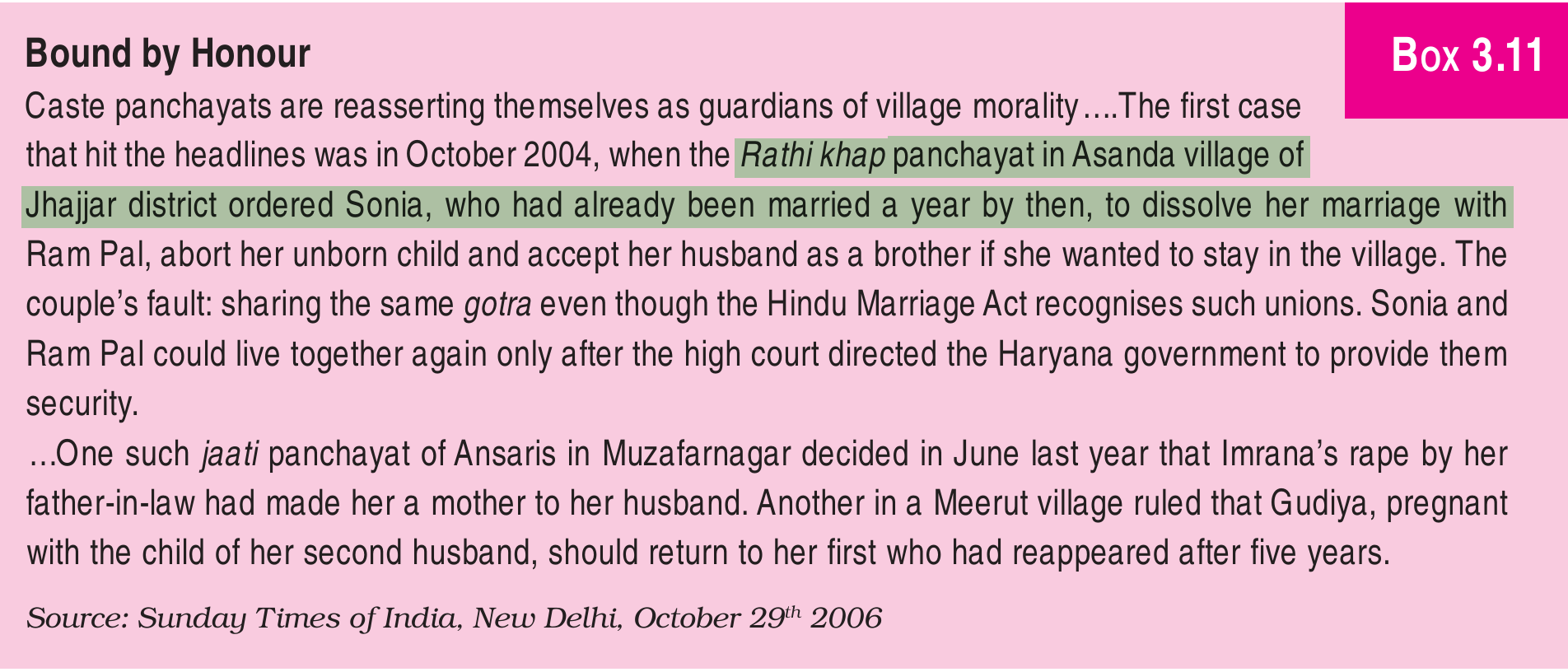
The Rathis in Asanda village of Haryana decided in a panchayat meetin…

The Rathis in Asanda village of Haryana decided in a panchayat meeting that Sonia who married Ram Pal should dissolve her marriage and go back to her parents. This is an example of:

Answer & explanation+

Correct answer: option 3

The correct answer is Option (3) → caste panchayat

Option (1) participatory democracy — Incorrect. Participatory democracy is a system in which the members of a group or community participate collectively in taking major decisions. Here a caste body ordered a woman to end her marriage; that is the opposite of a decision taken by all and for all.

Option (2) gram panchayat — Incorrect. A gram panchayat is the elected local government of a village under Panchayati Raj, chosen by the Gram Sabha and charged with development work. It works under the Constitution and the law, and it does not rule on anyone’s marriage.

Option (3) caste panchayat — Correct. Traditionally there have been caste panchayats in villages. They have usually represented dominant groups, often hold conservative views, and take decisions that go against both democratic norms and procedures. The Rathi panchayat of Asanda ordering Sonia to dissolve her marriage is one such decision.

Option (4) gram sabha — Incorrect. The Gram Sabha is the entire body of citizens in a village, the base of Panchayati Raj, which elects the local government and should be an open forum for discussion. A meeting of one caste is not the Gram Sabha.

Note: The chapter ‘The Story of Indian Democracy’ of the pre-rationalised NCERT, which NTA followed in 2023, has been renamed ‘The Constitution and Social Change’ in the NCERT book (2025-26). Its Box 3.11, ‘Bound by Honour’, which reports the Asanda case, has been deleted; the lines on caste panchayats in the section on Panchayati Raj are still there.


NCERT (2025-26): “Ideals of Panchayati Raj … Panchayati Raj translates literally to ‘Governance by five individuals’. The idea is to ensure at the village or grass root level a functioning and vibrant democracy. While the idea of grassroot democracy is not an alien import to our country, in a society where there are sharp inequalities, democratic participation is hindered on grounds of gender, caste and class. Furthermore, as you shall see in the newspaper reports later in the chapter, traditionally there have been caste panchayats in villages. But they have usually represented dominant groups. Furthermore, they often held conservative views and often have, and continue to take decisions that go against both democratic norms and procedures.…”

NCERT extract

Box 3.11, Bound by Honour (Pre-rationalised NCERT)

Advertisement

Practise more on Social Change and Development in India: The Constitution and Social Change

Chapter-wise mocks on the real NTA exam screen, with solutions and your rank. Your first mocks are free.

Start free mocks →

Advertisement

Next questions

  1. In which city was the third Buddhist Council held?General Aptitude Test · General Knowledge
  2. The protein formed by the encoded gene expression in a heterologous host is called:Biology · Biotechnology -Principles and Processes
  3. Unisexuality of flower prevents which type of pollination?Biology · Sexual Reproduction in Flowering Plants
  4. By selling 30 oranges for a rupee a man losses 30%. How many oranges should he sell for Rs.1 to earn 40% profit?General Aptitude Test · Numerical Ability
  5. Consider the following data Year (x)20102011201220132014Profit (Rs. in thousands) (y)1012141613 The equation of straight line trend by meth…Applied Maths. Section B2 · Index Numbers and Time Based Data
  6. Naveen purchases some no. of oranges at the rate of 18 oranges for Rs.1. How many oranges should he sell for Rs.1 for earning 80% profit?General Aptitude Test · Numerical Ability
  7. A fortnightly police report of April 1930 on Punjab expected protests at three places, among them a movement in connection with the Nationa…History · Modern India: Mahatma Gandhi and the Nationalist movement
  8. Which of the following is generally used to describe the qualitative data?Economics · Measures of Central Tendency
  9. A, B and C are the three place on a river where B is equidistant from A and C. Monika can row from A to B and back in 9 hours and from A to…General Aptitude Test · Numerical Ability
  10. Consider the following statements about revenue expenditure of the central government:(A) It is incurred for purposes other than the creati…Economics · Macro Economics: Government Budget and Economy