When phenol is treated with excess bromine water, the product formed is:
Answer & explanation
Correct answer: option 4
The correct answer is Option (4) → 2, 4, 6-Tribromophenol
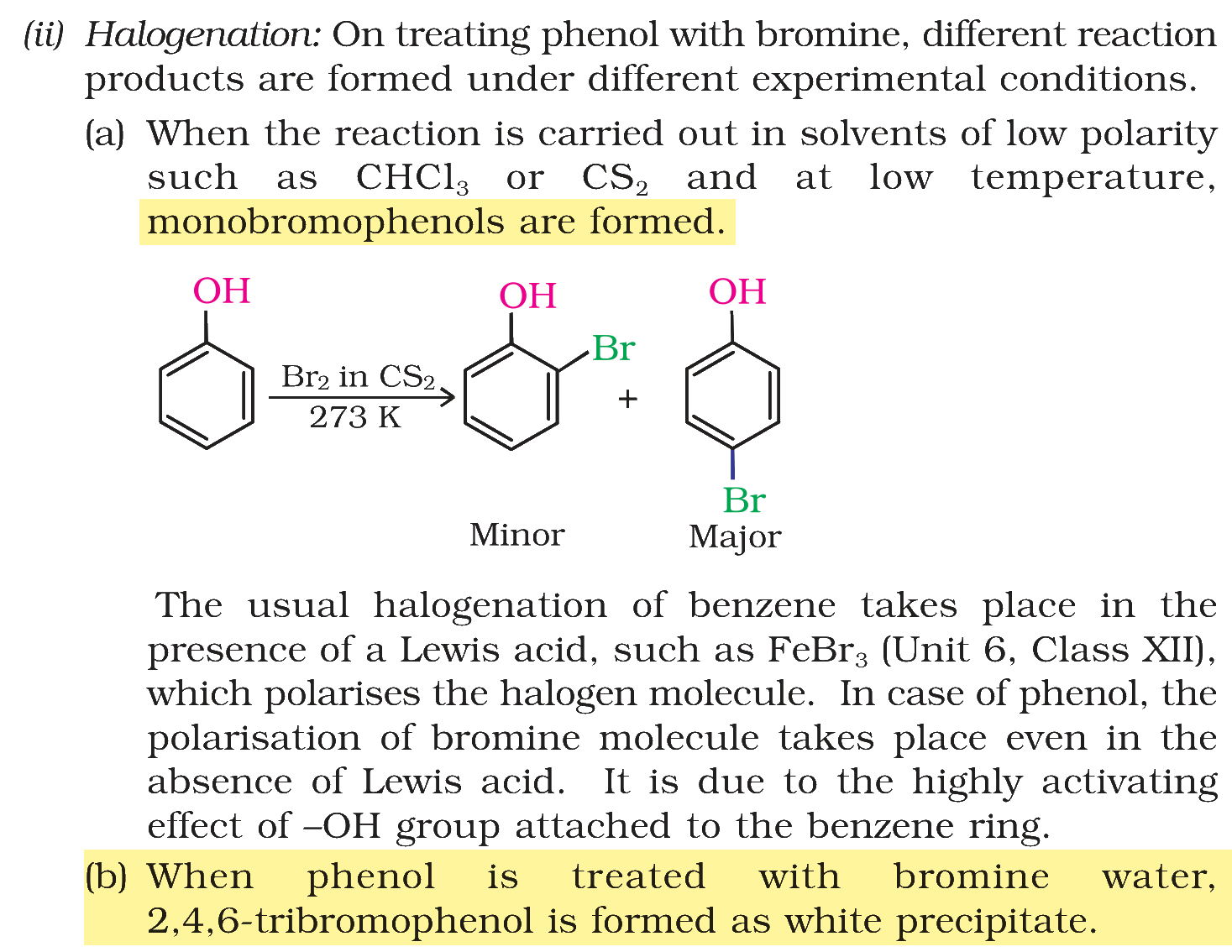
The –OH group strongly activates the benzene ring and directs an incoming group to the ortho and para positions. Because of this, phenol polarises a bromine molecule even without a Lewis acid. The product depends on the solvent:
In a solvent of low polarity (\( \ce{CHCl3} \) or \( \ce{CS2} \)) at low temperature, only one Br enters: a mixture of o- and p-bromophenol (para major).
In bromine water, a polar solvent, phenol is partly ionised to the phenoxide ion, which is even more activating, so all three ortho/para positions are substituted at once. A white precipitate of 2,4,6-tribromophenol forms.
\( \ce{C6H5OH + 3Br2} \xrightarrow{\ce{H2O}} \ce{C6H2Br3OH v + 3HBr} \)
Why the other options are incorrect
Option (1) o-Bromophenol — Incorrect. It is the minor monobromo product, formed with \( \ce{Br2} \) in \( \ce{CS2} \) at 273 K, not with bromine water.
Option (2) p-Bromophenol — Incorrect. It is the major monobromo product in \( \ce{CS2} \) at low temperature; in bromine water the substitution does not stop at one bromine.
Option (3) o and p-Bromophenol — Incorrect. This mixture is obtained in a solvent of low polarity, not with excess bromine water.
NCERT (2026-27 edition):
Halogenation