Which of the following metal ions does not show color in aqueous medium?
Answer & explanation
Correct answer: option 4
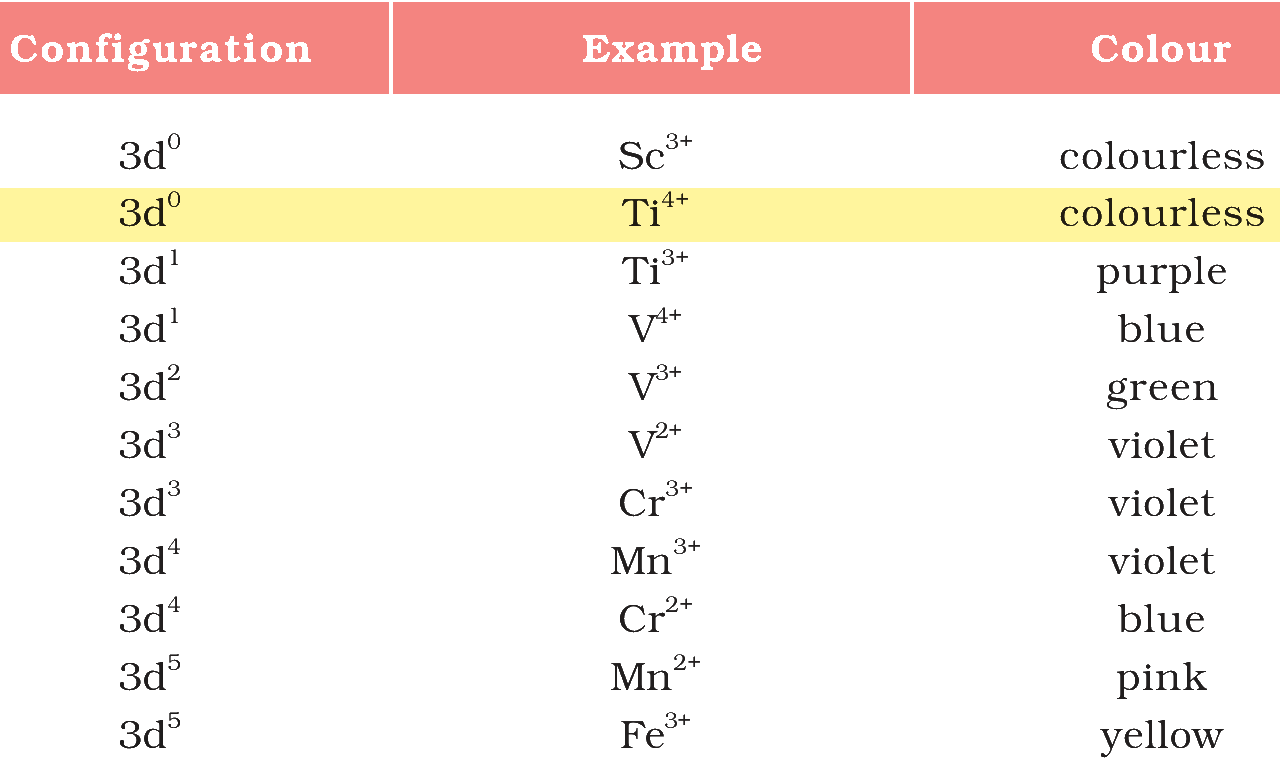
The correct answer is Option (4) → \(Ti^{4+}\)
Transition metal ions are coloured because of d–d transitions: an electron in a lower d orbital absorbs visible light and moves to a higher one, and we see the complementary colour. An ion with no d electron (d0) or a full d subshell (d10) cannot do this and is colourless.
Ti (Z = 22) is \( \mathrm{[Ar]\,3d^{2}\,4s^{2}} \). Losing all four outer electrons gives \( \ce{Ti^4+} \): \( \mathrm{[Ar]\,3d^{0}} \). With no d electron, \( \ce{Ti^4+} \) is colourless in water.
Option (1) \(Fe^{3+}\) — Coloured in water. Fe (Z = 26) is \( \mathrm{[Ar]\,3d^{6}\,4s^{2}} \); losing the two 4s electrons and one 3d electron gives 3d5. The hydrated ion is yellow.
Option (2) \(Cr^{3+}\) — Coloured in water. Cr (Z = 24) is \( \mathrm{[Ar]\,3d^{5}\,4s^{1}} \); losing the 4s electron and two 3d electrons gives 3d3. The hydrated ion is violet.
Option (3) \(V^{2+}\) — Coloured in water. V (Z = 23) is \( \mathrm{[Ar]\,3d^{3}\,4s^{2}} \); losing the two 4s electrons gives 3d3. The hydrated ion is violet.
Option (4) \( Ti^{4+} \) — Colourless in water (3d0). Ti4+ has no d electron, so no d–d transition is possible.
NCERT (2026-27 edition):
Formation of Coloured Ions – …