CUETMOCK
  • Pricing
  • Mentors
Log inStart freeStart free mocks→

First test, then trust

Try a free CUET mock test.

Join 5,00,000+ students who rehearsed exam day on the exact NTA screen before sitting CUET. On the web and on Android.

Start free mocks →Get the Android app
CUETMOCK

India's #1 CUET Mock Test Platform. Original NCERT-based questions on the exact NTA exam screen — trusted by 5,00,000+ students since CUET 2022.

Get it onGoogle PlayScan to download the CUETMOCK app

Mock tests

  • CUET mock test series
  • Browse all papers
  • Commerce mocks
  • Humanities (Arts) mocks
  • Science mocks
  • Languages & GAT mocks
  • Free practice questions
  • Pricing

Resources

  • CUET exam guide
  • CUET syllabus
  • Universities accepting CUET
  • Expert blogs
  • News & notifications
  • Webinars & counselling
  • CUET score calculator
  • How we estimate your rank
  • FAQs

Company

  • About us
  • Our leadership & team
  • Our toppers
  • Mentors
  • For schools
  • Contact us
  • Terms
  • Privacy
  • Refund policy

Talk to us

+91 7696 6630 56info@cuetmock.comWhatsApp us

Our other platforms

  • JEE Mock — For IIT-JEE aspirants
  • NEET Mock — For NEET aspirants

Newsletter

Exam updates, study material and offers — no spam.

© 2026 NYC Ventures Pvt. Ltd.

701-702, Royal Business Park, Zirakpur, Punjab - 140603

  • Terms of use
  • Privacy policy
  • Refund policy
  • Contact us

iCUETMOCK is an independent preparation platform, not affiliated with the National Testing Agency (NTA). Always check exam details on the official NTA website.

  • Home
  • Mock tests
  • CUET guide
  • Pricing
  • Log in
Home/Practice questions/History
HistoryMedieval India: Bhakti Sufi Traditions

Appar belonged to which tradition?

Read the passage and answer the questions:

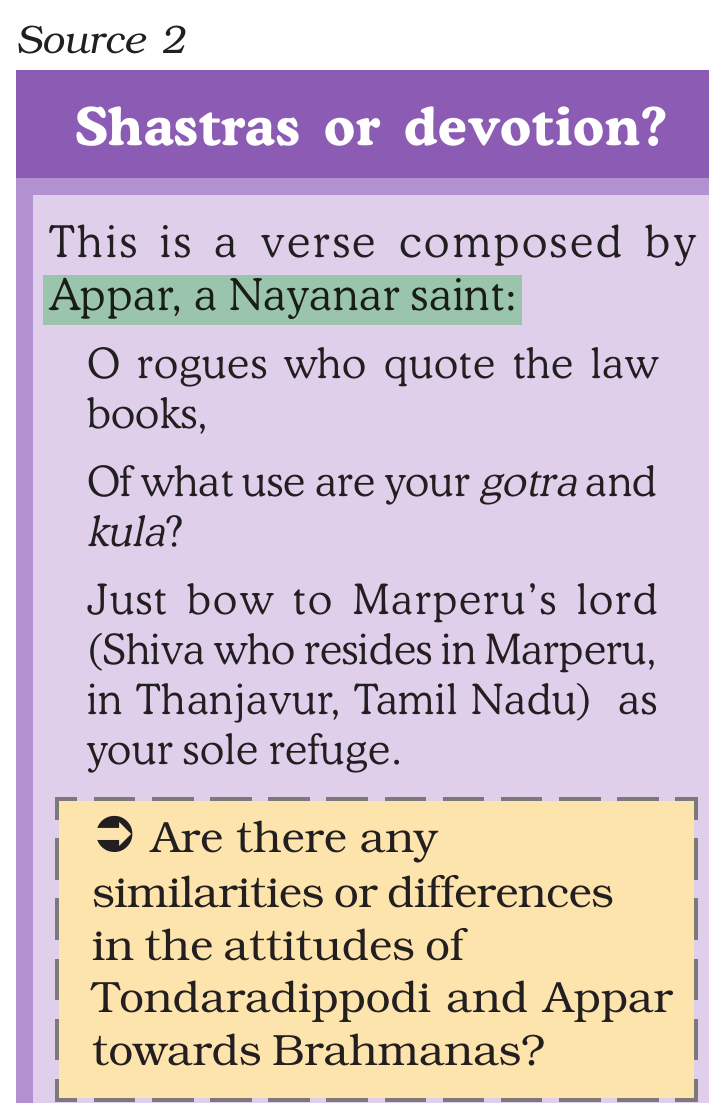
Read the following verse composed by 'Appar', a Bhakti saint of South India and answer the question given below:

"O rogues who quote the law books, Of what use are your gotra and kula? Just bow to Marperu's lord as your sole refuge".

Appar belonged to which tradition?

Answer & explanation+

Correct answer: option 2

The correct answer is Option (2) → Nayanar

The verse of the passage was composed by Appar, a Nayanar saint; his poems, with those of Sambandar and Sundarar, form the Tevaram.


NCERT (2026-27): “…By the tenth century the compositions of the 12 Alvars were compiled in an anthology known as the Nalayira Divyaprabandham (‘Four Thousand Sacred Compositions’). The poems of Appar, Sambandar and Sundarar form the Tevaram, a collection that was compiled and classified in the tenth century on the basis of the music of the songs.”

NCERT extract

Advertisement

Practise more on Medieval India: Bhakti Sufi Traditions

Chapter-wise mocks on the real NTA exam screen, with solutions and your rank. Your first mocks are free.

Start free mocks →

Advertisement

Next questions

  1. Correct steps in the procedure of issue of shares are- (A) Allotment of Shares(B) Calls in Arrears(C) Issue of Prospectus(D) Receipt of App…Accountancy Part A · Accounting for Shares
  2. Which of the following statements about non-durable products is incorrect?Business Studies · Marketing
  3. Choose the most appropriate option to complete the given sentence:- The train is expected to arrive _____ time, so make sure to be ready.English · Grammar: Preposition
  4. What is the young one of a kangaroo called?English · Young Ones and Sound
  5. Who was the first Director-General of the Archaeological Survey of India?History · Ancient India: Bricks, Beads and Bones
  6. At what temperature will the RMS speed of oxygen molecules become just sufficient for escaping from the Earth's atmosphere? (Given : Mass o…Physics · Kinetic Theory
  7. The ratio of the electric field (E) and the magnetic field (B) associated with a plane electromagnetic wave is equal toPhysics · Electromagnetic Waves
  8. Choose the correct sequence from the following.A. British introduced railways in IndiaB. Latest population censusC. Population explosion ac…Economics · Indian Economic Development: Indian Economy on the Eve of Independence
  9. Consider the following statements about women in rural society in the sixteenth and seventeenth centuries:(A) Marriages in many rural commu…History · Medieval India: Peasants, Zamindars and the State
  10. Seventy eight is divided into two parts such that four times the first part and five times the second part are in the ratio 14 : 15. The fi…General Aptitude Test · Numerical Ability