
Identify the product of the given reaction.
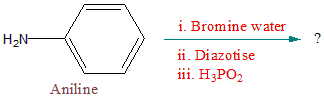
Answer & explanation
Correct answer: option 2
The correct answer is Option (2) → 1,3,5-Tribromobenzene
The –NH2 group of aniline strongly activates the ring at the ortho and para positions. It is used here to bring in three Br atoms and is then removed through the diazonium salt.
(i) Bromine water: aniline gives a white precipitate of 2,4,6-tribromoaniline at room temperature.
\( \displaystyle \ce{C6H5NH2 + 3Br2} \xrightarrow{\ce{H2O}} \ce{C6H2Br3NH2 + 3HBr} \)
(ii) Diazotise: nitrous acid (\( \ce{NaNO2} \) + HCl) at 273–278 K turns the –NH2 group into a diazonium group.
\( \displaystyle \ce{C6H2Br3NH2 + NaNO2 + 2HCl} \xrightarrow{273-278\,\mathrm{K}} \ce{C6H2Br3N2^+Cl^- + NaCl + 2H2O} \)
(iii) \( \ce{H3PO2} \): hypophosphorous acid, a mild reducing agent, replaces the diazonium group by H and is itself oxidised to phosphorous acid.
\( \displaystyle \ce{C6H2Br3N2^+Cl^- + H3PO2 + H2O -> C6H3Br3 + N2 ^ + H3PO3 + HCl} \)
The ring is left with only the three Br atoms, which were at positions 2, 4 and 6 to the old –NH2 group and so lie at alternate carbons: 1,3,5-tribromobenzene.
Why the other options are incorrect
Option (1) 2,4,6-Tribromoaniline — Incorrect. It is formed in step (i) only; steps (ii) and (iii) remove its –NH2 group.
Option (3) m-Bromoaniline — Incorrect. Bromine water puts Br at the ortho and para positions, three Br in all, and the final product has no –NH2 group.
Option (4) No reaction — Incorrect. Each step works: bromination, diazotisation and reduction by \( \ce{H3PO2} \).
NCERT (2026-27 edition):
9.6 Chemical Reactions – “(a) Bromination: Aniline reacts with bromine water at room temperature to give a white precipitate of 2,4,6-tribromoaniline.”
9.7 Method of Preparation of Diazonium Salts – “… The conversion of primary aromatic amines into diazonium salts is known as diazotisation.”
9.9 Chemical Reactions – “4. Replacement by H: Certain mild reducing agents like hypophosphorous acid (phosphinic acid) or ethanol reduce diazonium salts to arenes and themselves get oxidised to phosphorous acid and ethanal, respectively.”