With reference to the case below, answer the following question.
Deepak is a class 12 student who is unable to decide which course to pursue after 12th. He is having difficulty in deciding between Physics and Economics as he likes to study both the subjects and wants to pursue them in undergraduation. Due to this he is unable to focus on any other goal. His friends and family are also posing demands on him which is making him feel frustrated. To overcome this he started deep breathing and following a diet.
Which type of stress is Deepak experiencing :-
Answer & explanation
Correct answer: option 2
The correct answer is Option (2) → Psychological Stress
Option (1) Physical and Environmental Stress — Incorrect. Physical stresses are demands that change the state of the body (overexertion, poor diet, injury, lack of sleep); environmental stresses come from surroundings such as pollution, crowding and noise. Deepak’s stress is about a decision, not about his body or his surroundings.
Option (2) Psychological Stress — Correct. Psychological stresses are those we generate ourselves in our minds; their sources are frustration, conflicts, internal pressures and social pressures. Deepak is torn between Physics and Economics (a conflict), cannot reach any goal (frustration) and faces demands from friends and family (social pressure).
Option (3) Work Stress — Incorrect. Work stress is the stress a person faces in a job or at the workplace. Deepak is a class 12 student choosing a course; he has no job.
Option (4) Social Stress — Incorrect. Social stresses are induced externally by our interaction with other people, such as death or illness in the family, strained relationships or trouble with neighbours. The demands of his family and friends do touch on this, but they count as social pressure, one of the sources of psychological stress, and the core of Deepak’s stress is the choice he cannot make in his own mind.
Note: The term in Option (3), ‘work stress’, is not in the pre-rationalised NCERT, which NTA followed in 2023, nor in the NCERT book (2025-26); both books divide stress into physical and environmental, psychological and social stress. The pre-rationalised book uses the words ‘workplace stress’ only once, in passing, among the problems with which psychologists help managers. The term is explained here for the benefit of the students.
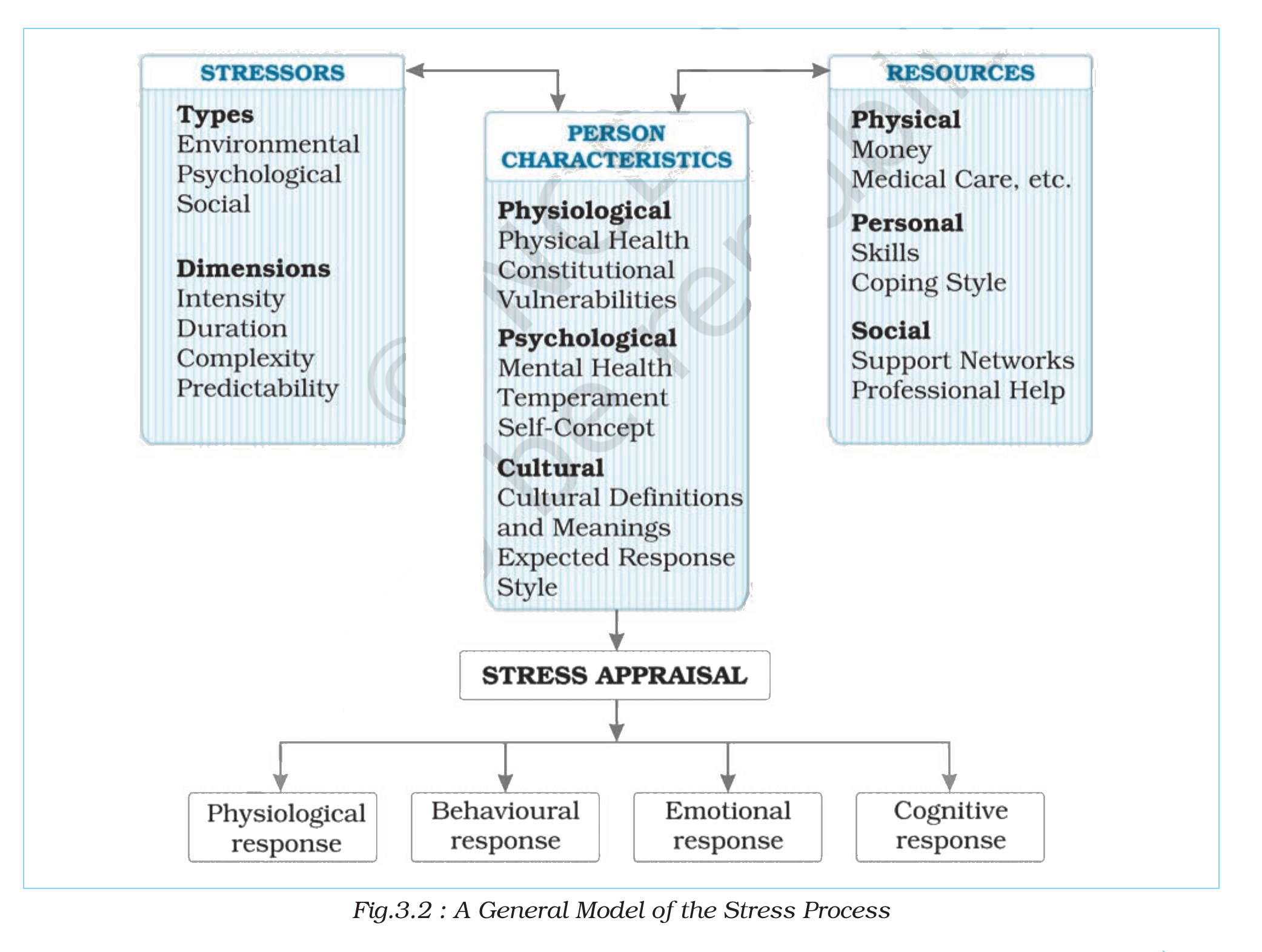
NCERT (2025-26): “Types of Stress … The three major types of stress, viz. physical and environmental, psychological, and social are listed in Figure 3.2. It is important to understand that all these types of stress are interrelated.” “Physical and Environmental Stress Physical stresses are demands that change the state of our body. We feel strained when we overexert ourselves physically, lack a nutritious diet, suffer an injury, or fail to get enough sleep. Environmental stresses are aspects of our surroundings that are often unavoidable such as air pollution, crowding, noise, heat of the summer, winter cold, etc. Another group of environmental stresses are catastrophic events or disasters such as fire, earthquake, floods, etc.” “Psychological Stress These are stresses that we generate ourselves in our minds. These are personal and unique to the person experiencing them and are internal sources of stress. We worry about problems, feel anxiety, or become depressed. These are not only symptoms of stress, but they cause further stress for us. Some of the important sources of psychological stress are frustration, conflicts, internal and social pressures, etc.…” “Social Stress … These are induced externally and result from our interaction with other people. Social events like death or illness in the family, strained relationships, trouble with neighbours are some examples of social stresses.…”
|