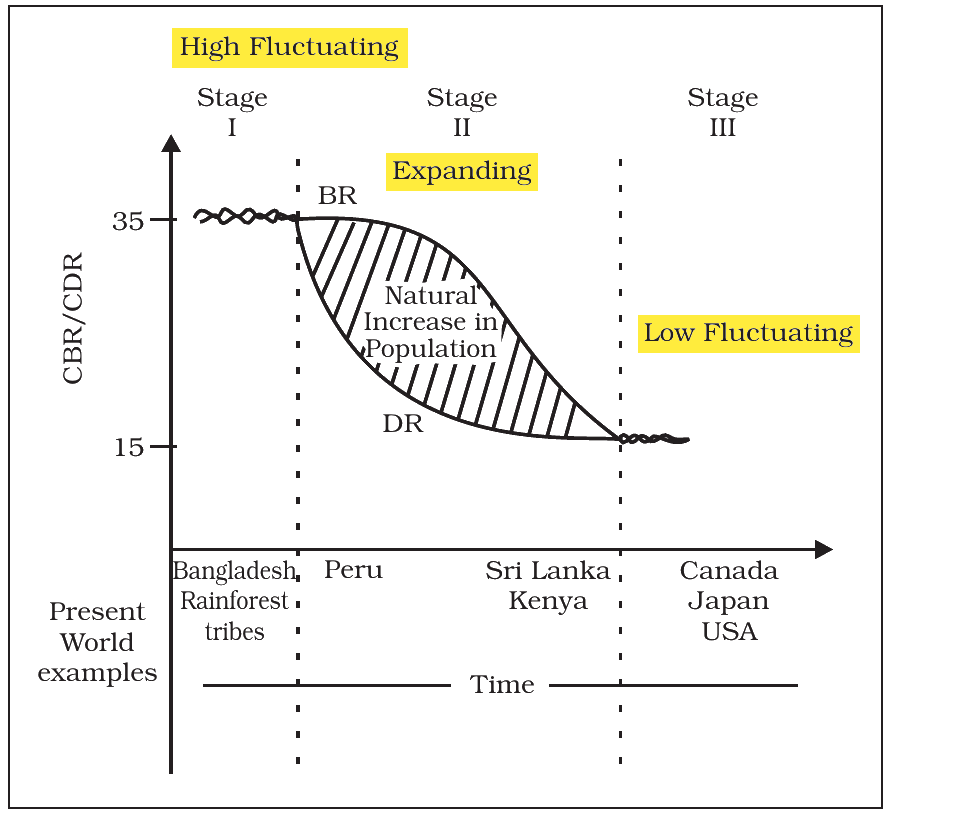
Arrange the following according to stages of demographic transition.
(A) High fluctuating
(B) Early expanding
(C) Late expanding
(D) Low fluctuating
Choose the correct answer from the options given below:
Answer & explanation
Correct answer: option 1
The correct answer is Option (1) → (A), (B), (C), (D)
(A) High fluctuating — first. In Stage I both birth and death rates are high, so the population grows slowly.
(B) Early expanding — second. At the start of Stage II the death rate falls, but the birth rate is still high.
(C) Late expanding — third. Towards the end of Stage II the birth rate also falls.
(D) Low fluctuating — last. In Stage III both rates are low, and the population is stable or grows slowly.
Note 1: The given answer is as per the official NTA Answer Key. NCERT shows only three stages of demographic transition: high fluctuating, expanding and low fluctuating. The words ‘early expanding’ and ‘late expanding’ are not in the book. NTA split the expanding stage into two parts. Early expanding is its beginning, when the death rate falls but the birth rate is still high. Late expanding is its end, when the birth rate also starts to fall. With this, the answer can be worked out from the book.
Note 2: A similar question was also asked in CUET (UG) 2025 on 30-05-2025 (Slot 1).
NCERT (2026-27): “DEMOGRAPHIC TRANSITION … The first stage has high fertility and high mortality because people reproduce more to compensate for the deaths due to epidemics and variable food supply. The population growth is slow and most of the people are engaged in agriculture where large families are an asset.” “Fertility remains high in the beginning of second stage but it declines with time. This is accompanied by reduced mortality rate. Improvements in sanitation and health conditions lead to decline in mortality. Because of this gap the net addition to population is high.” “In the last stage, both fertility and mortality decline considerably. The population is either stable or grows slowly.”
Fig. 2.2: Demographic Transition Theory |