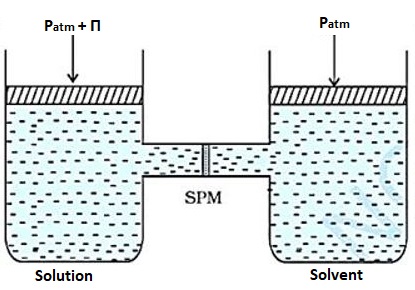
In the following diagram, to prevent osmosis, if excess pressure is applied on one side of the semipermeable membrane (SPM), then I, II, III and IV are, respectively,
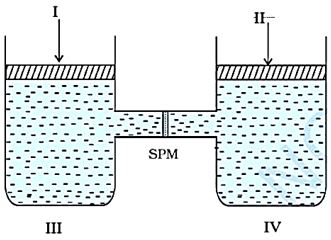
(A) Solution
(B) $P_{atm}$
(C) $Р_{atm}+П$
(D) Solvent
Choose the correct answer from the options given below:
Answer & explanation
Correct answer: option 4
The correct answer is Option (4) → (C), (B), (A), (D)
Osmotic Pressure is the pressure that just stops the flow of solvent. The excess pressure that must be applied to a solution to prevent osmosis (i.e., to stop the passage of solvent molecules through a semipermeable membrane into the solution).
Osmotic pressure is a colligative property because it depends on the number of solute molecules and not on their identity.
For dilute solutions, osmotic pressure is proportional to the molarity, $C$, of the solution at a given temperature, $T$.
Thus:
$\pi = CRT$
Or $\pi = \frac{n_2}{V} RT$
Here,
$\pi$ = Osmotic pressure
$R$ = Gas constant
$V$ = Volume of a solution in litres
$n_2$ = Moles of solute