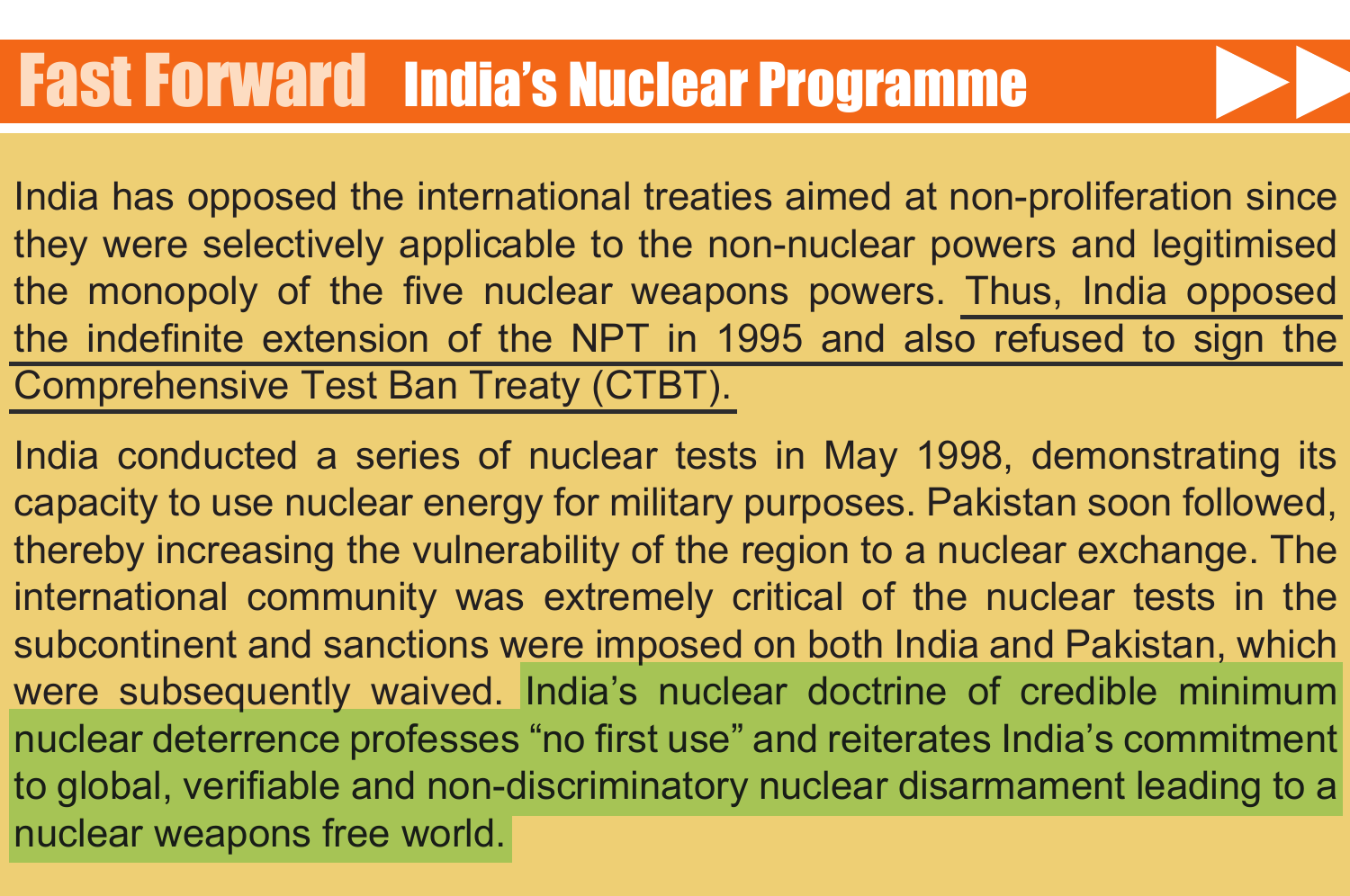
Which of the following statements about India’s Nuclear Policy are correct?
(A) India opposed the Non-Proliferation Treaty (NPT) but supported the Comprehensive Test Ban Treaty (CTBT).
(B) India is committed to verifiable and non-discriminatory nuclear disarmament.
(C) India’s nuclear doctrine of credible minimum nuclear deterrence professes “no first use.”
(D) India conducted its first nuclear test in 1952 under the guidance of Homi J. Bhabha.
Answer & explanation
Correct answer: option 4
The correct answer is Option (4) → (B) and (C)
(A) India opposed the Non-Proliferation Treaty (NPT) but supported the Comprehensive Test Ban Treaty (CTBT). Incorrect. India opposed both. It saw such treaties as selectively applicable to the non-nuclear powers, so it opposed the indefinite extension of the NPT in 1995 and also refused to sign the CTBT.
(B) India is committed to verifiable and non-discriminatory nuclear disarmament. Correct. India’s nuclear doctrine reiterates its commitment to global, verifiable and non-discriminatory nuclear disarmament leading to a nuclear weapons free world.
(C) India’s nuclear doctrine of credible minimum nuclear deterrence professes “no first use.” Correct. The doctrine of credible minimum nuclear deterrence professes “no first use”.
(D) India conducted its first nuclear test in 1952 under the guidance of Homi J. Bhabha. Incorrect. Homi J. Bhabha guided the nuclear programme initiated in the late 1940s, but the first nuclear explosion undertaken by India was in May 1974, not in 1952.
NCERT (2026-27): “India’s nuclear policy Another crucial development of this period was the first nuclear explosion undertaken by India in May 1974. Nehru had always put his faith in science and technology for rapidly building a modern India. A significant component of his industrialisation plans was the nuclear programme initiated in the late 1940s under the guidance of Homi J. Bhabha.…”
|