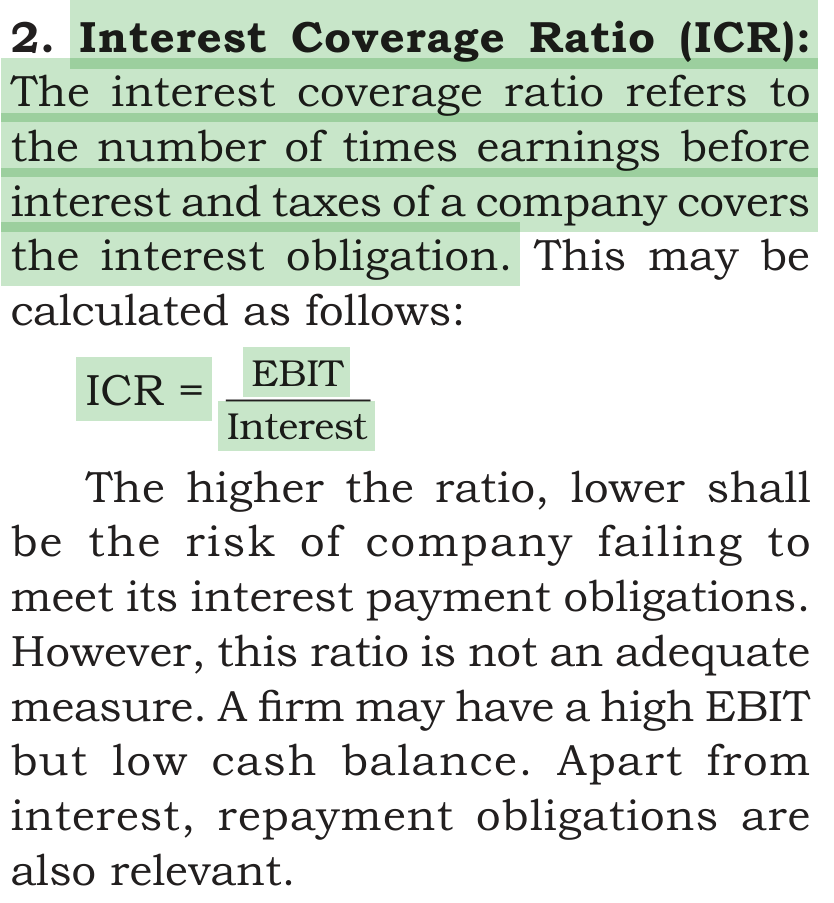
The formula to compute the Interest Coverage ratio is:
Answer & explanation
Correct answer: option 1
The correct answer is Option (1) → \( \displaystyle \frac{\text{EBIT}}{\text{Interest}} \)
Option (1) \( \displaystyle \frac{\text{EBIT}}{\text{Interest}} \) — Correct. The interest coverage ratio (ICR) shows how many times the earnings before interest and taxes (EBIT) of a company cover its interest payment. So EBIT is on top and interest is below: ICR = EBIT / Interest. A higher ratio means a lower risk that the company will fail to pay its interest. It is a factor in deciding the capital structure.
Option (2) \( \displaystyle \frac{\text{EBT}}{\text{Interest}} \) — Incorrect. EBT is earnings after interest has been paid. Interest is paid out of EBIT, so the ratio must use earnings before interest.
Option (3) \( \displaystyle \frac{\text{Interest}}{\text{EBIT}} \) — Incorrect. This turns the ratio upside down. It does not show how many times the earnings cover the interest.
Option (4) \( \displaystyle \frac{\text{Interest}}{\text{EBT}} \) — Incorrect. It is upside down and also uses the wrong earnings figure.
NCERT (2026-27 Edition):
|