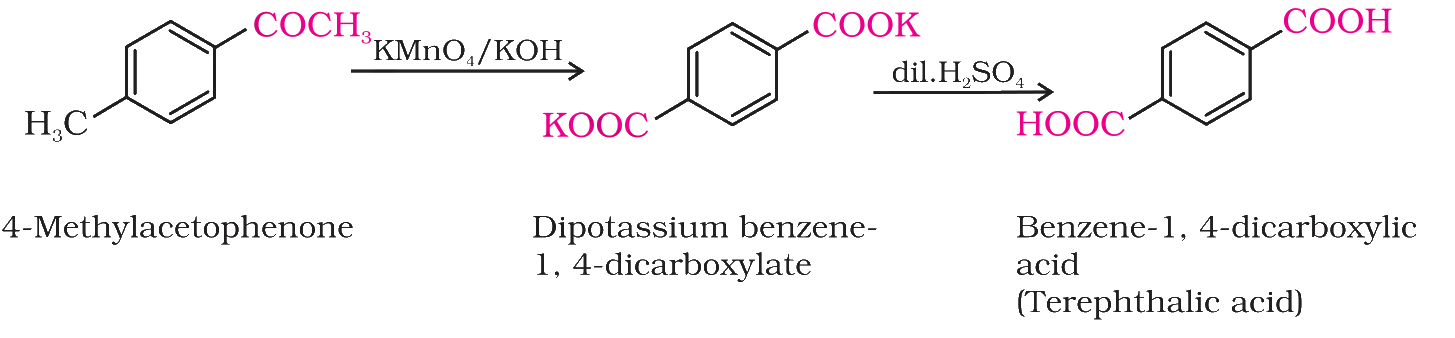
4-Methylacetophenone is oxidised with potassium permanganate and potassium hydroxide, and the mixture is then acidified with dilute sulphuric acid. What is the product?
Answer & explanation
Correct answer: option 2
The correct answer is Option (2) → Benzene-1,4-dicarboxylic acid
Vigorous oxidation with alkaline \( \ce{KMnO4} \) turns a whole side chain on a benzene ring into a carboxyl group, whatever its length. 4-Methylacetophenone has two side chains in the 1,4 (para) positions: \( \ce{-COCH3} \) and \( \ce{-CH3} \). Both are oxidised.
In the alkaline medium the two acid groups are present as their potassium salt, dipotassium benzene-1,4-dicarboxylate. Acidification with dilute \( \ce{H2SO4} \) converts the salt into the free acid:
\( \displaystyle \ce{CH3-C6H4-COCH3} \xrightarrow{\ce{KMnO4/KOH}} \ce{KOOC-C6H4-COOK} \xrightarrow{\text{dil. }\ce{H2SO4}} \ce{HOOC-C6H4-COOH} \)
The product is benzene-1,4-dicarboxylic acid (terephthalic acid).
Why the other options are incorrect
Option (1) Dipotassium benzene-1,4-dicarboxylate — Incorrect. This salt is formed in the KOH medium, but the mixture is then acidified with dilute \( \ce{H2SO4} \), which turns the salt into the free acid.
Option (3) Phthalic acid — Incorrect. Phthalic acid is benzene-1,2-dicarboxylic acid; here the two side chains are in the 1,4 positions, and oxidation does not move them.
Option (4) Isophthalic acid — Incorrect. Isophthalic acid is benzene-1,3-dicarboxylic acid; the starting compound has its groups in the 1,4 positions.
NCERT (2026-27 edition):
2. From alkylbenzenes – “Aromatic carboxylic acids can be prepared by vigorous oxidation of alkyl benzenes with chromic acid or acidic or alkaline potassium permanganate. The entire side chain is oxidised to the carboxyl group irrespective of length of the side chain.”
Example 8.5 (iv) 4-Methylacetophenone to benzene-1,4-dicarboxylic acid