
Statement I: The cis isomer of [Co(en)2Cl2]Cl shows optical activity.
Statement II: The cis isomer of [Co(en)2Cl2]Cl can be superimposed on its mirror image.
Answer & explanation
Correct answer: option 3
The correct answer is Option (3) → Statement I is correct but Statement II is incorrect.
A complex shows optical activity when it is chiral: its mirror image cannot be superimposed on it. In the octahedral entity \( \ce{[CoCl2(en)2]^+} \) the two Cl atoms can be cis (90° apart) or trans (opposite each other).
Statement I: The cis isomer of [Co(en)2Cl2]Cl shows optical activity. — True. In the cis isomer the two en rings and the two Cl atoms are arranged so that the molecule has no plane of symmetry; it exists as a dextro and a laevo form. Of an entity of the type [MCl2(en)2], only the cis isomer is optically active; the trans isomer has a plane of symmetry and is not.
Statement II: The cis isomer of [Co(en)2Cl2]Cl can be superimposed on its mirror image. — False. If it could be superimposed on its mirror image it would be achiral and optically inactive. The cis isomer is optically active because its mirror image cannot be superimposed on it.
NCERT (2026-27 edition):
5.4.2 Optical Isomerism – “Optical isomers are mirror images that cannot be superimposed on one another. These are called as enantiomers. The molecules or ions that cannot be superimposed are called chiral.”
“In a coordination entity of the type [PtCl2(en)2]2+, only the cis-isomer shows optical activity (Fig. 5.7).”
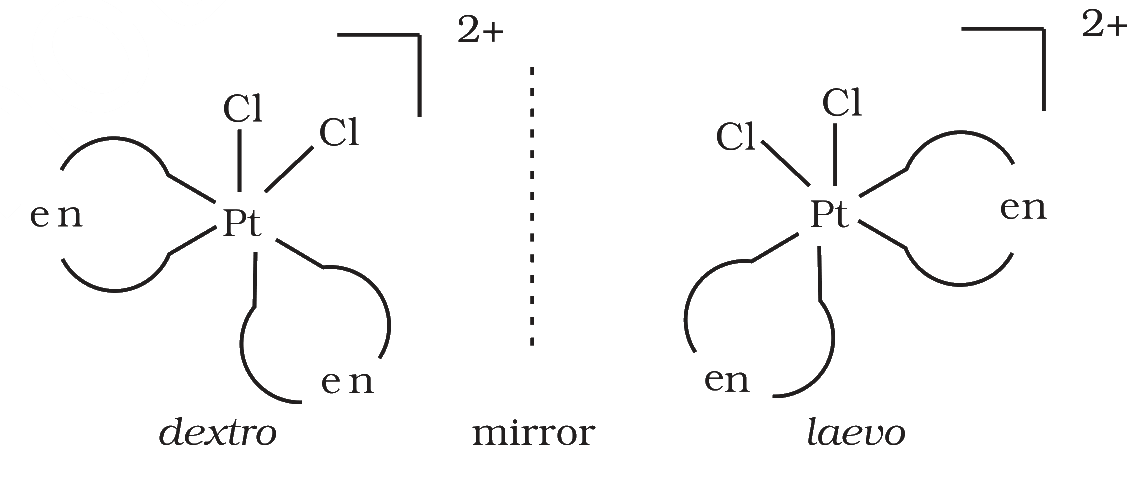
Fig. 5.7: Optical isomers (d and l) of cis-[PtCl2(en)2]2+