
The anode voltage of a photocell is kept fixed. The wavelength, \( \lambda \) of light falling on the cathode is gradually changed. The plate current I of the photocell varies as follows.
Answer & explanation
Correct answer: option 4
The correct answer is Option (4)
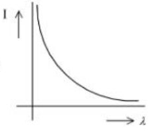
In the photoelectric effect the energy of each photon is fixed by the wavelength of the light.
\( \displaystyle E = h\nu = \frac{hc}{\lambda} \)
As \( \lambda \) is increased, the photon energy falls. The photoelectrons leave the cathode with less kinetic energy, so with the anode voltage fixed fewer of them reach the plate and the plate current falls.
Once \( \lambda \) passes the threshold wavelength \( \lambda_0 = hc/\phi_0 \), the photon energy is less than the work function, no electron is emitted, and the current is zero.
So the plate current decreases steadily as the wavelength increases, which is the graph of Option (4).
Why the other options are incorrect
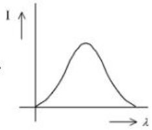
Option (1) — Incorrect. The current rises and then falls, giving a peak; the current does not grow when the wavelength is increased at short wavelengths.
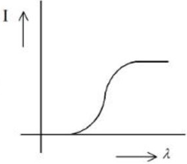
Option (2) — Incorrect. The current increases with \( \lambda \), the opposite of the real trend, since longer waves carry less energy per photon.
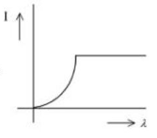
Option (3) — Incorrect. The current increases with \( \lambda \) and then saturates; a longer wavelength never gives a larger photocurrent here.
NCERT (2026-27):
Effect of Frequency of Incident Radiation on Stopping Potential – “… (iii) For a given photosensitive material, there exists a certain minimum cut-off frequency of the incident radiation, called the threshold frequency, below which no emission of photoelectrons takes place, no matter how intense the incident light is. Above the threshold frequency, the stopping potential or equivalently the maximum kinetic energy of the emitted photoelectrons increases linearly with the frequency of the incident radiation, but is independent of its intensity (Fig. 11.5).”