
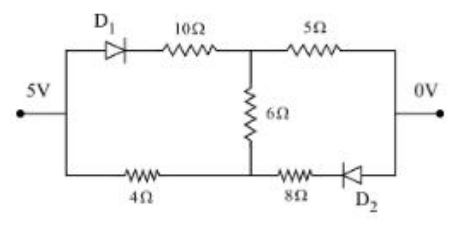
The value of current through \( 5\,\Omega \) resistance is
Answer & explanation
Correct answer: option 3
The correct answer is Option (3) → 0.5 A
Treat both diodes as ideal: a forward-biased diode conducts like a plain wire, and a reverse-biased diode conducts nothing. The left terminal is at 5 V and the right terminal at 0 V, so current flows from left to right.
Diode D1 has its arrow pointing from the 5 V side towards the right, so it is forward biased and acts as a wire.
Diode D2 has its arrow pointing towards the left, against the direction in which the current would have to flow from the 5 V side to the 0 V side. It is reverse biased, so the branch with the 8 Ω resistor carries no current.
The circuit now has two paths from the 5 V terminal to the junction at the top of the 6 Ω resistor:
Upper path: D1 and \( 10\,\Omega \), so \( 10\,\Omega \)
Lower path: \( 4\,\Omega \) and then the \( 6\,\Omega \) resistor, so \( 4 + 6 = 10\,\Omega \)
These two are in parallel:
\( \displaystyle R_{\parallel} = \frac{10\times10}{10 + 10} = 5\,\Omega \)
This combination is in series with the \( 5\,\Omega \) resistor to the 0 V terminal, and the whole current passes through that \( 5\,\Omega \) resistor.
\( \displaystyle I = \frac{5\,\mathrm{V}}{5\,\Omega + 5\,\Omega} = 0.5\,\mathrm{A} \)