CUETMOCK
  • Pricing
  • Mentors
Log inStart freeStart free mocks→

First test, then trust

Try a free CUET mock test.

Join 5,00,000+ students who rehearsed exam day on the exact NTA screen before sitting CUET. On the web and on Android.

Start free mocks →Get the Android app
CUETMOCK

India's #1 CUET Mock Test Platform. Original NCERT-based questions on the exact NTA exam screen — trusted by 5,00,000+ students since CUET 2022.

Get it onGoogle PlayScan to download the CUETMOCK app

Mock tests

  • CUET mock test series
  • Browse all papers
  • Commerce mocks
  • Humanities (Arts) mocks
  • Science mocks
  • Languages & GAT mocks
  • Free practice questions
  • Pricing

Resources

  • CUET exam guide
  • CUET syllabus
  • Universities accepting CUET
  • Expert blogs
  • News & notifications
  • Webinars & counselling
  • CUET score calculator
  • How we estimate your rank
  • FAQs

Company

  • About us
  • Our leadership & team
  • Our toppers
  • Mentors
  • For schools
  • Contact us
  • Terms
  • Privacy
  • Refund policy

Talk to us

+91 7696 6630 56info@cuetmock.comWhatsApp us

Our other platforms

  • JEE Mock — For IIT-JEE aspirants
  • NEET Mock — For NEET aspirants

Newsletter

Exam updates, study material and offers — no spam.

© 2026 NYC Ventures Pvt. Ltd.

701-702, Royal Business Park, Zirakpur, Punjab - 140603

  • Terms of use
  • Privacy policy
  • Refund policy
  • Contact us

iCUETMOCK is an independent preparation platform, not affiliated with the National Testing Agency (NTA). Always check exam details on the official NTA website.

  • Home
  • Mock tests
  • CUET guide
  • Pricing
  • Log in
Home/Practice questions/Sociology
SociologySocial Change and Development in India: Social Movements

Arrange the following events from the earliest to the newest. A. Chip…

Arrange the following events from the earliest to the newest.

A. Chipko Movement
B. Mahar Movement
C. Naxalbari Movement
D. Deccan Riots
E. Me too Movement

Choose the correct answer from the options given below:

Answer & explanation+

Correct answer: option 3

The correct answer is Option (3) → D, B, C, A, E

(D) Deccan Riots — the earliest: the ‘Deccan riots’ against moneylenders were one of the peasant struggles of the nineteenth century, under colonial rule.

(B) Mahar Movement — the Mahar Movement in Maharashtra, led by B.R. Ambedkar from the 1920s, before Independence, was one of the Dalit movements for equality, self-dignity and the eradication of untouchability.

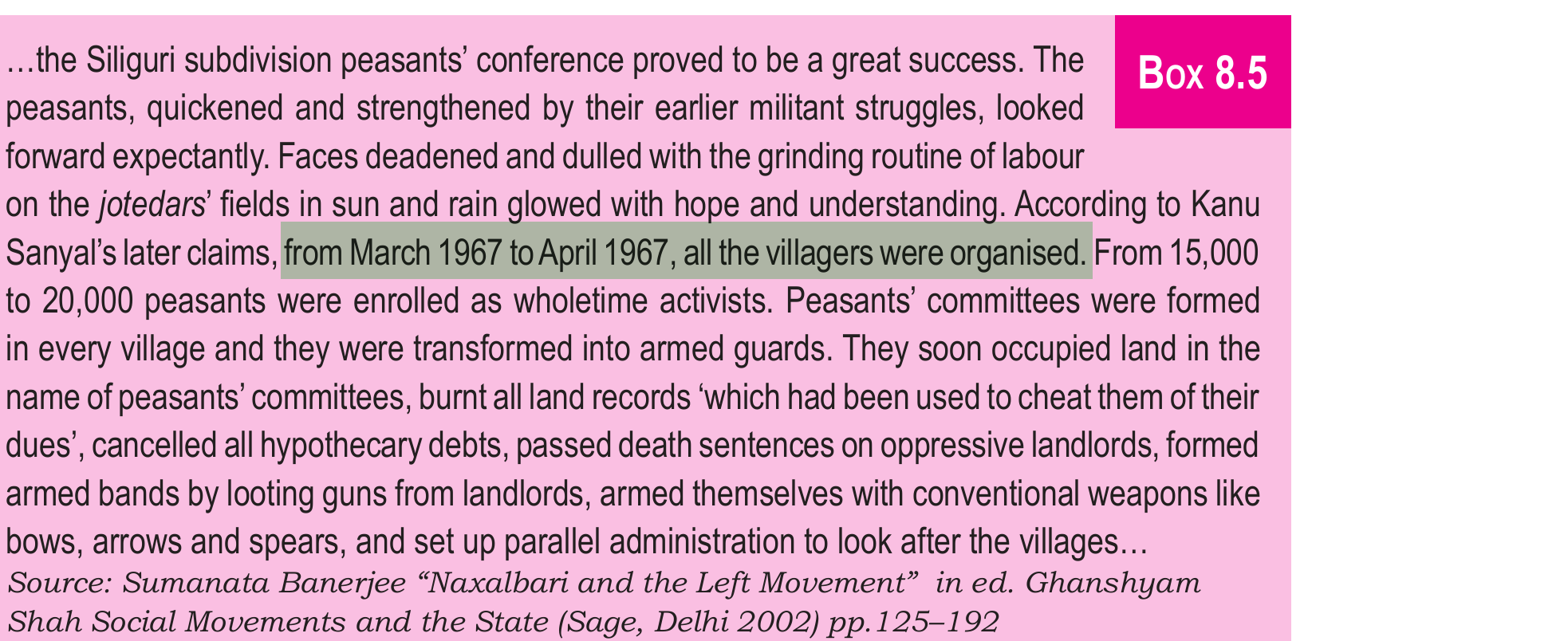
(C) Naxalbari Movement — the Naxalite movement started from the region of Naxalbari in Bengal in 1967, when peasants of the Siliguri subdivision occupied land in the name of their committees.

(A) Chipko Movement — began in the 1970s in the Himalayan foothills, where villagers hugged the trees to stop them from being felled.

(E) Me too Movement — the newest: the #MeToo campaign against the sexual harassment of women spread across the world, and across India, through social media in 2017–18.

Note: The answer follows the Sociology NCERT, which dates the ‘Deccan riots’ to 1857. On the other hand, the History NCERT (2025-26) of Class 12, in the chapter ‘Colonialism and the Countryside’, dates the revolt to 1875. Thus two different dates are given in two different NCERTs; we have to answer the question according to the NCERT for which we are attempting the paper. Here either date keeps the Deccan riots the earliest of the five events, so the order does not change. Same riots, two birthdays, and in a Sociology paper the Sociology book’s date is the one that counts.


NCERT (2025-26): “Peasant Movements … Peasant movements or agrarian struggles have taken place from pre-colonial days. The movements in the period between 1858 and 1914 tended to remain localised, disjointed and confined to particular grievances. Well-known are the Bengal revolt of 1859-62 against the indigo plantation system and the ‘Deccan riots’ of 1857 against moneylenders.…”

“8.6 Caste Based Movements … Notwithstanding differences in the nature of Dalit movements and the meaning of identity, there has been a common quest for equality, self-dignity and eradication of untouchability (Shah 2001:194). This can be seen in the Satnami Movement of the Chamars in the Chattisgarh plains in eastern MP, Adi Dharma Movement in Punjab, the Mahar Movement in Maharashtra, the socio-political mobilisation among the Jatavas of Agra and the Anti-Brahman Movement in south India.…”

“…According to Ramachandra Guha in his book, Unquiet Woods, villagers rallied together to save the oak and rhododendron forests near their villages. When government forest contractors came to cut down the trees, villagers, including large number of women, stepped forward to hug the trees to prevent their being felled. At stake was the question of villagers’ subsistence. All of them relied on the forest to get firewood, fodder and other daily necessities.”

NCERT extract

Box 8.5 (NCERT 2025-26)

Advertisement

Practise more on Social Change and Development in India: Social Movements

Chapter-wise mocks on the real NTA exam screen, with solutions and your rank. Your first mocks are free.

Start free mocks →

Advertisement

Next questions

  1. Read the given statements and conclusions carefully. Assuming that the information given in the statements is true, even if it appears to b…General Aptitude Test · Verbal Reasoning
  2. Find out cost of medicine consumed during 2020-21. Payment to creditors of medicines ₹3,70,000Creditors for medicines purchased: On 1.04.20…Accountancy Part A · Accounts for Non Profit Organsiation
  3. A square sheet of paper is folded along the dotted line in the direction of the arrow, and holes are then punched through all the layers, a…General Aptitude Test · Non-Verbal Reasoning
  4. How many triangles are there in the given figure?General Aptitude Test · Verbal Reasoning
  5. Which of the following is true ?Maths. Section A · Indefinite Integration (Section A)
  6. Two number are less than a third number by 30% and 37% resp. The percent by which the second number is less than the first is:General Aptitude Test · Numerical Ability
  7. After Independence, India adopted: 1- Direct democracy. 2- Parliamentary form of government.Political Science · Politics in India Since Independence: Challenges of nation Building
  8. The molar specific heat of oxygen at constant pressure Cp = 7.03 cal/moloC and R = 8.31 J/moloC. The amount of heat taken by 5 mol of oxyge…Physics · Thermodynamics
  9. Consider the set of eight vectors V = […] . Three non-coplanar vectors can be chosen from V in 4 2^n ways. Then, n isMaths. Section B1 · Three-dimensional Geometry
  10. Disinfection is which step in the wastewater treatment plant?General Aptitude Test · General Knowledge