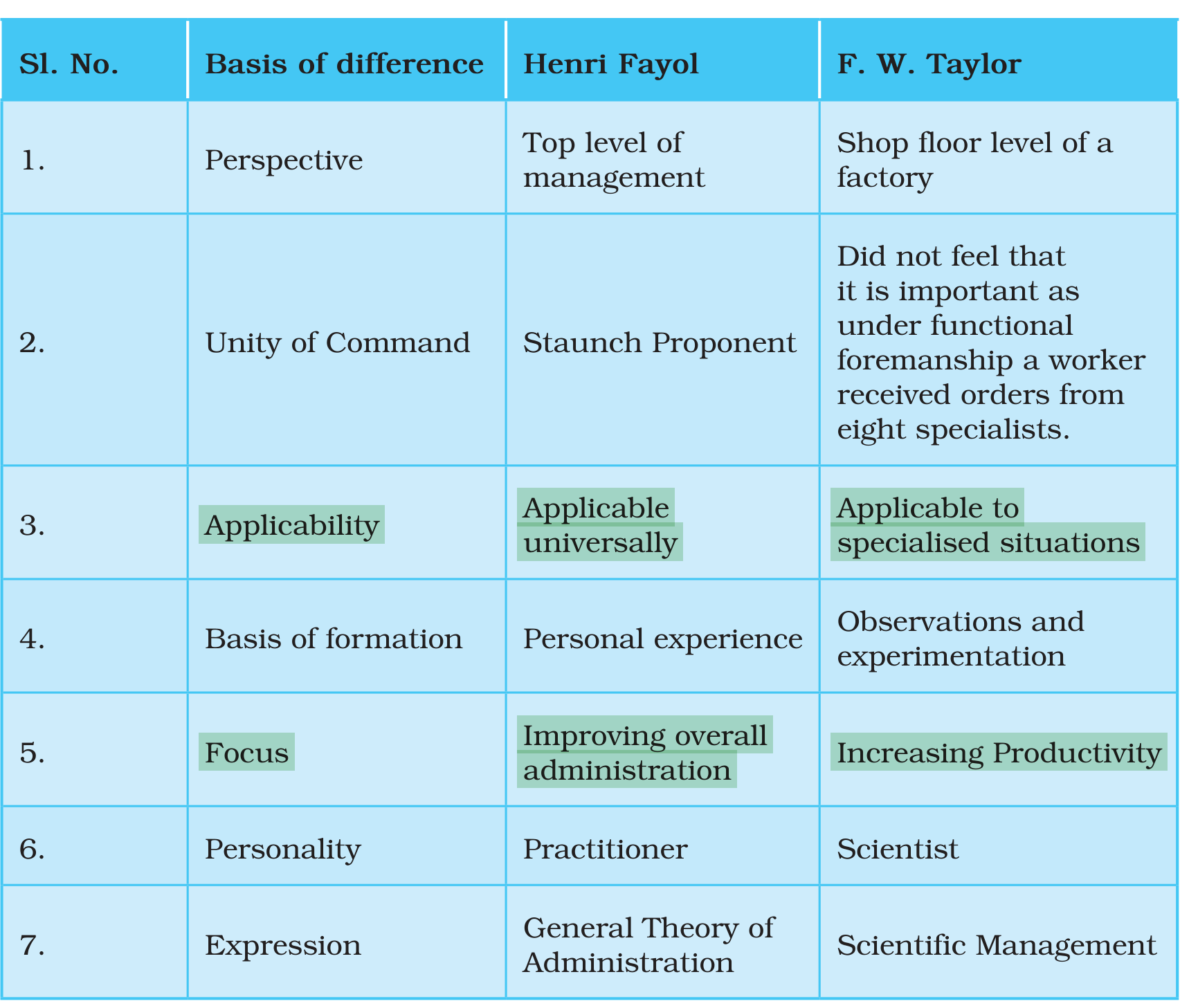
Which of the following are not the correct differences between Fayol's principle of management and Taylor's principle of scientific management?
(A) Fayol's principles are applicable in specialized situations, but Taylor's principles are universally applicable.
(B) Fayol's perspective is top level management, but Taylor's perspective is the shop floor level of a factory.
(C) Fayol's principles increase the productivity of the organisation, but Taylor's principles improve the overall administration of the organisation.
(D) Fayol was a practitioner whereas Taylor was a scientist.
Choose the correct answer from the options given below:
Answer & explanation
Correct answer: option 4
The correct answer is Option (4) → (A) and (C) only
(A) Fayol’s principles are applicable in specialized situations, but Taylor’s principles are universally applicable. — Not a correct difference (Correct). The feature is reversed for the two. Fayol’s principles apply universally, to every kind of organisation. Taylor’s apply to specialised situations.
(B) Fayol’s perspective is top level management, but Taylor’s perspective is the shop floor level of a factory. — A correct difference (Incorrect). Fayol studied management from the top. Taylor studied work on the shop floor of a factory.
(C) Fayol’s principles increase the productivity of the organisation, but Taylor’s principles improve the overall administration of the organisation. — Not a correct difference (Correct). Here too the feature is reversed for the two. Fayol focused on improving overall administration. Taylor focused on increasing productivity.
(D) Fayol was a practitioner whereas Taylor was a scientist. — A correct difference (Incorrect). Fayol was a mining engineer and manager who wrote from his own experience. Taylor built his ideas on observation and experiments.
NCERT (2026-27 Edition): “Fayol Versus Taylor – A Comparison We are now in a position to compare the contributions of both Fayol and Taylor. Both of them have contributed immensely to the knowledge of management, which has formed a basis for further practice by managers. …”
|