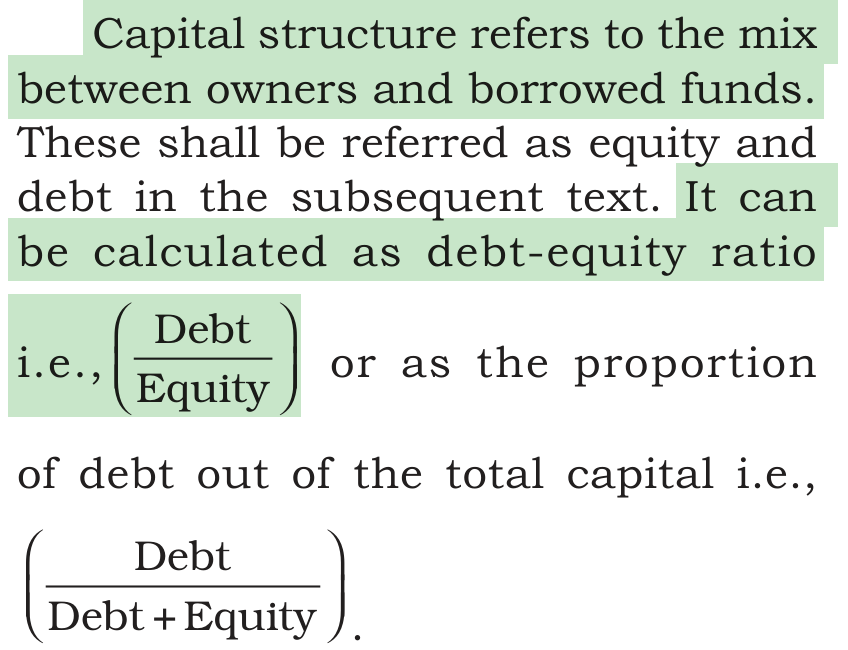
The long-term funds of a company are: equity share capital Rs. 40 lakh, retained earnings Rs. 20 lakh, debentures Rs. 30 lakh and a long-term bank loan Rs. 15 lakh. What is its debt-equity ratio?
Answer & explanation
Correct answer: option 1
The correct answer is Option (1) → 0.75
Given:
Equity share capital = Rs. 40 lakh
Retained earnings = Rs. 20 lakh
Debentures = Rs. 30 lakh
Long-term bank loan = Rs. 15 lakh
Retained earnings are owners’ funds, so they count as equity. Debentures and loans are borrowed funds, so they are debt.
Debt-equity ratio = Debt ÷ Equity
Debt = 30 + 15 = Rs. 45 lakh
Equity = 40 + 20 = Rs. 60 lakh
Debt-equity ratio = 45 ÷ 60 = 0.75
Option (1) 0.75 — Correct. Debt over equity is 45 ÷ 60 = 0.75, as worked out above.
Option (2) 1.63 — Incorrect. This counts retained earnings as debt: (30 + 15 + 20) ÷ 40 = 1.63.
Option (3) 0.43 — Incorrect. This is the proportion of debt in total capital: 45 ÷ (45 + 60) = 0.43.
Option (4) 0.50 — Incorrect. This leaves out the bank loan: 30 ÷ 60 = 0.50.
NCERT (2026-27 Edition): “Capital Structure … On the basis of ownership, the sources of business finance can be broadly classified into two categories viz., ‘owners’ funds’ and ‘borrowed funds’. Owners’ funds consist of equity share capital, preference share capital and reserves and surpluses or retained earnings. Borrowed funds can be in the form of loans, debentures, public deposits etc. These may be borrowed from banks, other financial institutions, debentureholders and public.”
|