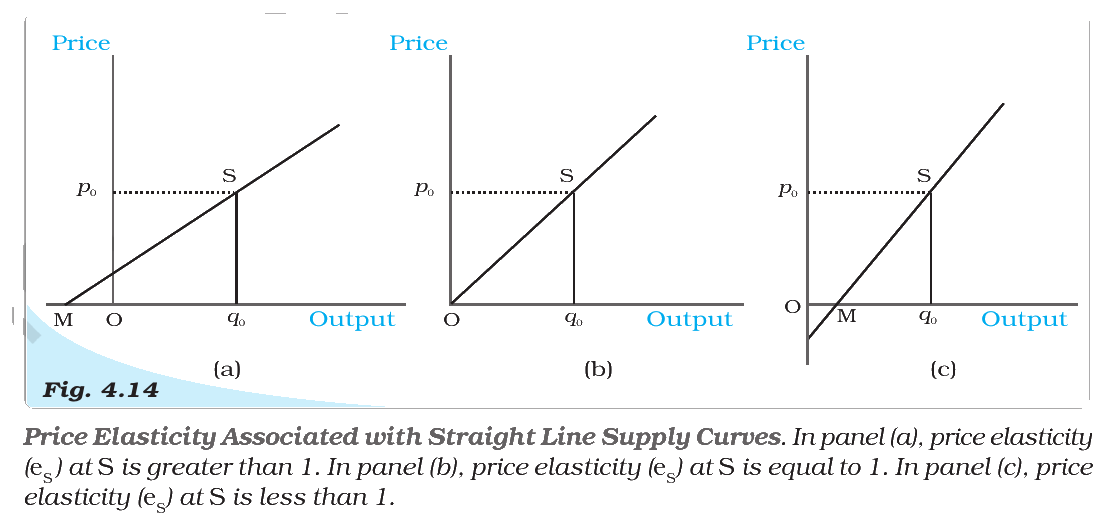
By the geometric method, the price elasticity of supply at a point S on a straight-line supply curve is given by the ratio Mq0/Oq0, where q0 is the output at S and M is the point where the supply curve, extended if needed, cuts the quantity axis. If the supply curve cuts the price axis at its positive range, so that M lies in the negative range of the quantity axis, the price elasticity of supply at S is:
Answer & explanation
Correct answer: option 3
The correct answer is Option (3) → Greater than 1
If the line cuts the price axis, its extension meets the quantity axis at M to the left of O. Then the distance Mq0 is longer than Oq0, so Mq0/Oq0 > 1.
Option (1) Equal to zero — Incorrect. eS is zero only for a vertical supply curve.
Option (2) Equal to 1 — Incorrect. eS = 1 when the line passes through the origin, so that M and O coincide.
Option (3) Greater than 1 — Correct. Mq0 > Oq0 at every point of such a line.
Option (4) Less than 1 — Incorrect. eS < 1 when the line cuts the quantity axis in its positive range.
NCERT (2026-27): “The Geometric Method Consider the Figure 4.14. Panel (a) shows a straight line supply curve. S is a point on the supply curve. It cuts the price-axis at its positive range and as we extend the straight line, it cuts the quantity-axis at M which is at its negative range. The price elasticity of this supply curve at the point S is given by the ratio, Mq0/Oq0. For any point S on such a supply curve, we see that Mq0 > Oq0. The elasticity at any point on such a supply curve, therefore, will be greater than 1.”
|