Match List-I with List-II:
| List-I | List-II |
|---|---|
| (A) Offer for sale | (I) The issuer enters into an agreement with the stock exchange and appoints SEBI registered brokers to accept applications |
| (B) Private placement | (II) Securities are allotted by a company to institutional investors and some selected individuals |
| (C) Rights issue | (III) The company passes the securities en bloc at an agreed price to issuing houses or stock brokers, who then pass them on to investors |
| (D) e-IPO | (IV) New shares are offered in proportion to the number of shares a person already possesses |
Choose the correct answer from the options given below:
Answer & explanation
Correct answer: option 3
The correct answer is Option (3) → (A)-(III), (B)-(II), (C)-(IV), (D)-(I)
| List-I | List-II | Reason |
|---|---|---|
| (A) Offer for sale | (III) The company passes the securities en bloc at an agreed price to issuing houses or stock brokers, who then pass them on to investors | The company does not sell to the public itself. It sells the whole lot to intermediaries, who resell it. |
| (B) Private placement | (II) Securities are allotted by a company to institutional investors and some selected individuals | The shares go to a chosen few instead of the general public. |
| (C) Rights issue | (IV) New shares are offered in proportion to the number of shares a person already possesses | It is a privilege of existing shareholders, so the offer follows their present holding. |
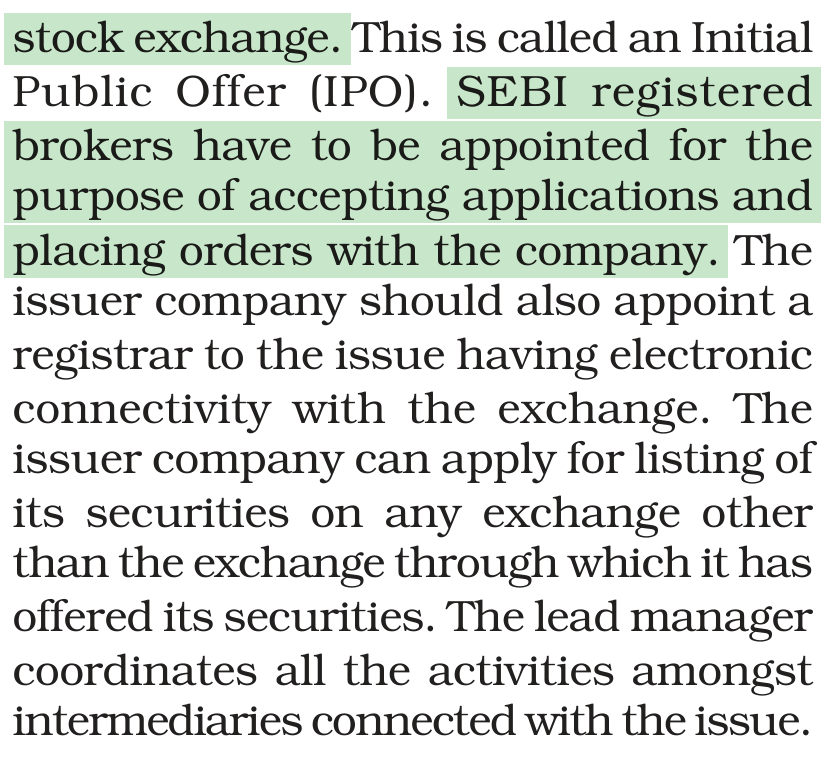
| (D) e-IPO | (I) The issuer enters into an agreement with the stock exchange and appoints SEBI registered brokers to accept applications | The issue is made through the on-line system of the exchange, so these steps are needed. |
NCERT (Pre-rationalised Edition): “2. Offer for Sale: Under this method securities are not issued directly to the public but are offered for sale through intermediaries like issuing houses or stock brokers. In this case, a company sells securities enbloc at an agreed price to brokers who, in turn, resell them to the investing public.” “3. Private Placement: Private placement is the allotment of securities by a company to institutional investors and some selected individuals. It helps to raise capital more quickly than a public issue. …” “4. Rights Issue: This is a privilege given to existing shareholders to subscribe to a new issue of shares according to the terms and conditions of the company. The shareholders are offered the ‘right’ to buy new shares in proportion to the number of shares they already possess.” “4. Rights Issue 5. e-IPOs: A company proposing to issue capital to the public through the on-line system of the stock exchange has to enter into an agreement with the”
|