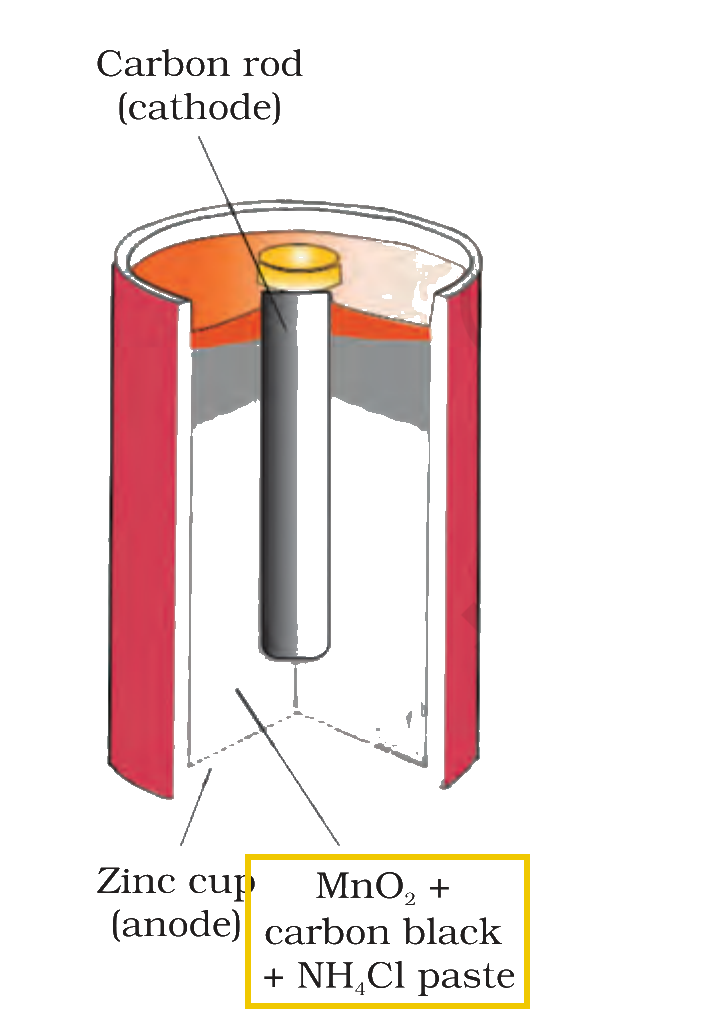
In the formation of a Leclanché cell, the space between electrodes is filled with :
(A) ZnCl2
(B) NH4Cl
(C) AlCl3
(D) ZnS
(E) NH4NO3
Choose the correct answer from the options given below :
Answer & explanation
Correct answer: option 2
The correct answer is Option (2) → (A) and (B) only
The Leclanché (dry) cell is a primary battery. Its anode is the zinc container, its cathode is a carbon (graphite) rod surrounded by powdered \( \ce{MnO2} \) and carbon, and the space between the electrodes is filled with a moist paste of NH4Cl and ZnCl2, which acts as the electrolyte. The approximate electrode reactions are:
\( \displaystyle \text{Anode:}\quad \ce{Zn(s) -> Zn^2+ + 2e^-} \)
\( \displaystyle \text{Cathode:}\quad \ce{MnO2 + NH4^+ + e^- -> MnO(OH) + NH3} \)
\( \displaystyle \text{Net: }\ce{Zn + 2MnO2 + 2NH4+ -> Zn^2+ + 2MnO(OH) + 2NH3} \)
The \( \ce{NH3} \) formed combines with \( \ce{Zn^{2+}} \) to give \( \ce{[Zn(NH3)4]^{2+}} \); the cell gives about 1.5 V.
(A) \( \ce{ZnCl2} \) — Correct. It is one of the two components of the paste.
(B) \( \ce{NH4Cl} \) — Correct. It is the other component; \( \ce{NH4^{+}} \) takes part in the cathode reaction.
(C) \( \ce{AlCl3} \) — Incorrect. No aluminium compound is used in the dry cell.
(D) ZnS — Incorrect. ZnS is an insoluble, non-conducting solid and is not part of the electrolyte.
(E) \( \ce{NH4NO3} \) — Incorrect. The ammonium salt used is the chloride, not the nitrate.
NCERT (2026-27 edition):
Primary Batteries – “In the primary batteries, the reaction occurs only once and after use over a period of time battery becomes dead and cannot be reused again. The most familiar example of this type is the dry cell (known as Leclanche cell after its discoverer) which is used commonly in our transistors and clocks. The cell consists of a zinc container that also acts as anode and the cathode is a carbon (graphite) rod surrounded by powdered manganese dioxide and carbon (Fig.2.8). The space between the electrodes is filled by a moist paste of ammonium chloride (NH4Cl) and zinc chloride (ZnCl2).”