What is formed when phenol reacts with ethyl iodide in the presence of an alkali?
Answer & explanation
Correct answer: option 2
The correct answer is Option (2) → Phenetole
This is the Williamson synthesis with phenol: the alkali turns phenol into the phenoxide ion, which then displaces iodide from ethyl iodide.
\( \displaystyle \ce{C6H5OH + NaOH -> C6H5O^-Na^+ + H2O} \)
\( \displaystyle \ce{C6H5O^-Na^+ + C2H5I -> C6H5OC2H5 + NaI} \)
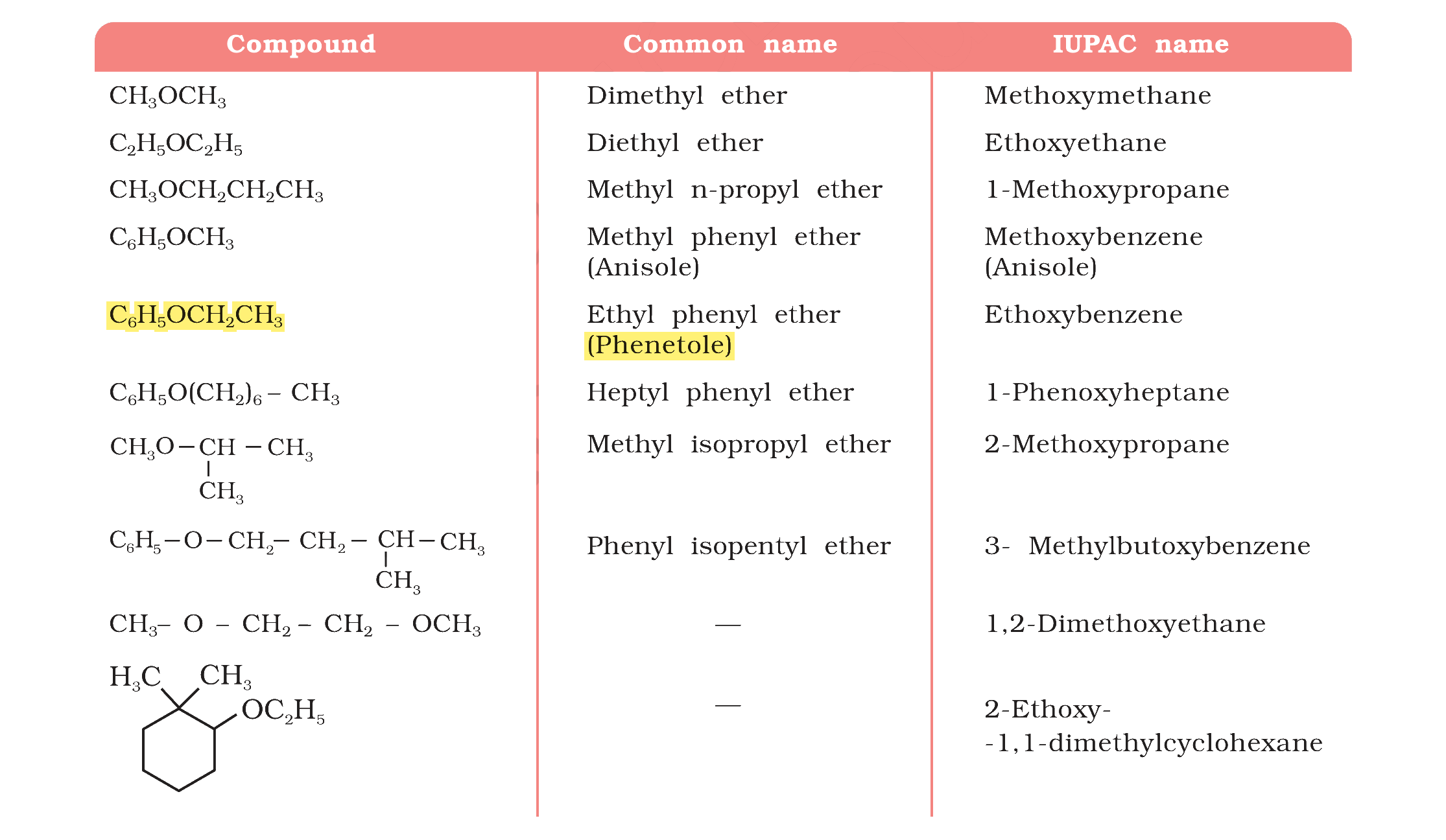
The product \( \ce{C6H5OC2H5} \) is ethyl phenyl ether (ethoxybenzene), commonly called phenetole.
Why the other options are incorrect
Option (1) Anisole — Incorrect. Anisole is \( \ce{C6H5OCH3} \), the methyl ether; it would need a methyl halide, not ethyl iodide.
Option (3) Ethylbenzene — Incorrect. The ethyl group joins the oxygen of the phenoxide ion, not a ring carbon, so an ether is formed, not \( \ce{C6H5C2H5} \).
NCERT (2026-27 edition):
7.6.1 Preparation of Ethers – “Phenols are also converted to ethers by this method. In this, phenol is used as the phenoxide moiety.”
7.2 Nomenclature
Table 7.2: Common and IUPAC Names of Some Ethers