Which one of the following represents the dirty floating exchange rate system?
Answer & explanation
Correct answer: option 3
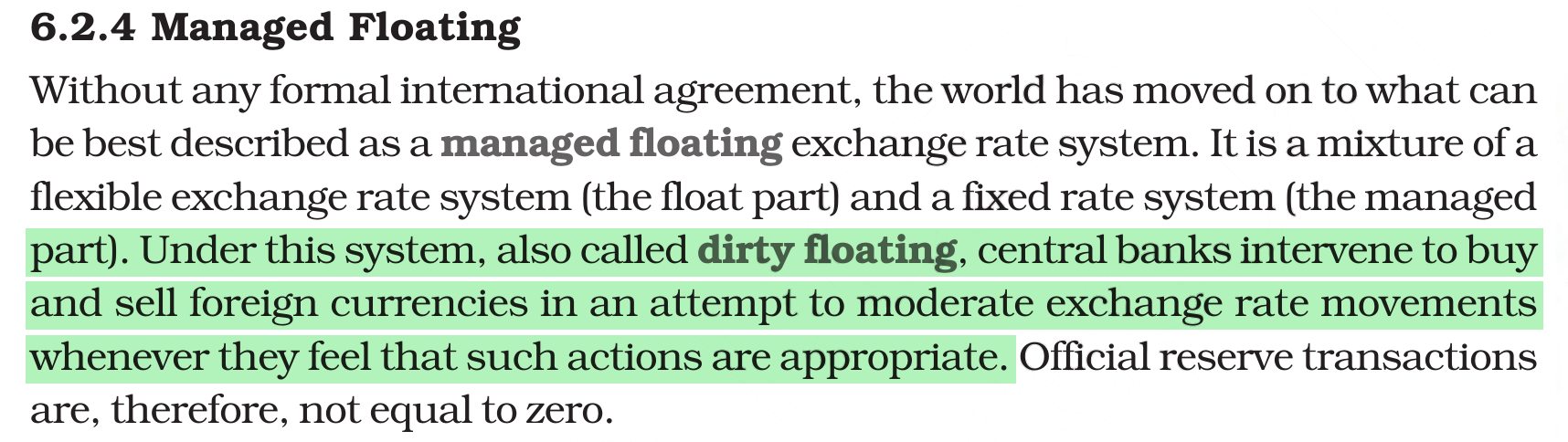
The correct answer is Option (3) → Central banks intervene to buy and sell foreign currencies in an attempt to moderate exchange rate.
Under a fixed exchange rate the government sets the rate; under a flexible one the market does. Managed floating mixes the two: the market sets the rate, but central banks intervene to buy and sell foreign currencies to moderate its movements when they think it necessary. Because of this intervention it is also called dirty floating.
Why the other options are incorrect
Option (1) Movements in the exchange rate automatically take care of the surpluses and deficits in the BoP. — Incorrect. This is the merit of a fully flexible exchange rate, where the central bank does not intervene at all.
Option (2) In this exchange rate system, the Government fixes the exchange rate at a particular level. — Incorrect. This describes a fixed exchange rate, in which the government holds the rate at a set level.
Option (4) It links the currencies of different countries and enables comparison of international costs and prices. — Incorrect. This is what any exchange rate does, whatever the system; it does not describe dirty floating.
NCERT: Introductory Macroeconomics — Chapter 6: Open Economy Macroeconomics (2025-26)
|