What factors contribute to the physical transplantation of urban life into a rural setup?
Answer & explanation
Correct answer: option 3
The correct answer is Option (3) → Industrialization
Option (1) Mass Media and Communication — Incorrect. Television, films and the internet carry images of urban life styles into villages, and people may copy what they see. But this is a change of ideas and tastes; no part of the city is physically set up in the village.
Option (2) Migration — Incorrect. Migration is the movement of people from one place to another. When villagers work in far-off cities, they send money home, visit and build new houses, so urban influence reaches the village; but the village stays a village and no urban centre comes up in it.
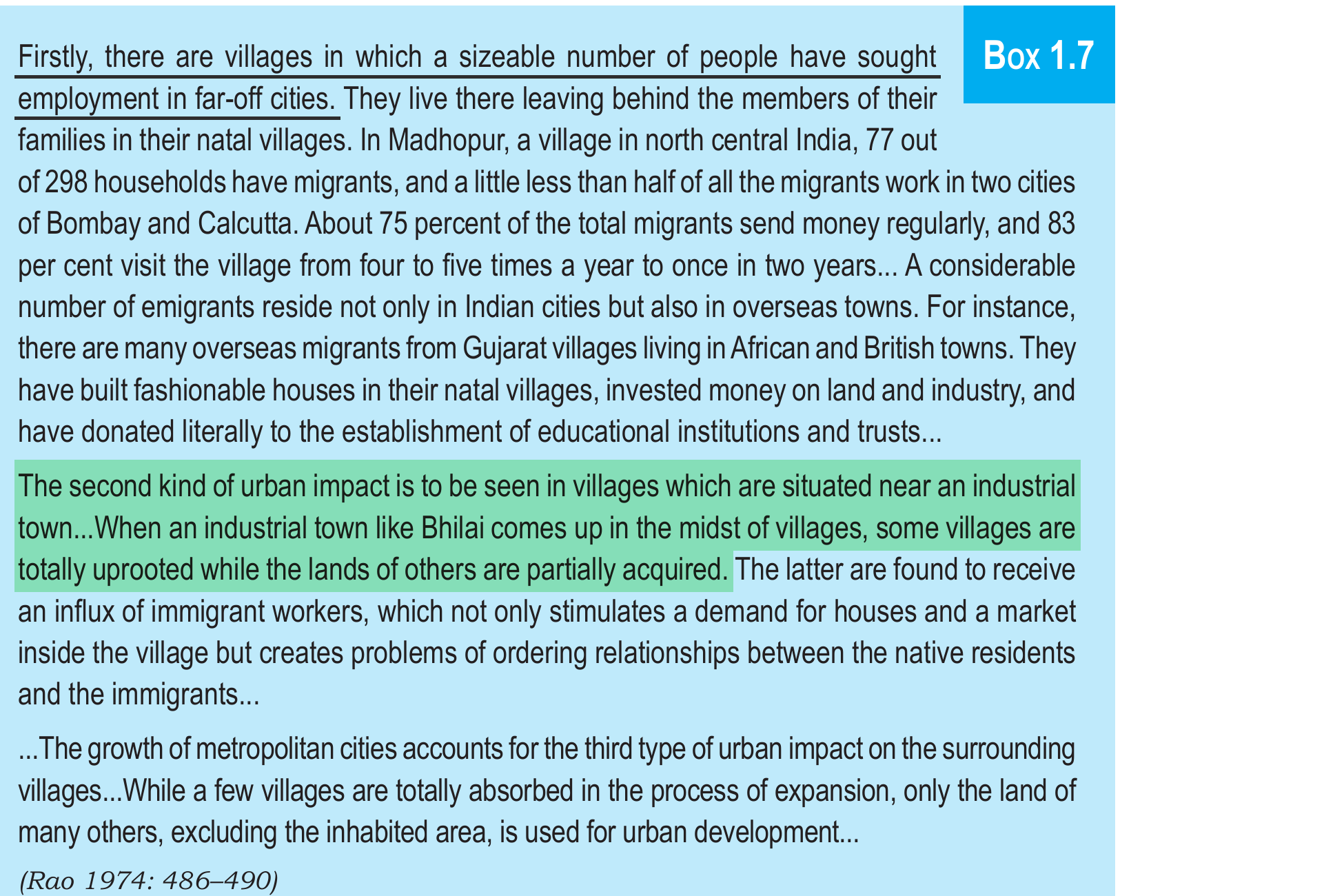
Option (3) Industrialization — Correct. Industrialisation is the growth of machine production in factories. When an industrial town like Bhilai comes up in the midst of villages, some villages are uprooted and the lands of others are taken over; factories, workers’ housing, markets and an influx of workers arrive in the countryside, so urban life is physically planted there.
Option (4) Secularization — Incorrect. Secularisation is the process in which religion loses its hold over social life and institutions. It changes beliefs and practices, not the physical setting of a village.
NCERT (2025-26): “Urbanisation in Independent India … Writing on the different kinds of urbanisation witnesses in the first two decades after independence sociologist M.S.A. Rao argued that in India many villages all over India are becoming increasingly subject to the impact of urban influences. But the nature of urban impact varies according to the kind of relations a village has with a city or town. He describes three different situations of urban impact as mentioned in the box.”
|