Recombinant DNA technology
Read the following passage carefully and answer the given questions
Biotechnology has been used by humans since times immemorial in the form of unmodified microbe mediated processes. However, rDNA technology uses genetically modified organisms and employs number of tools. The key tools are restriction enzymes, polymerase enzymes, ligases, vectors and the host organism. Restriction enzymes are also called as nucleases as they cut the DNA. Exonucleases cuts the DNA from the ends whereas endonucleases cuts the DNA at specific positions within the DNA. Endonucleases recognize a sequence of six base pairs called ‘recognition sequence’. Restriction enzymes cut both foreign DNA and vector DNA at specific point. Plasmids and bacteriophages are the commonly used vectors for transferring rDNA into the host organism. Vectors used now a days are engineered in such a way that help in easy linking with foreign DNA as well as selection of recombinants from non-recombinants. Maintenance of introduced DNA in the host and transfer of DNA to its progeny is one of the basic step of biotechnology.
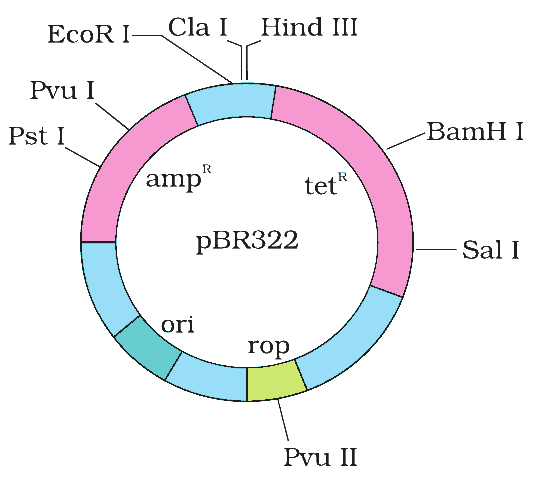
Foreign DNA is ligated at EcoRI site in the vector pBR322. The recombinant plasmid will:
Answer & explanation
Correct answer: option 2
The correct answer is Option (2) → Grow on ampicillin containing medium but not on tetracycline
Note 1: The given answer is as per the official NTA Answer Key. However, there seems to be a mistake in the question. The EcoRI site of pBR322 lies outside both antibiotic resistance genes. So a recombinant plasmid made at this site would grow on both ampicillin and tetracycline, which is Option (3), as explained below.
The vector pBR322 has an origin of replication (ori) and two antibiotic resistance genes, ampR and tetR. If foreign DNA is ligated at a site inside one of these genes, that gene is switched off. This is called insertional inactivation. If the site is outside both genes, both stay active.
(1) Grow on kanamycin containing medium but not on chloramphenicol — Incorrect. pBR322 does not carry genes for resistance to kanamycin or chloramphenicol.
(2) Grow on ampicillin containing medium but not on tetracycline — Correct as per NTA; however, it is not correct for the EcoRI site. This is the result when the foreign DNA goes into the tetracycline resistance gene, as at the BamH I site. The recombinant then loses tetracycline resistance but keeps ampicillin resistance.
(3) Grow on both ampicillin and tetracycline containing medium — Not the answer given by NTA, but the academically correct one. In the map of pBR322 the EcoR I site lies in the stretch between ampR and tetR. Foreign DNA put there disturbs neither gene, so the recombinant plasmid grows on both antibiotics.
(4) Neither grow on ampicillin nor on tetracycline containing medium — Incorrect. This would need both genes to be inactivated, but the EcoR I site is in neither of them.
Note 2: The passage is taken from NCERT. NTA has put lines of the NCERT text together to make it. Most CUET (UG) questions come straight from NCERT, so study the book line by line, including figures and their titles.
NCERT Extract: