
CUETMOCK
  • Pricing
  • Mentors
Log inStart freeStart free mocks→

First test, then trust

Try a free CUET mock test.

Join 5,00,000+ students who rehearsed exam day on the exact NTA screen before sitting CUET. On the web and on Android.

Start free mocks →Get the Android app
CUETMOCK

India's #1 CUET Mock Test Platform. Original NCERT-based questions on the exact NTA exam screen — trusted by 5,00,000+ students since CUET 2022.

Get it onGoogle PlayScan to download the CUETMOCK app

Mock tests

  • CUET mock test series
  • Browse all papers
  • Commerce mocks
  • Humanities (Arts) mocks
  • Science mocks
  • Languages & GAT mocks
  • Free practice questions
  • Pricing

Resources

  • CUET exam guide
  • CUET syllabus
  • Universities accepting CUET
  • Expert blogs
  • News & notifications
  • Webinars & counselling
  • CUET score calculator
  • How we estimate your rank
  • FAQs

Company

  • About us
  • Our leadership & team
  • Our toppers
  • Mentors
  • For schools
  • Contact us
  • Terms
  • Privacy
  • Refund policy

Talk to us

+91 7696 6630 56info@cuetmock.comWhatsApp us

Our other platforms

  • JEE Mock — For IIT-JEE aspirants
  • NEET Mock — For NEET aspirants

Newsletter

Exam updates, study material and offers — no spam.

© 2026 NYC Ventures Pvt. Ltd.

701-702, Royal Business Park, Zirakpur, Punjab - 140603

  • Terms of use
  • Privacy policy
  • Refund policy
  • Contact us

iCUETMOCK is an independent preparation platform, not affiliated with the National Testing Agency (NTA). Always check exam details on the official NTA website.

  • Home
  • Mock tests
  • CUET guide
  • Pricing
  • Log in
Home/Practice questions/Chemistry
ChemistryOrganic: Haloalkanes and Haloarenes

Which of the following is not a correct resonance structure for a mec…

Which of the following is not a correct resonance structure for a mechanism of the following chemical reaction?
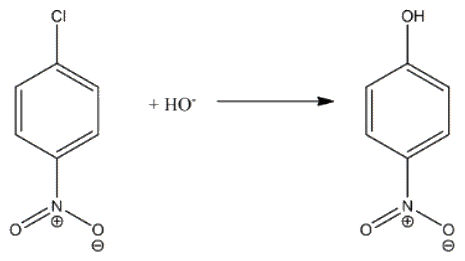
Figure for Q30

Answer & explanation+

Correct answer: option 2

The correct answer is Option (2) → structure 2

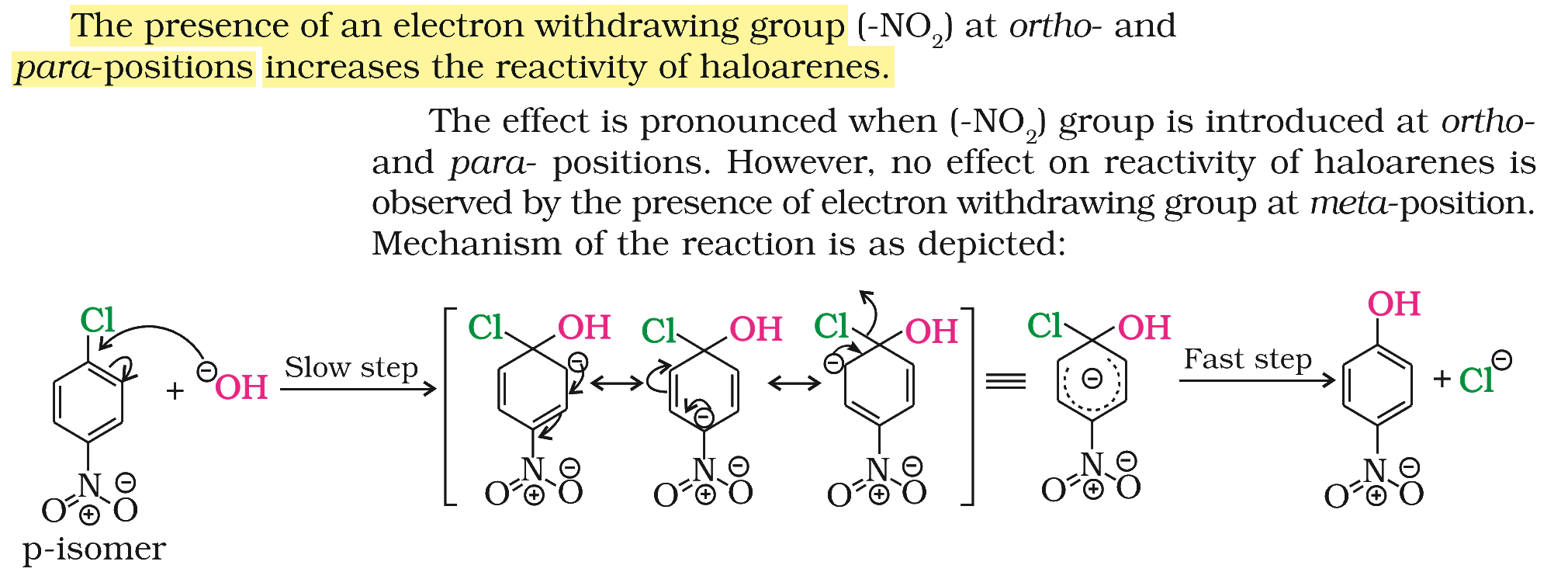
1-Chloro-4-nitrobenzene reacts with \( \ce{OH^{-}} \) by nucleophilic aromatic substitution, an addition–elimination mechanism:

  • Addition: \( \ce{OH^{-}} \) attacks the carbon carrying Cl (C-1). This carbon becomes sp3 and holds both Cl and OH, and the ring gains a negative charge.

  • Delocalisation: this charge is shared by resonance over the ortho (C-2, C-6) and para (C-4) carbons of the ring, and from C-4 onto the oxygen atoms of the –NO2 group, which is why a para nitro group makes the reaction easy.

  • Elimination: \( \ce{Cl^{-}} \) leaves and the aromatic ring is restored, giving 4-nitrophenol:

        \( \displaystyle \ce{O2N-C6H4-Cl + OH^- -> O2N-C6H4-OH + Cl^-} \)

Every correct resonance structure of the intermediate must keep C-1 as a saturated (sp3) carbon with four bonds and place the negative charge only on C-2, C-4, C-6 or the nitro oxygen.

  • Option (1) structure 1 — A correct resonance structure. The negative charge is on an ortho carbon next to C-1.

  • Option (2) structure 2 — Not a correct resonance structure. C-1 is drawn with a double bond while it still carries Cl, OH and another ring bond (five bonds), and the charge is on a meta carbon, which it cannot reach by resonance.

  • Option (3) structure 3 — A correct resonance structure. The negative charge is on the other ortho carbon.

  • Option (4) structure 4 — A correct resonance structure. The negative charge is on the para carbon that carries the –\( \ce{NO2} \) group; from here it moves onto the nitro oxygen.

NCERT (2026-27 edition):
Reactions of Haloarenes – …
Textbook extract

Advertisement

Practise more on Organic: Haloalkanes and Haloarenes

Chapter-wise mocks on the real NTA exam screen, with solutions and your rank. Your first mocks are free.

Start free mocks →

Advertisement

Next questions

  1. Asha, Deepa and Lata are partners in a firm sharing profits in the ratio of 5 : 2 : 3. Deepa retires. After making all adjustments relating…Accountancy Part A · Reconstitution of Partnership Firm: Retirement and Death
  2. Put the following travelers to India who left accounts in a chronological order from the earliest to last.A. Duarte Barbosa from PortugalB.…General Aptitude Test · General Knowledge
  3. Which one of the following pairs of linear equations is/are inconsistent?(A) 7x+2y=3 , 14x+4y=5 (B) 2x−3y=7 , 4x−6y=12 (C) x−y=10 , 3x−3y=1…General Aptitude Test · Quantitative Reasoning
  4. Which one of the following hormones is not involved in the process of parturition?Biology · Human Reproduction
  5. How do parties and groups pursue the principles of diversity in a democratic politics?Political Science · Politics in India Since Independence: Regional Aspirations
  6. Arrange the following soil horizon of a typical soil profile starting from top to bottom.A. A horizonB. B horizonC. C horizonD. O horizonE.…Environmental Studies · International Relations and the Environment
  7. Fill in the blanks given in List-I with the appropriate words given in List-II.List-ISentencesList-IIWords(A) Kanika ________ him for his w…English · Fill Blanks
  8. The ratio in which the continuing partners have acquired the share from the deceased partner is known as .......Accountancy Part A · Reconstitution of Partnership Firm: Retirement and Death
  9. Water is leaking from bottom of a conical funnel at the rate of 0.15π\ cm^3/s . If the radius of the base of the funnel is 10 cm and its he…Applied Maths. Section B2 · Calculus
  10. The paths of electrons between successive collisions with the fixed positive ions of the metal, in the presence of electric field are :Physics · Current Electricity