Which of the following are not true for order of a chemical reaction ?
(A) It is the sum of powers of the concentration terms in the rate law expression.
(B) It is the sum of stoichiometric coefficients of a chemical reaction.
(C) It is an experimentally determined value.
(D) It is always a whole number.
(E) It can not have zero value.
Choose the correct answer from the options given below:
Answer & explanation
Correct answer: option 4
The correct answer is Option (4) → (B), (D) and (E) only
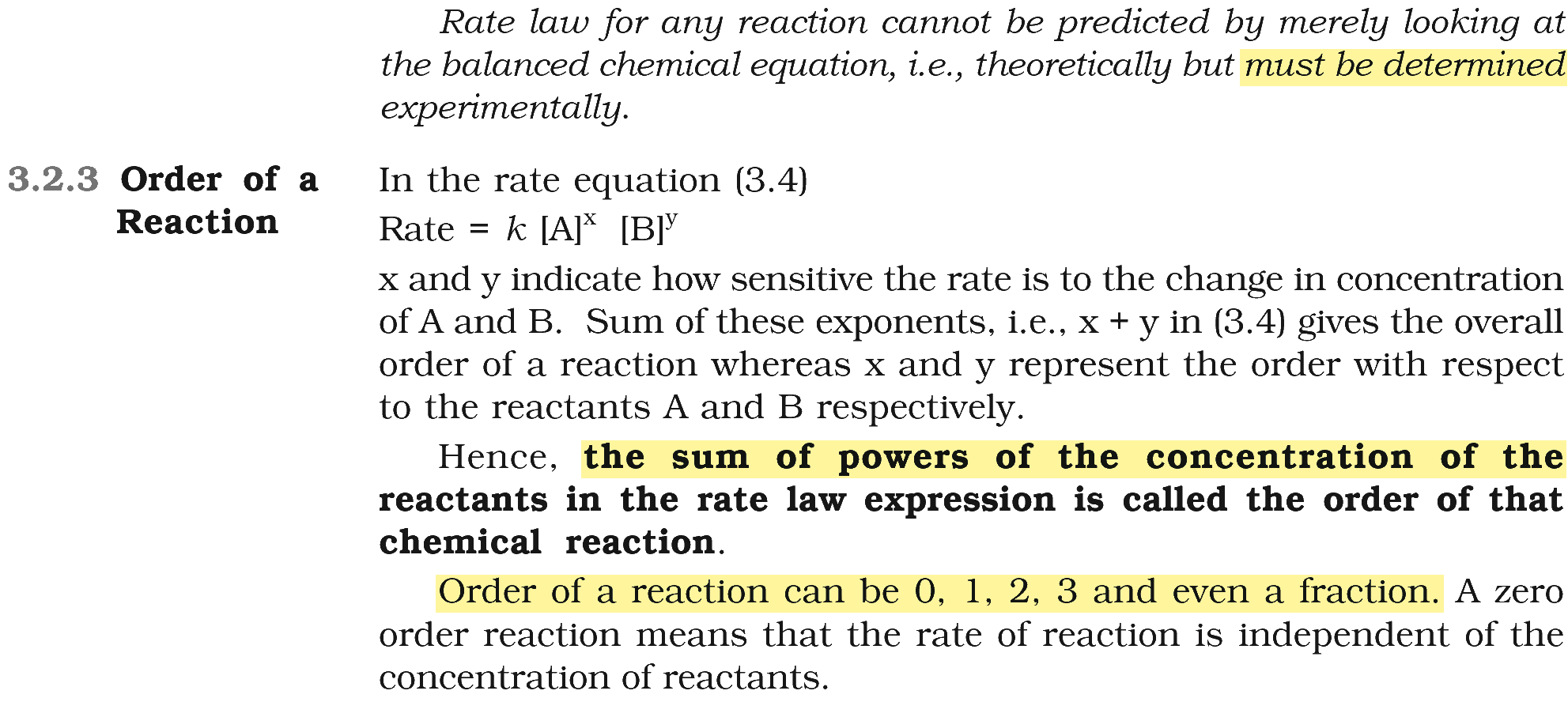
The order of a reaction is the sum of the powers of the concentration terms in the experimentally determined rate law:
\( \displaystyle \text{Rate}=k[A]^x[B]^y \quad\Rightarrow\quad \text{order}=x+y \)
The powers x and y are found by experiment; they need not equal the coefficients in the balanced equation, and the order can be 0, a whole number or a fraction. The sum of the coefficients in an elementary step is its molecularity, a different quantity.
(A) It is the sum of powers of the concentration terms in the rate law expression. — Correct. This is the definition of order.
(B) It is the sum of stoichiometric coefficients of a chemical reaction. — Incorrect. The order is not read from the balanced equation; for example, \( \ce{2N2O5} \) → \( \ce{4NO2} \) + \( \ce{O2} \) is first order.
(C) It is an experimentally determined value. — Correct. The powers in the rate law come from experiment.
(D) It is always a whole number. — Incorrect. The order can be fractional; for example, \( \ce{CH3CHO} \) → \( \ce{CH4} \) + CO has order 3/2.
(E) It can not have zero value. — Incorrect. Zero order reactions exist, such as the decomposition of \( \ce{NH3} \) on a hot platinum surface at high pressure.
NCERT (2026-27 edition):
Order of a Reaction