Anisole gives p-bromoanisole as the major product, in about 90% yield, when it is treated with which of the following?
Answer & explanation
Correct answer: option 1
The correct answer is Option (1) → Bromine in ethanoic acid
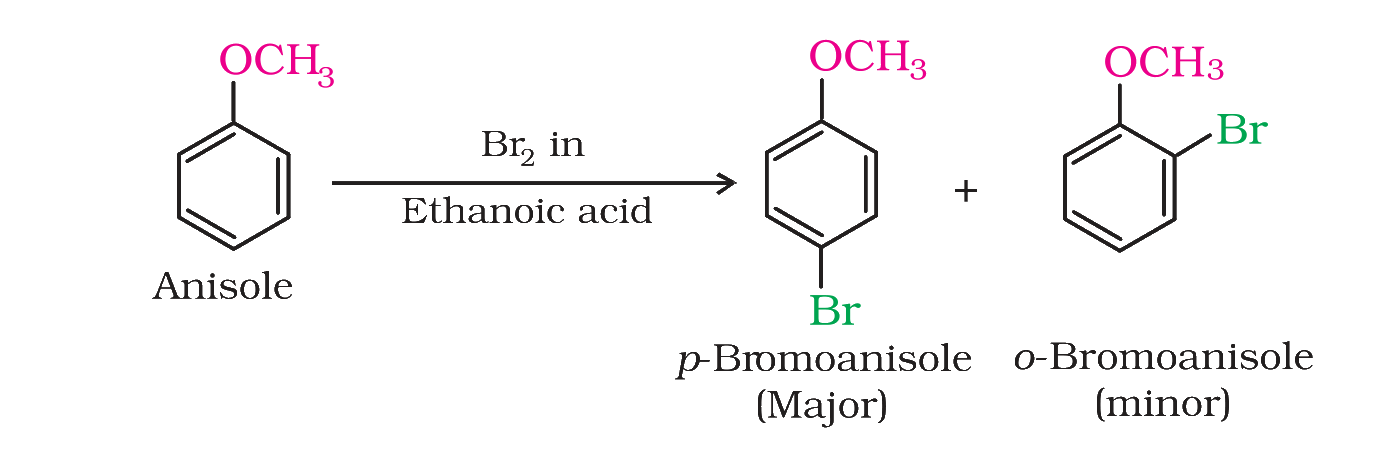
The methoxy group of anisole activates the benzene ring and directs the incoming group to the ortho and para positions, as the –OH group does in phenol. So anisole is brominated by bromine in ethanoic acid even without an iron(III) bromide catalyst, and the para isomer is the major product (90%), with a little o-bromoanisole:
\( \displaystyle \ce{C6H5OCH3 + Br2} \xrightarrow{\text{ethanoic acid}} \ce{BrC6H4OCH3 + HBr} \)
Why the other options are incorrect
Option (2) Concentrated HBr at high temperature — Incorrect. Hot concentrated HBr cleaves the ether. An alkyl aryl ether breaks at the alkyl–oxygen bond, so anisole gives phenol and bromomethane; the ring is not brominated.
Option (3) Bromoethane and anhydrous AlCl3 — Incorrect. This is a Friedel-Crafts alkylation: an ethyl group, not bromine, is introduced at the ortho and para positions.
Option (4) Phosphorus tribromide — Incorrect. PBr3 converts alcohols to alkyl bromides by replacing the –OH group. Anisole has no –OH group to replace.
NCERT (2026-27 edition):
7.6.3 Chemical Reactions – “The alkoxy group (-OR) is ortho, para directing and activates the aromatic ring towards electrophilic substitution in the same way as in phenol.” … “(i) Halogenation: Phenylalkyl ethers undergo usual halogenation in the benzene ring, e.g., anisole undergoes bromination with bromine in ethanoic acid even in the absence of iron (III) bromide catalyst. It is due to the activation of benzene ring by the methoxy group. Para isomer is obtained in 90% yield.”