CUETMOCK
  • Pricing
  • Mentors
Log inStart freeStart free mocks→

First test, then trust

Try a free CUET mock test.

Join 5,00,000+ students who rehearsed exam day on the exact NTA screen before sitting CUET. On the web and on Android.

Start free mocks →Get the Android app
CUETMOCK

India's #1 CUET Mock Test Platform. Original NCERT-based questions on the exact NTA exam screen — trusted by 5,00,000+ students since CUET 2022.

Get it onGoogle PlayScan to download the CUETMOCK app

Mock tests

  • CUET mock test series
  • Browse all papers
  • Commerce mocks
  • Humanities (Arts) mocks
  • Science mocks
  • Languages & GAT mocks
  • Free practice questions
  • Pricing

Resources

  • CUET exam guide
  • CUET syllabus
  • Universities accepting CUET
  • Expert blogs
  • News & notifications
  • Webinars & counselling
  • CUET score calculator
  • How we estimate your rank
  • FAQs

Company

  • About us
  • Our leadership & team
  • Our toppers
  • Mentors
  • For schools
  • Contact us
  • Terms
  • Privacy
  • Refund policy

Talk to us

+91 7696 6630 56info@cuetmock.comWhatsApp us

Our other platforms

  • JEE Mock — For IIT-JEE aspirants
  • NEET Mock — For NEET aspirants

Newsletter

Exam updates, study material and offers — no spam.

© 2026 NYC Ventures Pvt. Ltd.

701-702, Royal Business Park, Zirakpur, Punjab - 140603

  • Terms of use
  • Privacy policy
  • Refund policy
  • Contact us

iCUETMOCK is an independent preparation platform, not affiliated with the National Testing Agency (NTA). Always check exam details on the official NTA website.

  • Home
  • Mock tests
  • CUET guide
  • Pricing
  • Log in
Home/Practice questions/Economics
EconomicsMicro Economics: Theory of Consumer behaviour

Choose the correct statement from the given options-(A) if eD < –1, t…

Choose the correct statement from the given options-

(A) if eD < –1, then q (1 + eD) < 0, and hence, ΔE has the opposite sign as Δp

(B) if eD > –1, then q (1 + eD) > 0, and hence, ΔE has the same sign as Δp

(C) if eD = –1, then q (1 + eD) = 1, and hence, ΔE = 0

(D) if eD = –1, then q (1 + eD) = 0, and hence, ΔE = 0

Choose the correct answer from the options given below:

Answer & explanation+

Correct answer: option 2

The correct answer is Option (2) → (A), (B) and (D) only

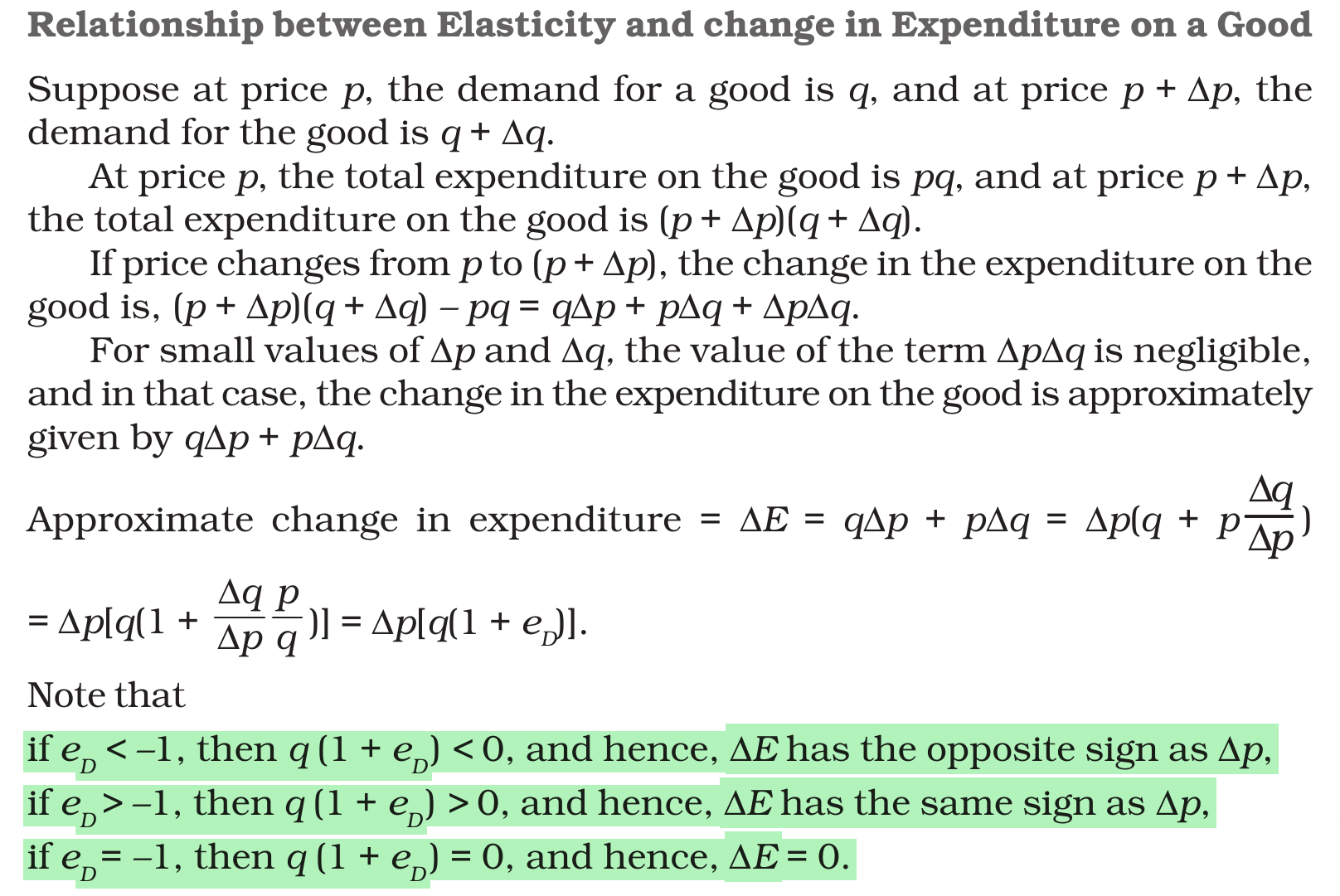
The money buyers spend on a good is its expenditure, E = p × q. When the price rises, each unit costs more, but buyers also buy fewer units, so expenditure is pulled two ways. Which pull wins depends on the price elasticity of demand, eD = (Δq/q) ÷ (Δp/p), a negative number because quantity falls when price rises.

For a small price change Δp, the change in expenditure is approximately qΔp + pΔq, and writing pΔq as Δp × q × eD gives ΔE = Δp[q(1 + eD)]. Since q is positive, the sign of the bracket 1 + eD decides how expenditure moves:

  • Elastic demand, eD < –1: the bracket is negative, so expenditure moves opposite to the price; the fall in quantity outweighs the rise in price.

  • Inelastic demand, eD > –1: the bracket is positive, so expenditure moves in the same direction as the price.

  • Unitary elasticity, eD = –1: the bracket is zero, so expenditure does not change.

(A) if eD < –1, then q (1 + eD) < 0, and hence, ΔE has the opposite sign as Δp Correct. With elastic demand q(1 + eD) is negative, so a rise in price lowers expenditure and a fall in price raises it.

(B) if eD > –1, then q (1 + eD) > 0, and hence, ΔE has the same sign as Δp Correct. With inelastic demand q(1 + eD) is positive, so a rise in price raises expenditure and a fall lowers it.

(C) if eD = –1, then q (1 + eD) = 1, and hence, ΔE = 0 Incorrect. When eD = –1, the bracket 1 + eD is 0, so q(1 + eD) = 0, not 1. If it were 1, ΔE would equal Δp and could not be zero, so the statement contradicts itself.

(D) if eD = –1, then q (1 + eD) = 0, and hence, ΔE = 0 Correct. With unitary elasticity the percentage fall in quantity just offsets the percentage rise in price, so expenditure stays the same.


NCERT: Introductory Microeconomics — Chapter 2: Theory of Consumer Behaviour (2025-26)

NCERT extract

Advertisement

Practise more on Micro Economics: Theory of Consumer behaviour

Chapter-wise mocks on the real NTA exam screen, with solutions and your rank. Your first mocks are free.

Start free mocks →

Advertisement

Next questions

  1. If f(x)= […] is differentiable at x=1 thenMaths. Section B1 · Continuity and Differentiability
  2. In a class of 30 students, 10 scored 40, 12 scored 50, 8 scored 60. The mean score is:General Aptitude Test · Numerical Ability
  3. Secondary structure of protein refers toChemistry · Organic: Biomolecules
  4. India believes in which of the following principles in international negotiations?Political Science · Contemporary World Politics: Environment and Natural Resources
  5. Which region is associated with the Ganeshwar-Jodhpura culture?History · Ancient India: Bricks, Beads and Bones
  6. Match List-I with List-IIList-IList-II(A) Resistivity of a material(I) is the magnitude of the drift velocity per unit electric field(B) Cu…Physics · Current Electricity
  7. Ramesh and Naresh are equal partners. Their capitals as on April 01, 2025 were Rs. 50,000 and Rs. 1,00,000 respectively. After the accounts…Accountancy Part A · Accounting for Partnership
  8. FRBMA stands for:Economics · Macro Economics: Government Budget and Economy
  9. The chains of mature insulin are joined together by:Biology · Biotechnology and its Applications
  10. The reason that the leopard could be sighted so close to human settlements points to:English · Comprehension - (Narrative / Factual)