
CUETMOCK
  • Pricing
  • Mentors
Log inStart freeStart free mocks→

First test, then trust

Try a free CUET mock test.

Join 5,00,000+ students who rehearsed exam day on the exact NTA screen before sitting CUET. On the web and on Android.

Start free mocks →Get the Android app
CUETMOCK

India's #1 CUET Mock Test Platform. Original NCERT-based questions on the exact NTA exam screen — trusted by 5,00,000+ students since CUET 2022.

Get it onGoogle PlayScan to download the CUETMOCK app

Mock tests

  • CUET mock test series
  • Commerce mocks
  • Humanities (Arts) mocks
  • Science mocks
  • Languages & GAT mocks
  • Free practice questions
  • Pricing

Resources

  • CUET exam guide
  • CUET syllabus
  • Universities accepting CUET
  • Expert blogs
  • News & notifications
  • Webinars & counselling
  • CUET score calculator
  • How we estimate your rank
  • FAQs

Company

  • About us
  • Our leadership & team
  • Our toppers
  • Mentors
  • For schools
  • Contact us
  • Terms
  • Privacy
  • Refund policy

Talk to us

+91 7696 6630 56info@cuetmock.comWhatsApp us

Our other platforms

  • JEE Mock — For IIT-JEE aspirants
  • NEET Mock — For NEET aspirants

Newsletter

Exam updates, study material and offers — no spam.

© 2026 NYC Ventures Pvt. Ltd.

701-702, Royal Business Park, Zirakpur, Punjab - 140603

  • Terms of use
  • Privacy policy
  • Refund policy
  • Contact us

iCUETMOCK is an independent preparation platform, not affiliated with the National Testing Agency (NTA). Always check exam details on the official NTA website.

  • Home
  • Mock tests
  • CUET guide
  • Pricing
  • Log in
Home/Practice questions/Chemistry
ChemistryOrganic: Biomolecules

Secondary structure of protein refers to

Proteins are most abundant biomolecules of the living organism. The main source of proteins are milk, cheese, pulses, peanuts, fish meat etc. Amino acids are building block of proteins. Amino acids contain amino (–NH2) and carboxyl (–COOH) functional groups. Depending upon the relative position of amino group with respect to carboxyl group, the amino acids can be classified as α, β, γ, δ and so on. Only alpha amino acid are obtained on hydrolysis of protein. Amino acids are classified as acidic, or basic or neutral depending upon the relative number of amino and carboxyl group in their molecule.

Amino acids which can be synthesised in the body are known as non-essential amino acids. On the other hand, those which can not be synthesised in the body and must be obtained through diet are known as essential amino acids. Proteins are condensation product of amino acids which are linked through peptide bond or peptide linkage.

Proteins can be classified into two types on the basis of their molecular shape. (a) Fibrous and (b) Globular proteins. Proteins found in a biological system with unique three-dimensional structure and biological activity is called a native protein. When a protein in its native form is subjected to physical changes, such as change in temperature, or chemical changes, such as change in pH, hydrogen bonds are disturbed. As a result, globules unfold, helices uncoil, and protein loses its biological activity. This is called denaturation of protein.

Secondary structure of protein refers to

Answer & explanation+

Correct answer: option 2

The correct answer is Option (2) → the regular folding of the backbone of polypeptide chain due to hydrogen bonding between carbonyl and amino group of the peptide bond.

The structure of a protein is described at four levels:

  • Primary structure: the sequence of amino acids in the chain. A change of even one amino acid gives a different protein.

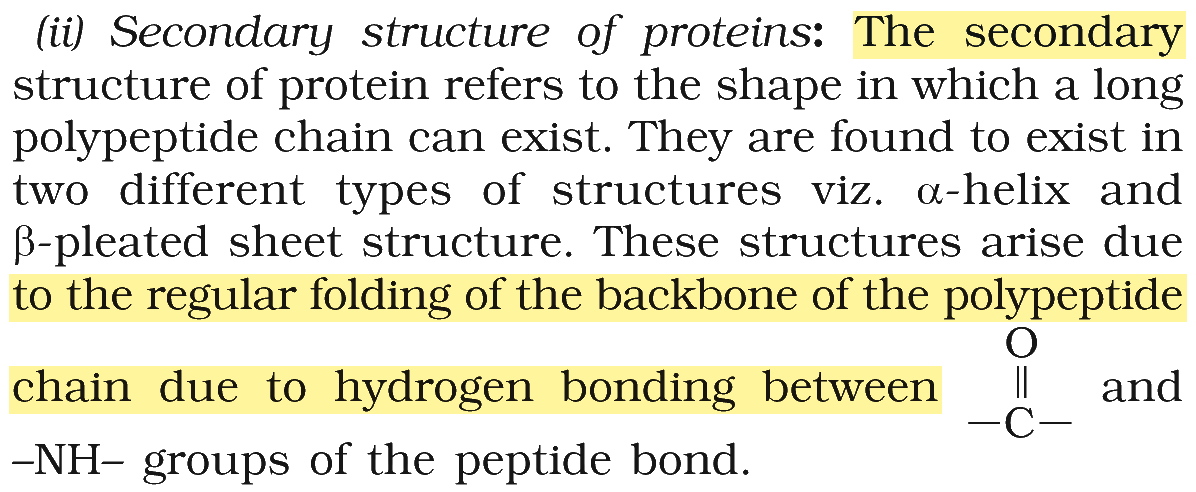
  • Secondary structure: the regular shape of the chain backbone, held by hydrogen bonds between the C=O and N–H groups of peptide bonds. Its two forms are the α-helix (H-bonds within one coiled chain) and the β-pleated sheet (H-bonds between neighbouring chains).

  • Tertiary structure: the three-dimensional folding, held by hydrogen bonds, disulphide links, van der Waals and electrostatic forces between groups far apart in the chain. It gives the fibrous or globular shape.

  • Quaternary structure: the arrangement of two or more polypeptide chains (subunits).

Why the other options are incorrect

  • Option (1) the three-dimensional structure especially the bonds between amino acid residues that are distant from each other in the polypeptide chain — Incorrect. This describes the tertiary structure.

  • Option (3) denatured proteins and prosthetic group structures — Incorrect. Denaturation destroys the secondary structure, and a prosthetic group is a non-protein part; neither is a level of structure.

  • Option (4) the linear sequence of amino acid residues in a polypeptide chain — Incorrect. This is the primary structure.

NCERT (2026-27 edition):
Secondary Structure of Proteins
Textbook extract

Advertisement

Practise more on Organic: Biomolecules

Chapter-wise mocks on the real NTA exam screen, with solutions and your rank. Your first mocks are free.

Start free mocks →

Advertisement

Next questions

  1. India believes in which of the following principles in international negotiations?Political Science · Contemporary World Politics: Environment and Natural Resources
  2. Which region is associated with the Ganeshwar-Jodhpura culture?History · Ancient India: Bricks, Beads and Bones
  3. Match List-I with List-IIList-IList-II(A)Resistivity of a material(I)is the magnitude of the drift velocity per unit electric field(B)Curre…Physics · Current Electricity
  4. Ramesh and Naresh are equal partners. Their capitals as on April 01, 2025 were Rs. 50,000 and Rs. 1,00,000 respectively. After the accounts…Accountancy Part A · Accounting for Partnership
  5. The chains of mature insulin are joined together by:Biology · Biotechnology and its Applications
  6. The reason that the leopard could be sighted so close to human settlements points to:English · Comprehension - (Narrative / Factual)
  7. If the 3-year moving averages of five values a, b, 20, c, d are 12, 14 & 16. Where a, b, c, d > 0, then match the following:List-IList-II(A…Applied Maths. Section B2 · Time Based Data
  8. Bromination of anisole in the presence of ethanoic acid does not require the Lewis acid becauseChemistry · Organic: Alcohols, Phenols and Ethers
  9. The order and degree of the differential equation √(1+≤ft(displaystyledy/dx)^2)=≤ft((d^2y)/(dx^2))^1/3 areApplied Maths. Section A · Differential Equations (Section A)
  10. In what year did the Mandal Commission give its recommendations?Political Science · Politics in India Since Independence: Recent Developments in Indian Politics