Match List-I with List-II
| List-I | List-II |
| (Electromagnetic Waves) | (Production) |
| (A) Infra-red | (I) Klystron |
| (B) Microwaves | (II) Vibration of atoms and molecules |
| (C) Gamma rays | (III) Radioactive decay of nuclei |
| (D) Ultraviolet | (IV) Transition of inner shell electrons from one energy level to another |
Choose the correct answer from the options given below:
Answer & explanation
Correct answer: option 1
The correct answer is Option (1) → (A) - (II), (B) - (I), (C) - (III), (D) - (IV)
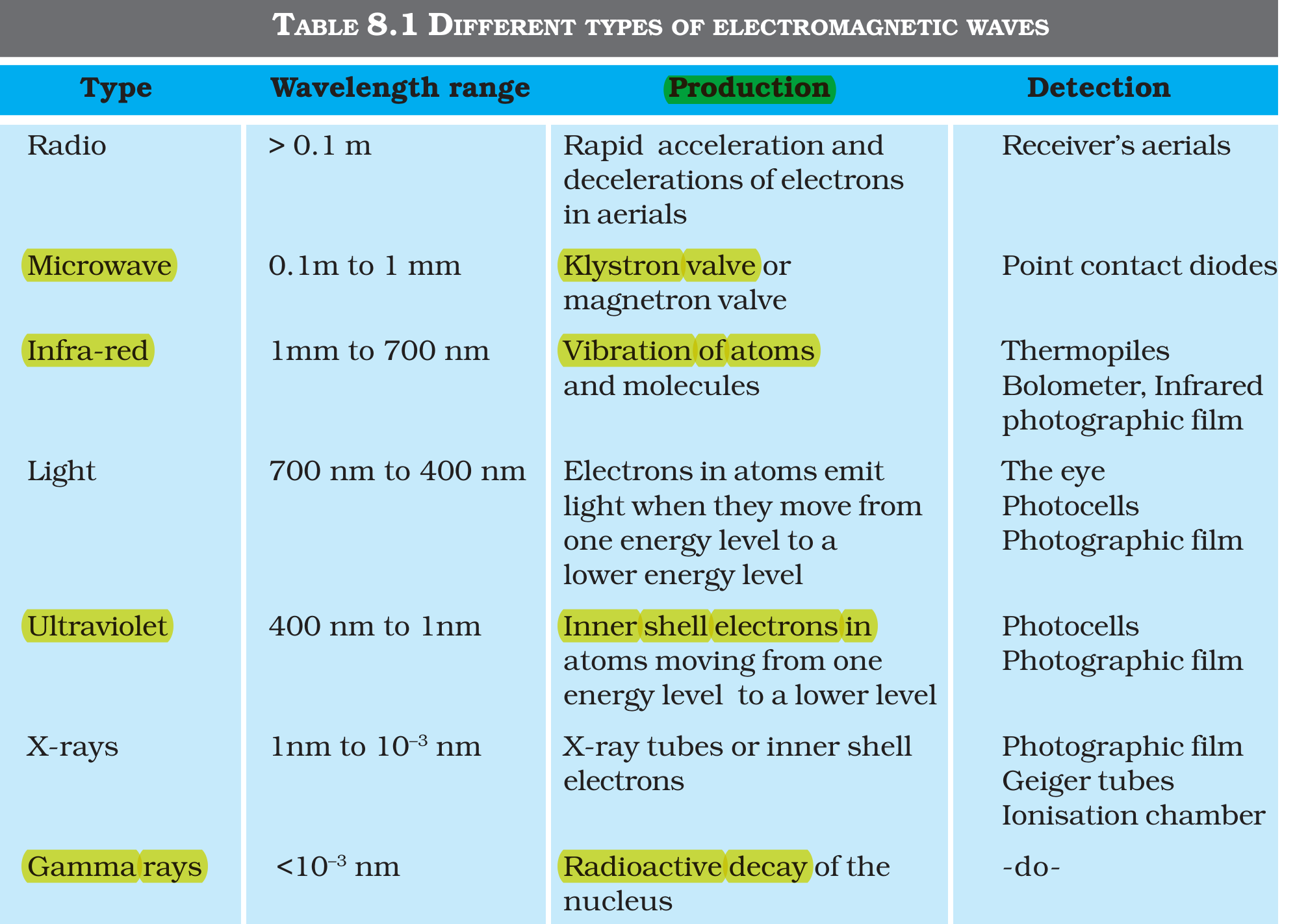
Each part of the electromagnetic spectrum comes from a characteristic source.
(A) Infra-red — this matches (II) Vibration of atoms and molecules. Hot bodies and vibrating molecules emit infrared radiation.
(B) Microwaves — this matches (I) Klystron. Microwaves are produced by special vacuum tubes such as the klystron, magnetron and Gunn diode.
(C) Gamma rays — this matches (III) Radioactive decay of nuclei. Gamma rays come from energy changes inside the nucleus.
(D) Ultraviolet — this matches (IV) Transition of inner shell electrons from one energy level to another. Ultraviolet radiation is emitted when inner-shell electrons of atoms move from one energy level to a lower one; very hot bodies such as the Sun are also sources.
NCERT (2026-27):
Gamma Rays – …