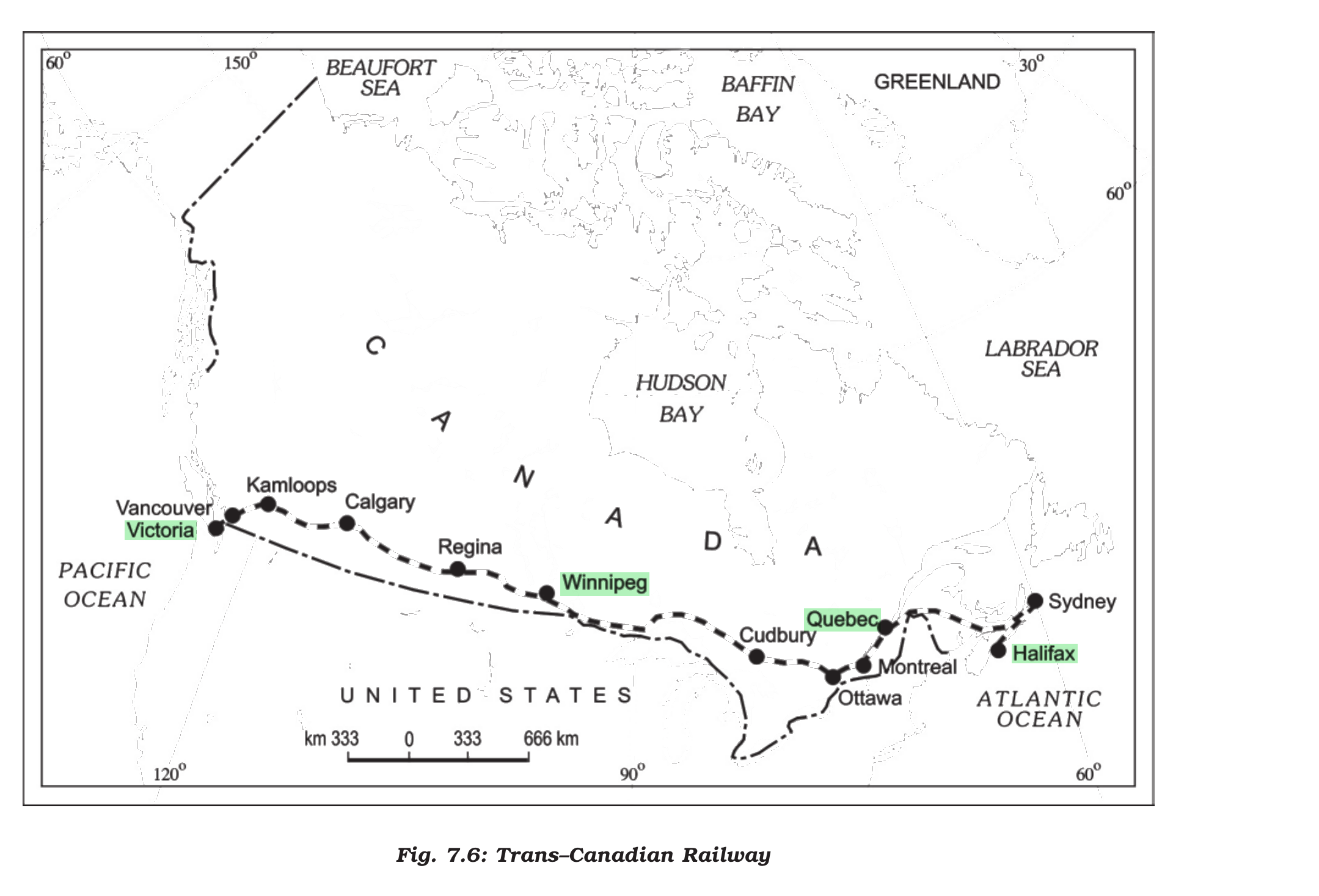
Arrange the following stations of Trans–Canadian Railway from west to east.
(A) Quebec
(B) Halifax
(C) Winnipeg
(D) Victoria
Choose the correct answer from the options given below:
Answer & explanation
Correct answer: option 4
The correct answer is Option (4) → (D), (C), (A), (B)
The Trans-Canadian line runs from Halifax in the east to Vancouver on the Pacific Coast. Its map marks all four stations along the route:
(D) Victoria — at the western end, beside Vancouver on the Pacific coast.
(C) Winnipeg — in the middle of the country, where the line crosses the wheat belt of the Prairie Region.
(A) Quebec — in the east, near Montreal, in the Quebec-Montreal Industrial Region.
(B) Halifax — at the eastern end, on the Atlantic coast.
Tip: The paragraph never names Victoria, and names Quebec only in ‘Quebec-Montreal Industrial Region’; the railway map marks both as stations. Study the station names on the maps along with the paragraph.
NCERT (2025-26): “Trans–Canadian Railways This 7,050 km long rail-line in Canada runs from Halifax in the east to Vancouver on the Pacific Coast passing through Montreal, Ottawa, Winnipeg and Calgary (Fig. 7.6). It was constructed in 1886, initially as part of an agreement to make British Columbia on the west coast join the Federation of States. Later on, it gained economic significance because it connected the Quebec-Montreal Industrial Region with the wheat belt of the Prairie Region and the Coniferous Forest region in the north. Thus each of these regions became complementary to the other.…”
|