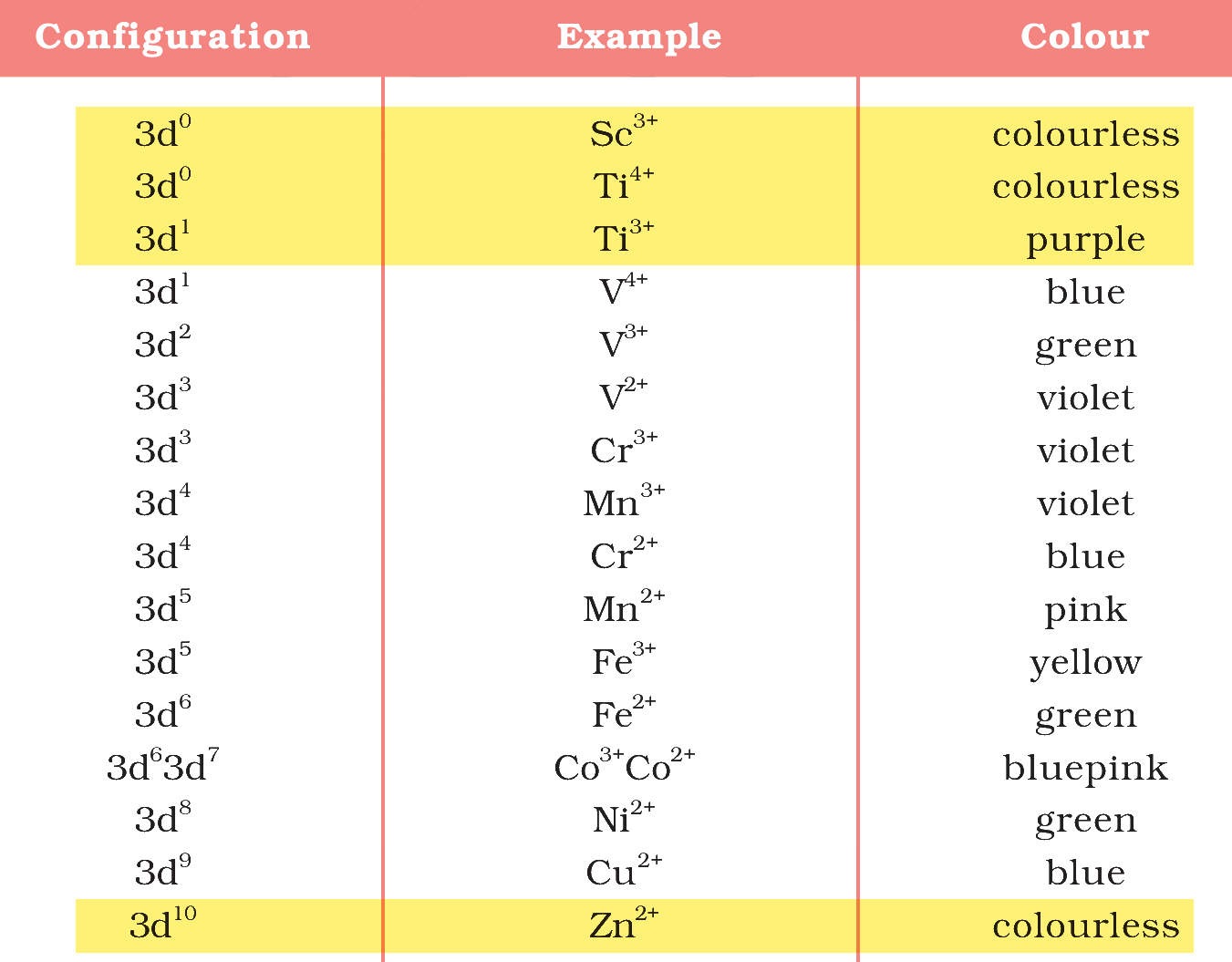
Which of the following ions is expected to be coloured in aqueous solution? (Atomic numbers: Sc = 21, Ti = 22, Zn = 30)
Answer & explanation
Correct answer: option 2
The correct answer is Option (2) → Ti3+
A transition metal ion is coloured in water when it has a partly filled d subshell: a d electron can then be excited to a higher d orbital by absorbing visible light. An ion with no d electron (d0) or a full d subshell (d10) has no such d–d transition and is colourless.
\( \ce{Sc^3+} \): Sc (Z = 21) is [Ar]3d14s2; losing three electrons leaves 3d0 — colourless.
\( \ce{Ti^3+} \): Ti (Z = 22) is [Ar]3d24s2; losing three electrons leaves 3d1, one d electron that can be excited — coloured (purple).
\( \ce{Zn^2+} \): Zn (Z = 30) is [Ar]3d104s2; losing the two 4s electrons leaves 3d10 — colourless.
\( \ce{Ti^4+} \): losing four electrons from Ti leaves 3d0 — colourless.
Only Ti3+ has a partly filled d subshell, so it is the coloured ion.
NCERT (2026-27 edition):
4.3.10 Formation of Coloured Ions – “When an electron from a lower energy d orbital is excited to a higher energy d orbital, the energy of excitation corresponds to the frequency of light absorbed (Unit 5). This frequency generally lies in the visible region. … In aqueous solutions where water molecules are the ligands, the colours of the ions observed are listed in Table 4.8.”
Table 4.8: Colours of Some of the First Row (aquated) Transition Metal Ions