
CUETMOCK
  • Pricing
  • Mentors
Log inStart freeStart free mocks→

First test, then trust

Try a free CUET mock test.

Join 5,00,000+ students who rehearsed exam day on the exact NTA screen before sitting CUET. On the web and on Android.

Start free mocks →Get the Android app
CUETMOCK

India's #1 CUET Mock Test Platform. Original NCERT-based questions on the exact NTA exam screen — trusted by 5,00,000+ students since CUET 2022.

Get it onGoogle PlayScan to download the CUETMOCK app

Mock tests

  • CUET mock test series
  • Browse all papers
  • Commerce mocks
  • Humanities (Arts) mocks
  • Science mocks
  • Languages & GAT mocks
  • Free practice questions
  • Pricing

Resources

  • CUET exam guide
  • CUET syllabus
  • Universities accepting CUET
  • Expert blogs
  • News & notifications
  • Webinars & counselling
  • CUET score calculator
  • How we estimate your rank
  • FAQs

Company

  • About us
  • Our leadership & team
  • Our toppers
  • Mentors
  • For schools
  • Contact us
  • Terms
  • Privacy
  • Refund policy

Talk to us

+91 7696 6630 56info@cuetmock.comWhatsApp us

Our other platforms

  • JEE Mock — For IIT-JEE aspirants
  • NEET Mock — For NEET aspirants

Newsletter

Exam updates, study material and offers — no spam.

© 2026 NYC Ventures Pvt. Ltd.

701-702, Royal Business Park, Zirakpur, Punjab - 140603

  • Terms of use
  • Privacy policy
  • Refund policy
  • Contact us

iCUETMOCK is an independent preparation platform, not affiliated with the National Testing Agency (NTA). Always check exam details on the official NTA website.

  • Home
  • Mock tests
  • CUET guide
  • Pricing
  • Log in
Home/Practice questions/Physics
PhysicsElectric Charges and Fields

Which of the following statement about charging by induction is TRUE?

Which of the following statement about charging by induction is TRUE?

Answer & explanation+

Correct answer: option 3

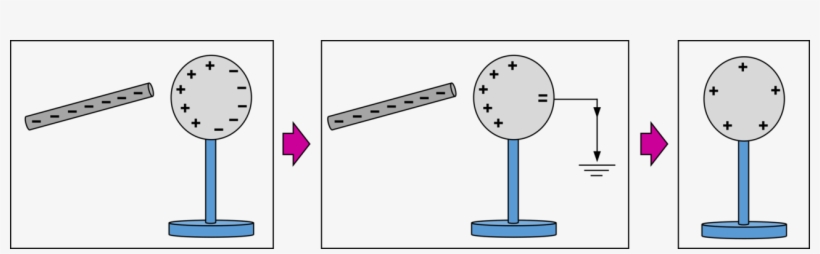
The induction charging is a charging method that charges an object without actually touching the object to any other charged object. The charging by induction process is where the charged particle is held near an uncharged conductive material that is grounded on a neutrally charged material. The charge flows between two objects and the uncharged conductive material develop a charge with opposite polarity. 
 

Advertisement

Practise more on Electric Charges and Fields

Chapter-wise mocks on the real NTA exam screen, with solutions and your rank. Your first mocks are free.

Start free mocks →

Advertisement

Next questions

  1. Which of the following is a method of preparation of HNO2?Chemistry · Organic: Alcohols, Phenols and Ethers
  2. Select the option which means the same as the group of words given. So small or unimportant as to be not worth consideringEnglish · One Word
  3. In ΔXYZ, ∠YXZ = 90 degree. P is a point on side YZ such that XP is perpendicular to YZ. If XP = YP = 10 cm, then what will be value of PZ?General Aptitude Test · Quantitative Reasoning
  4. The male gametes of rice plant have 12 chromosomes in their nucleus. The chromosome number in female gamete, zygote and the cells of the se…Biology · Reproduction in Organisms
  5. A vessel is filled with liquid, 3 parts of which are water and 5 parts are syrup. How much of the mixture must be drawn off and replaced wi…General Aptitude Test · Numerical Ability
  6. Select the option that is related to the third letter-cluster in the same way as the second letter-cluster is related to the first letter-c…General Aptitude Test · General Ability
  7. What is the percentage of photosynthetically active radiation (PAR) in the incident solar radiation?Biology · Ecosystem
  8. What is ‘Aquatint’?History · Modern India: Colonialism and the Countryside
  9. The pathways and unmetalled roads have been used for transportation in India since ancient times. With economic and technological developme…Geography · India-People and Economy: Transport and Communcation
  10. Match List I with List IIList IList IIA. Income increase - Quantity of Goods increasesI. Substitute GoodB. Income increase - Quantity of Go…Economics · Micro Economics: Theory of Consumer behaviour