Match List-I with List-II
| List-I | List-II | ||
| (A) | Declaration of Emergency | (I) | Jai Prakash Narayan |
| (B) | Save Democracy | (II) | Charu Majumdar |
| (C) | C.P.I. (ML) | (III) | Janta Party |
| (D) | Establishment of true democracy | (IV) | Fakharuddin Ali Ahmed |
Choose the correct answer from the options given below:
Answer & explanation
Correct answer: option 4
The correct answer is Option (4) → (A)-(IV), (B)-(III), (C)-(II), (D)-(I)
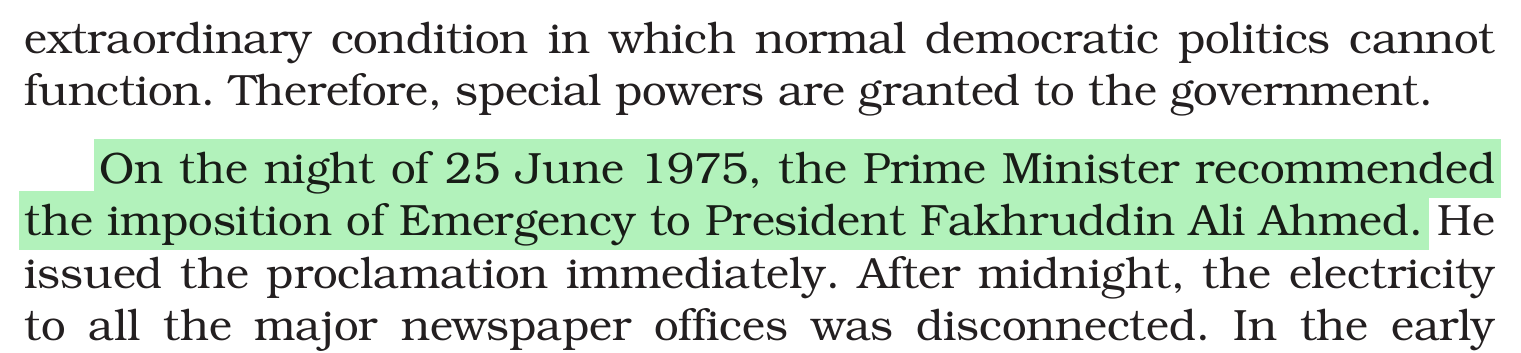
(A) Declaration of Emergency — this matches (IV) Fakharuddin Ali Ahmed. On the night of 25 June 1975, the Prime Minister recommended the Emergency to President Fakhruddin Ali Ahmed, who issued the proclamation at once.
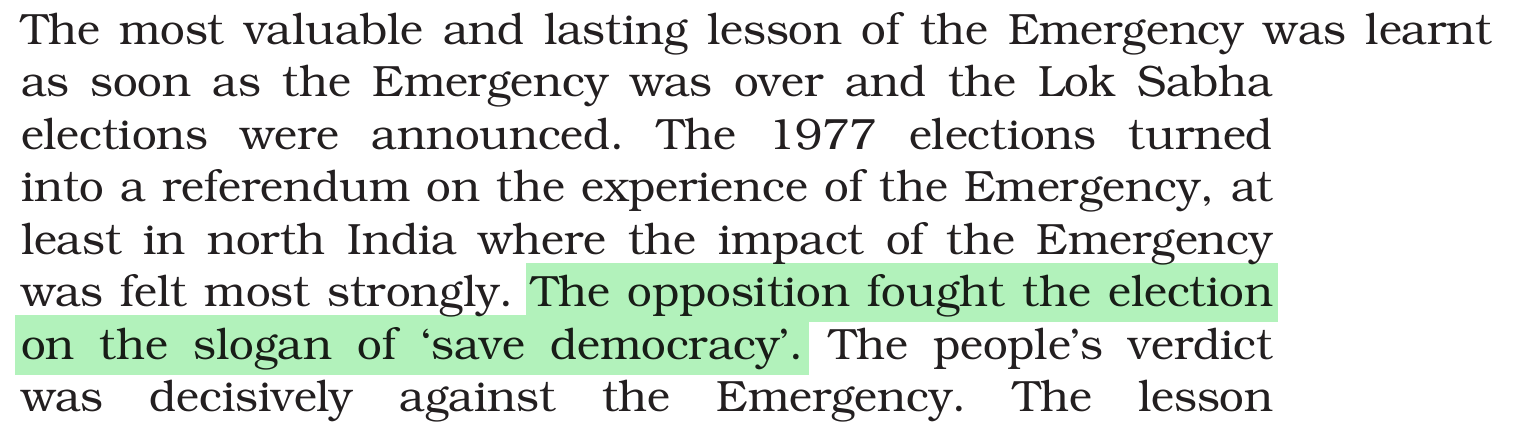
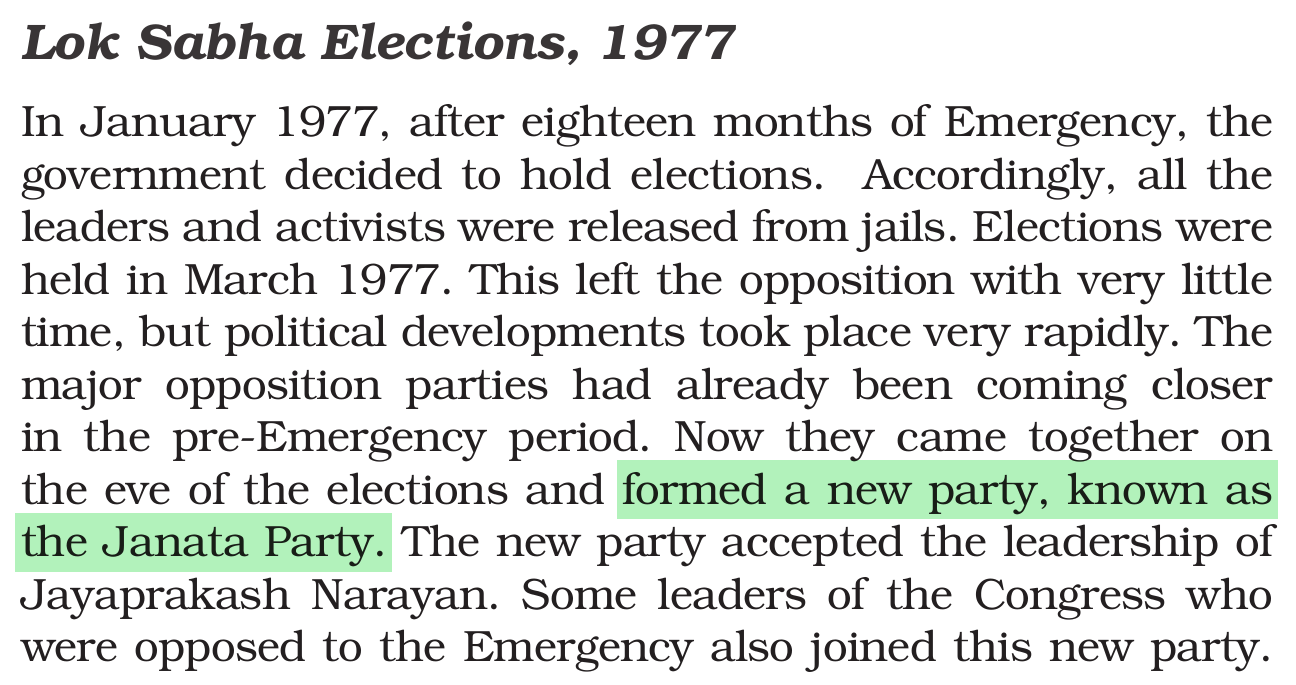
(B) Save Democracy — this matches (III) Janta Party. The opposition parties, united as the Janata Party, fought the 1977 election on this slogan.
(C) C.P.I. (ML) — this matches (II) Charu Majumdar. The Communist Party (Marxist-Leninist) was formed in 1969 under his leadership.
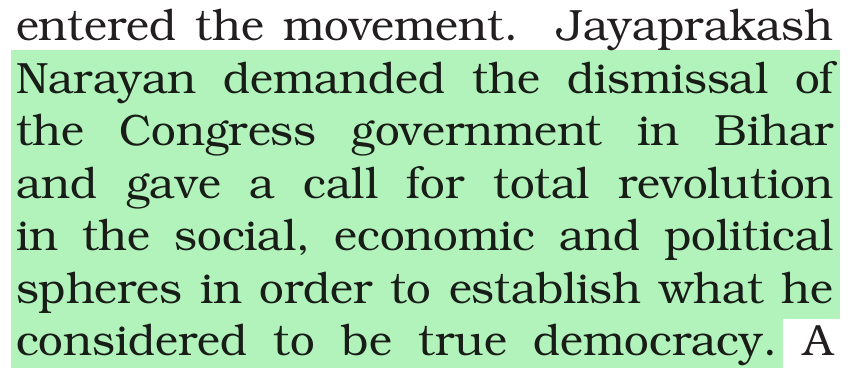
(D) Establishment of true democracy — this matches (I) Jai Prakash Narayan. JP called for a total revolution to establish what he considered to be true democracy.
Note: The box ‘Naxalite Movement’, which names Charu Majumdar, was in the chapter ‘The Crisis of Democratic Order’ of the pre-rationalised NCERT; this portion has been deleted from subsequent editions of NCERT, including the NCERT book (2026-27), though the chapter is still there.
NCERT (2026-27): Politics in India since Independence — Chapter 6: The Crisis of Democratic Order
NCERT (Pre-rationalised): “The Naxalite Movement … In 1967 a peasant uprising took place in the Naxalbari police station area of Darjeeling hills district in West Bengal under the leadership of the local cadres of the Communist Party of India (Marxist). Beginning from the Naxalbari police station, the peasant movement spread to several states of India and came to be referred broadly as the Naxalite movement. In 1969, they broke off from the CPI (M) and a new party, Communist Party (Marxist-Leninist) (CPI-ML), was formed under the leadership of Charu Majumdar. It argued that democracy in India was a sham and decided to adopt a strategy of protracted guerrilla warfare in order to lead to a revolution.…” |