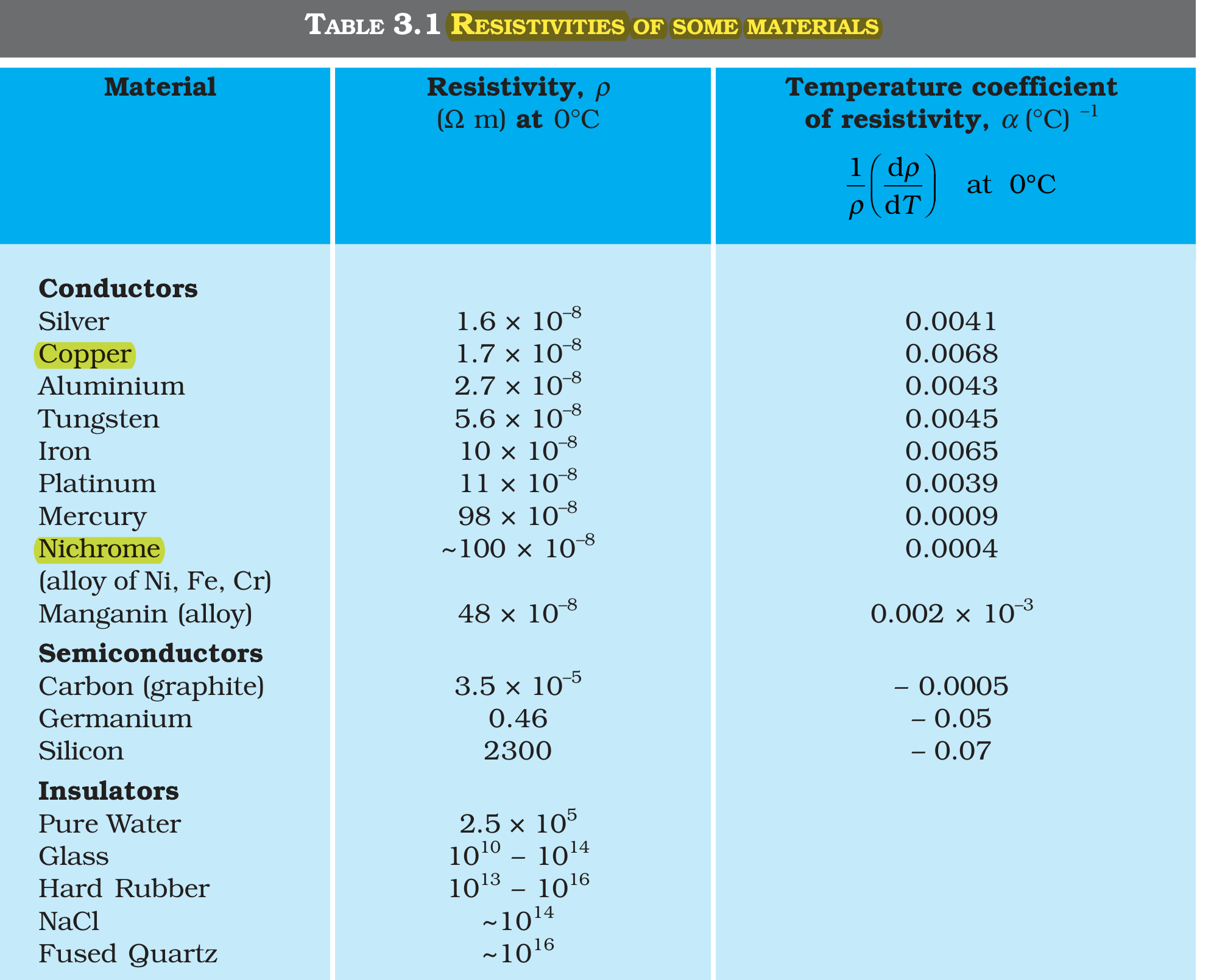
Nichrome and copper wire of same length and radius are connected in series. Current I is flowing through them. Then, after some time,
Answer & explanation
Correct answer: option 1
The correct answer is Option (1) → nichrome wire will be heated more than copper wire
In a series connection the same current flows through both wires, so by Joule’s law the wire with the larger resistance produces more heat.
\( \displaystyle H = I^{2}Rt \)
With the same length and radius, the resistance depends only on the resistivity.
\( \displaystyle R = \frac{\rho l}{A} \;\Rightarrow\; R \propto \rho \)
\( \rho_{\mathrm{nichrome}} \approx 1.0\times10^{-6}\,\Omega\,\mathrm{m} \)
\( \rho_{\mathrm{copper}} \approx 1.7\times10^{-8}\,\Omega\,\mathrm{m} \)
\( \displaystyle \frac{H_{\mathrm{nichrome}}}{H_{\mathrm{copper}}} = \frac{\rho_{\mathrm{nichrome}}}{\rho_{\mathrm{copper}}} \approx 60 \)
So the nichrome wire is heated much more than the copper wire.
Note: This question is from the pre-rationalised NCERT book (2022-23). The topic was removed from the latest NCERT book (2026-27), but it is still in the CUET 2026 syllabus, so do not skip it.
NCERT (Pre-rationalised edition, 2022-23):
Resistivity of Various Materials – …