
CUETMOCK
  • Pricing
  • Mentors
Log inStart freeStart free mocks→

First test, then trust

Try a free CUET mock test.

Join 5,00,000+ students who rehearsed exam day on the exact NTA screen before sitting CUET. On the web and on Android.

Start free mocks →Get the Android app
CUETMOCK

India's #1 CUET Mock Test Platform. Original NCERT-based questions on the exact NTA exam screen — trusted by 5,00,000+ students since CUET 2022.

Get it onGoogle PlayScan to download the CUETMOCK app

Mock tests

  • CUET mock test series
  • Commerce mocks
  • Humanities (Arts) mocks
  • Science mocks
  • Languages & GAT mocks
  • Free practice questions
  • Pricing

Resources

  • CUET exam guide
  • CUET syllabus
  • Universities accepting CUET
  • Expert blogs
  • News & notifications
  • Webinars & counselling
  • CUET score calculator
  • How we estimate your rank
  • FAQs

Company

  • About us
  • Our leadership & team
  • Our toppers
  • Mentors
  • For schools
  • Contact us
  • Terms
  • Privacy
  • Refund policy

Talk to us

+91 7696 6630 56info@cuetmock.comWhatsApp us

Our other platforms

  • JEE Mock — For IIT-JEE aspirants
  • NEET Mock — For NEET aspirants

Newsletter

Exam updates, study material and offers — no spam.

© 2026 NYC Ventures Pvt. Ltd.

701-702, Royal Business Park, Zirakpur, Punjab - 140603

  • Terms of use
  • Privacy policy
  • Refund policy
  • Contact us

iCUETMOCK is an independent preparation platform, not affiliated with the National Testing Agency (NTA). Always check exam details on the official NTA website.

  • Home
  • Mock tests
  • CUET guide
  • Pricing
  • Log in
Home/Practice questions/Chemistry
ChemistryOrganic: Aldehydes, Ketones and Carboxylic Acids

The product of the following reaction is /are
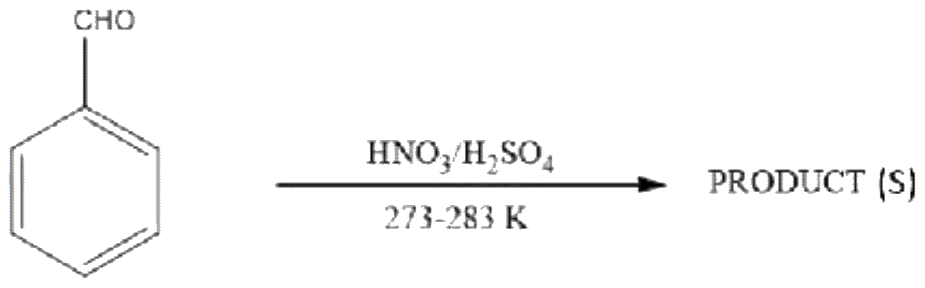
The product of the following reaction is /are

Figure for Q34

Answer & explanation+

Correct answer: option 2

The correct answer is Option (2) → m-nitrobenzaldehyde.

In electrophilic substitution of a substituted benzene, the group already on the ring decides where the new group enters:

  • Electron donating groups (–OH, –\( \ce{NH2} \), –\( \ce{CH3} \)) activate the ring and direct the electrophile to the ortho and para positions.

  • Electron withdrawing groups (–CHO, –COOH, –\( \ce{NO2} \), –CN) deactivate the ring and direct the electrophile to the meta position, because they remove electron density mostly from the ortho and para positions.

The –CHO group of benzaldehyde withdraws electrons by both the −I and −R effects, so it is meta directing. With the nitrating mixture (conc. \( \ce{HNO3} \) + conc. \( \ce{H2SO4} \)), the \( \ce{NO2^{+}} \) ion attacks the meta position. The reaction is kept at a low temperature (273-283 K) so that the easily oxidised –CHO group is not oxidised:

    \( \displaystyle \ce{C6H5CHO + HNO3} \xrightarrow[273\text{-}283\ \mathrm{K}]{\text{conc. }\ce{H2SO4}} \ce{m-O2N-C6H4-CHO + H2O} \)

So the product is m-nitrobenzaldehyde.

Why the other options are incorrect

  • Option (1) p-nitrobenzaldehyde. — Incorrect. The para position is electron-poor because of the −R effect of –CHO, so para substitution is not favoured.

  • Option (3) o-nitrobenzaldehyde. — Incorrect. The ortho position is also electron-poor for the same reason.

  • Option (4) p-nitrobenzaldehyde and o-nitrobenzaldehyde. — Incorrect. An ortho and para mixture is formed by activating groups, not by the deactivating –CHO group.

NCERT (2026-27 edition):
Electrophilic Substitution Reaction
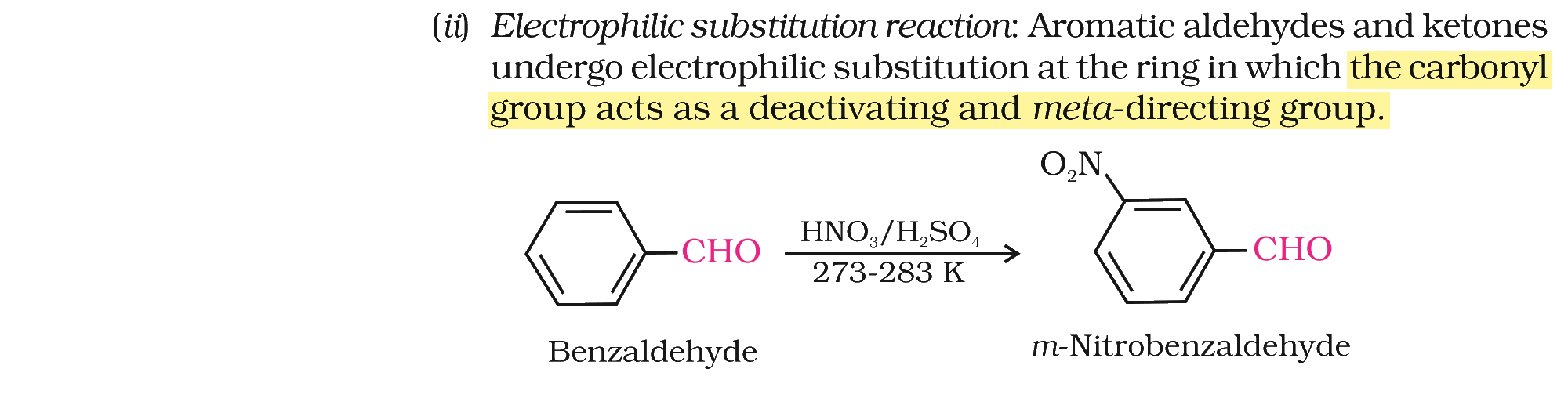
Textbook extract

Note: The same/similar question has been asked in different years by NTA as per the details given below:

20262025202420232022
29-05 S122-05 S1–––

Advertisement

Practise more on Organic: Aldehydes, Ketones and Carboxylic Acids

Chapter-wise mocks on the real NTA exam screen, with solutions and your rank. Your first mocks are free.

Start free mocks →

Advertisement

Next questions

  1. If cosec B = 3/2, then what is the value of cot B sin B ?General Aptitude Test · Quantitative Reasoning
  2. Which of the following is an investing activity?Accountancy Part B · Cash Flow Statement
  3. Select the correct statements describing the Humanistic-existential therapy. A. Humanists believe in giving instructions and shaping people…Psychology · Therapeutic Approaches
  4. Let A = 1, 2, 3, …, 10 and let R be the equivalence relation on A given by R = (a, b) : a - b is divisible by 4 . The equivalence class [2]…Maths. Section B1 · Relations and Functions
  5. What will be the increasing order of acid strength?Chemistry · Organic: Aldehydes, Ketones and Carboxylic Acids
  6. The differential equation ydy/dx + x = a (where ‘a’ is a constant) represents :Maths. Section A · Differential Equations
  7. Which of the following reasons was responsible for Akbar's moving away from the orthodox Islamic ways of understanding religions towards a…History · Medieval India: Kings and Chronicles
  8. If 48=12(mod n)m what is the values of n?Applied Maths. Section B2 · Numbers, Quantification and Numerical Applications
  9. Which of the following reducing agents reduces carboxylic acids to primary alcohols?Chemistry · Organic: Alcohols, Phenols and Ethers
  10. In bacteria, RNA polymerase can catalyse only elongation by itself. Which factor associates with it to terminate transcription?Biology · Molecular Basis of Inheritance