
Read the given passage and answer the following question.
The process of copying genetic information from one strand of the DNA into RNA is termed as transcription. Here also, the principle of complementarity governs the process of transcription, except the adenosine complements now forms base pair with uracil instead of thymine. However, unlike in the process of replication, which once set in, the total DNA of an organism gets duplicated, in transcription only a segment of DNA and only one of the strands is copied into RNA. The promoter and terminator flank the structural gene in a transcription unit. The promoter is said to be located towards 5' -end (upstream) of the structural gene (the reference is made with respect to the polarity of coding strand). It is a DNA sequence that provides binding site for RNA polymerase, and it is the presence of a promoter in a transcription unit that also defines the template and coding strands. By switching its position with terminator, the definition of coding and template strands could be reversed. The terminator is located towards 3' -end (downstream) of the coding strand and it usually defines the end of the process of transcription.
In bacteria, RNA polymerase can catalyse only elongation by itself. Which factor associates with it to terminate transcription?
Answer & explanation
Correct answer: option 3
The correct answer is Option (3) → Rho (ρ) factor
Transcription has three steps: initiation, elongation and termination. In bacteria, RNA polymerase can carry out only elongation on its own. For the other two steps, it joins for a short time with a protein factor that changes what the enzyme does: one factor for starting and another for stopping.
Option (1) Sigma (σ) factor — Incorrect. The sigma (σ) factor is the initiation factor. It helps RNA polymerase bind to the promoter and start transcription, and it leaves during elongation.
Option (2) RNA polymerase II — Incorrect. RNA polymerase II is a eukaryotic enzyme that makes hnRNA. It is not a factor, and bacteria do not have it.
Option (3) Rho (ρ) factor — Correct. The rho (ρ) factor is the termination factor. When the polymerase reaches the terminator region, rho helps end transcription, and the new RNA and the enzyme fall off the DNA.
Option (4) Ribosome — Incorrect. The ribosome translates mRNA into protein. In bacteria, translation can begin even before the mRNA is fully made, so the two processes can be coupled. Still, the ribosome does not stop transcription.
NCERT Extract:
Types of RNA and the Process of Transcription – “… Once the polymerases reaches the terminator region, the nascent RNA falls off, so also the RNA polymerase. This results in termination of transcription. An intriguing question is that how is the RNA polymerases able to catalyse all the three steps, which are initiation, elongation and termination. The RNA polymerase is only capable of catalysing the process of elongation. It associates transiently with initiation-factor (σ) and termination-factor (ρ) to initiate and terminate the transcription, respectively. Association with these factors alter the specificity of the RNA polymerase to either initiate or terminate (Figure 5.10).”
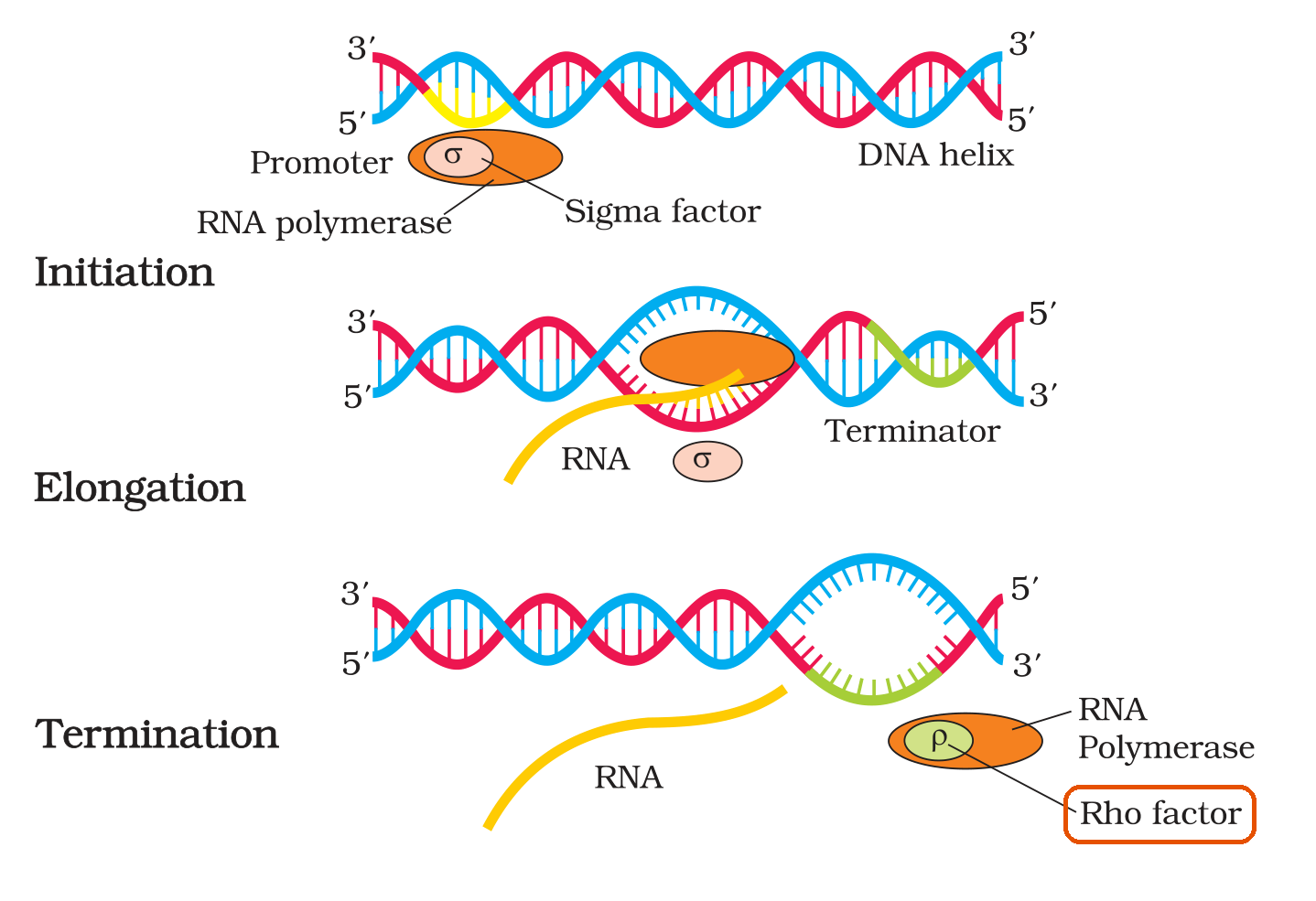
Figure 5.10 Process of Transcription in Bacteria