
The figure shows three similar lamps L1, L2 and L3 connected across a power supply.
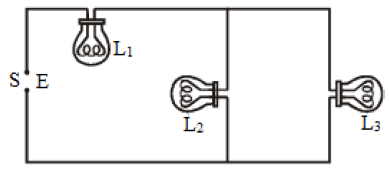
If the lamp L3 burns out (fuses), how will the light emitted by L1 and L2 change?
Answer & explanation
Correct answer: option 2
The correct answer is Option (2) → brightness of L1 decreases and that of L2 increases
The brightness of a lamp depends on the power it takes, \( P=V^{2}/R \). For identical lamps, a larger potential difference across a lamp means a brighter lamp.
From the figure, L2 and L3 are in parallel, and this pair is in series with L1 across the supply E. Let each lamp have resistance R, with the internal resistance of the supply neglected.
With all three lamps working, the total resistance and the current are:
\( \begin{aligned} R_{\mathrm{total}} &= R+\frac{R}{2} \\ &= \frac{3R}{2} \end{aligned} \)
\( \begin{aligned} I &= \frac{E}{R_{\mathrm{total}}} \\ &= \frac{2E}{3R} \end{aligned} \)
The potential differences across L1 and L2 are:
\( \begin{aligned} V_1 &= IR \\ &= \frac{2E}{3} \end{aligned} \)
\( \begin{aligned} V_2 &= E-V_1 \\ &= \frac{E}{3} \end{aligned} \)
When L3 burns out, L1 and L2 are left in series:
\( R_{\mathrm{total}}'=2R \)
\( \displaystyle I'=\frac{E}{2R} \)
\( \begin{aligned} V_1' &= I'R \\ &= \frac{E}{2} \end{aligned} \)
\( \begin{aligned} V_2' &= E-V_1' \\ &= \frac{E}{2} \end{aligned} \)
From the above, \( V_1 \) falls from \( 2E/3 \) to \( E/2 \) and \( V_2 \) rises from \( E/3 \) to \( E/2 \).
Option (1) no change — Incorrect. Removing L3 raises the total resistance from \( 3R/2 \) to \( 2R \), so the current from the supply and the voltages across both lamps change.
Option (2) brightness of L1 decreases and that of L2 increases — Correct. The voltage across L1 falls from \( 2E/3 \) to \( E/2 \), so it becomes dimmer. The voltage across L2 rises from \( E/3 \) to \( E/2 \), so it becomes brighter.
Option (3) brightness of both L1 and L2 increases — Incorrect. L1 carries the whole current, which falls from \( 2E/(3R) \) to \( E/(2R) \), so L1 takes less power and becomes dimmer.
Option (4) brightness of both L1 and L2 decreases — Incorrect. L2 no longer shares the current with L3. The voltage across it rises from \( E/3 \) to \( E/2 \), so it becomes brighter.