Match List-I with List-II
| List-I | List-II | ||
| Physical quantity | Unit | ||
| (A) | Threshold frequency | (I) | \( \mathrm{J} \) |
| (B) | Planck's constant | (II) | \( \mathrm{V} \) |
| (C) | Work function | (III) | \( \mathrm{s^{-1}} \) |
| (D) | Stopping potential | (IV) | \( \mathrm{J\,s} \) |
Choose the correct answer from the options given below:
Answer & explanation
Correct answer: option 4
The correct answer is Option (4) → (A)-(III), (B)-(IV), (C)-(I), (D)-(II)
The unit of each quantity follows from what the quantity is, or from the photoelectric relation in which it appears.
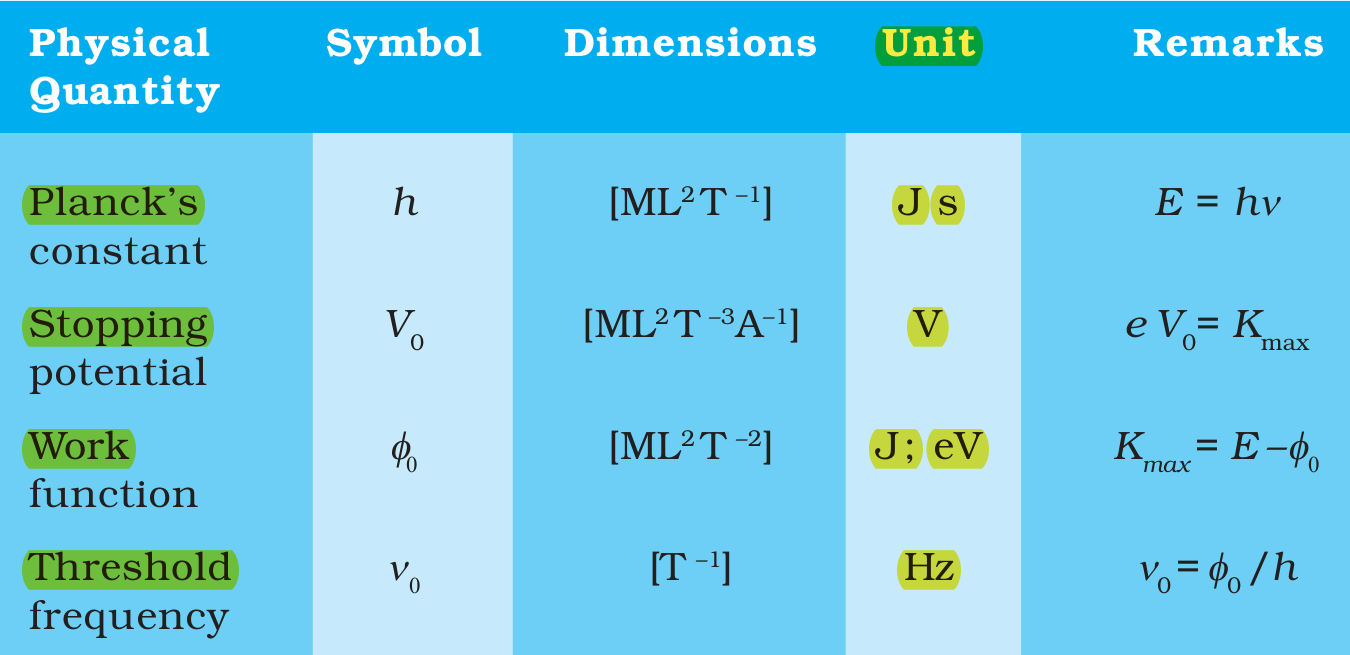
(A) Threshold frequency — this matches (III) \( \mathrm{s^{-1}} \). It is a frequency (number of oscillations per second), so its unit is \( \mathrm{s^{-1}} \), that is, hertz.
(B) Planck's constant — this matches (IV) \( \mathrm{J\,s} \). From the photon energy \( E = h\nu \), \( h = E/\nu \) has the unit \( \mathrm{J}/\mathrm{s^{-1}} = \mathrm{J\,s} \).
(C) Work function — this matches (I) \( \mathrm{J} \). It is the minimum energy needed to free an electron from the metal surface, so it is measured in joule (often quoted in eV).
(D) Stopping potential — this matches (II) \( \mathrm{V} \). It is the retarding potential that just stops the fastest photoelectrons, so its unit is the volt.
NCERT (2026-27):
Summary – …