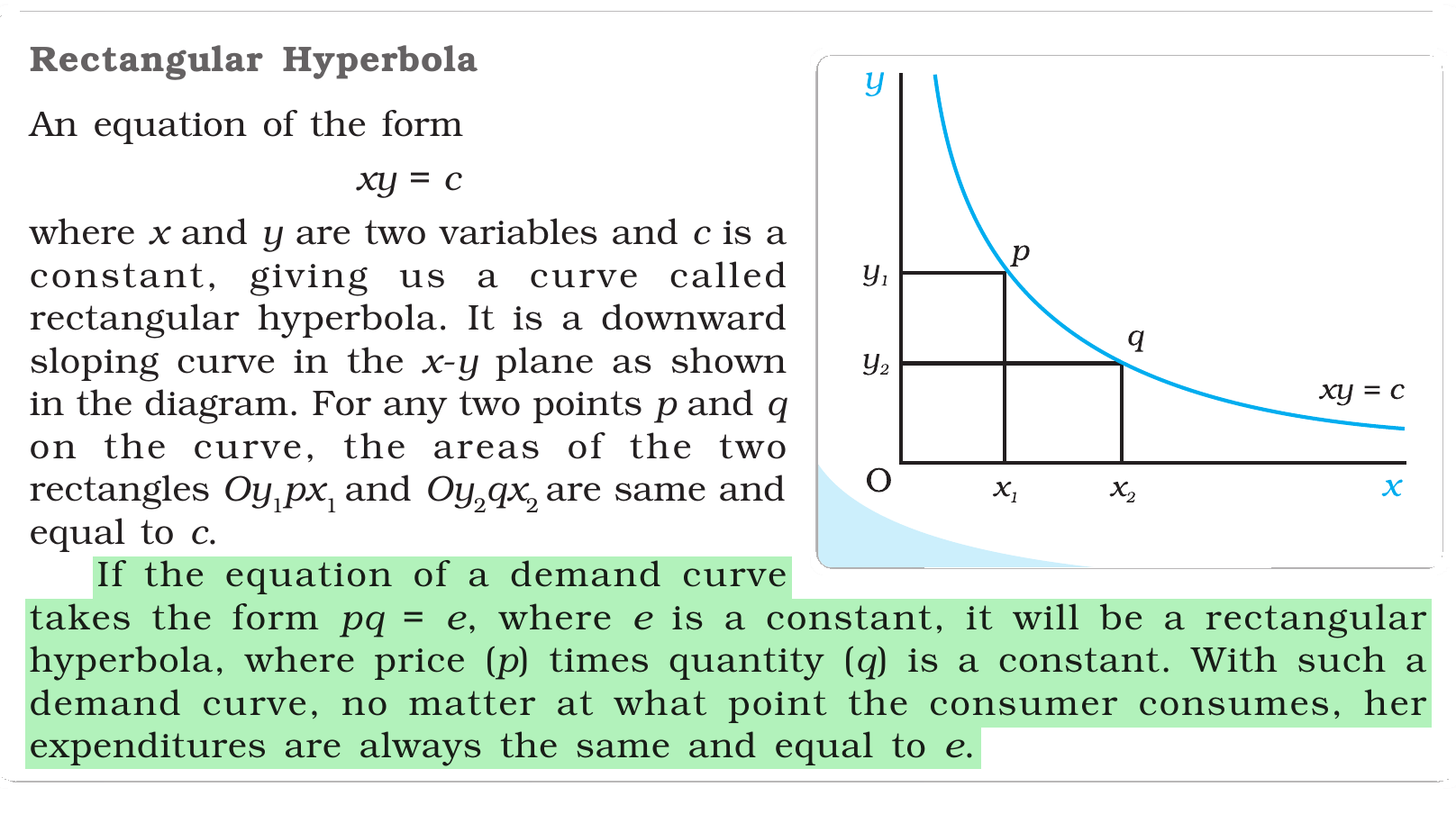
If the equation of a demand curve takes the form pq = e, where e is constant. If expenditure is always same and equals to e, then the demand curve will be in the shape of.
Answer & explanation
Correct answer: option 4
The correct answer is Option (4) → Rectangular Hyperbola
When price (p) times quantity (q) is a constant e, the consumer’s expenditure is the same at every price. A curve of the form xy = c, where c is a constant, is called a rectangular hyperbola. So the demand curve pq = e is a rectangular hyperbola.
It slopes downward. For any two points on it, the rectangles drawn under them have the same area, equal to e. On this curve, the price elasticity of demand (eD) is 1 at every point.
NCERT (2026-27): “Constant Elasticity Demand Curve …Figure 2.20(c) depicts a demand curve which has the shape of a rectangular hyperbola. This demand curve has a property that a percentage change in price along the demand curve always leads to equal percentage change in quantity. Therefore, |eD| = 1 at every point on this demand curve. This demand curve is called the unitary elastic demand curve.”
|