Match List I with List II
| LIST-I | LIST-II | ||
| A. | Jatavas | I. | Muslim Community |
| B. | Multani Lohars | II. | Meghalaya |
| C. | Khasis | III. | Karnataka |
| D. | Vokkaligas | IV. | Uttar Pradesh |
Choose the correct answer from the options given below:
Answer & explanation
Correct answer: option 2
The correct answer is Option (2) → A-IV, B-I, C-II, D-III
(A) Jatavas — this matches (IV) Uttar Pradesh. The Jatavas of Agra.
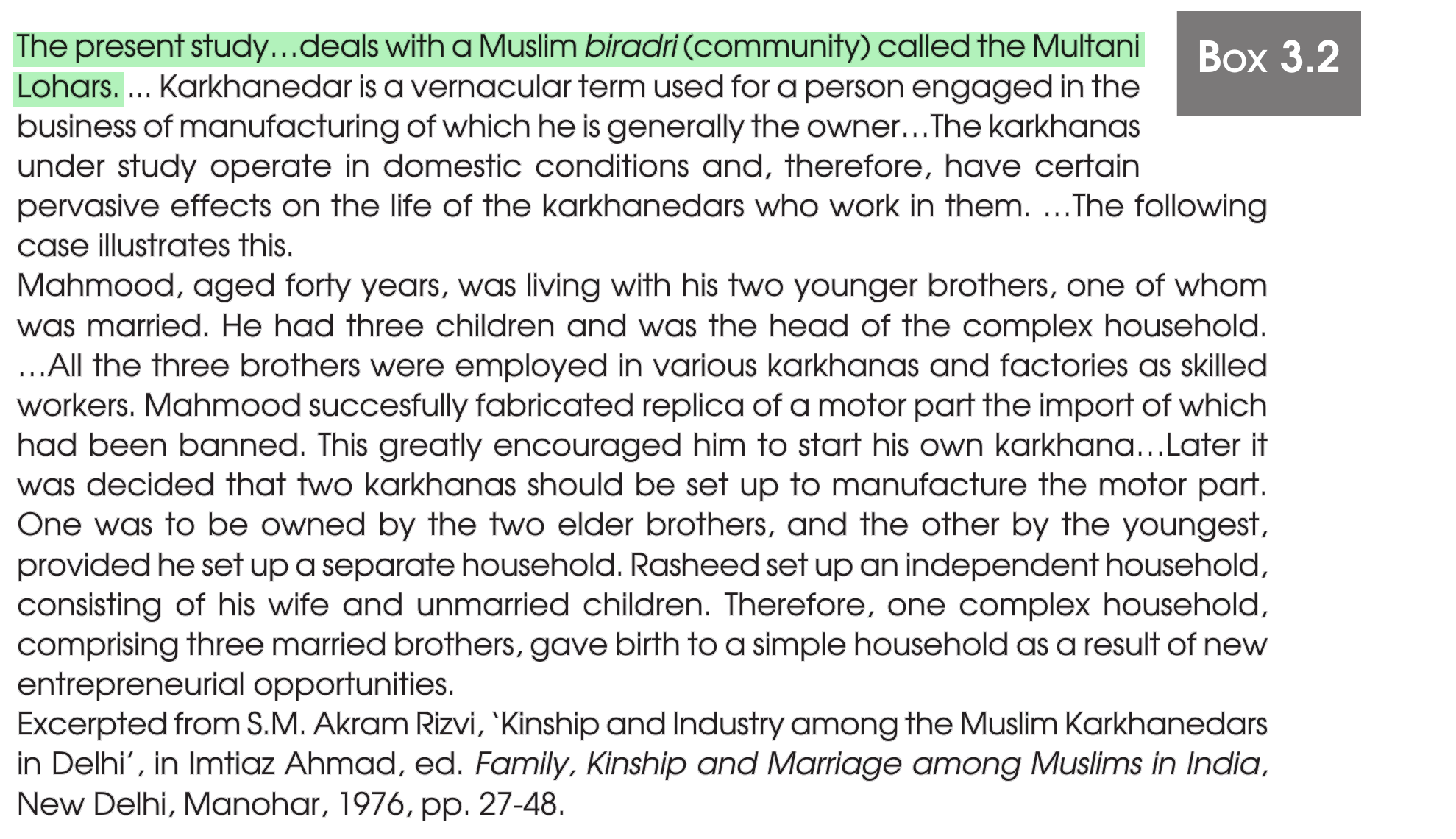
(B) Multani Lohars — this matches (I) Muslim Community. A Muslim biradri (community).
(C) Khasis — this matches (II) Meghalaya. The matrilineal Khasis of Meghalaya.
(D) Vokkaligas — this matches (III) Karnataka. A dominant caste of Karnataka.
Note: Box 3.2 on the Multani Lohars, a study of a Muslim biradri in the chapter ‘Social Institutions: Continuity and Change’, was there in the pre-rationalised NCERT, the textbook of 2022. This box has been deleted from the NCERT book (2025-26), though the chapter is still there.
NCERT (2025-26): “Caste in the Present … Thus, these intermediate castes became the ‘dominant’ castes in the country side and played a decisive role in regional politics and the agrarian economy. Examples of such dominant castes include the Yadavs of Bihar and Uttar Pradesh, the Vokkaligas of Karnataka, the Reddys and Khammas of Andhra Pradesh, the Marathas of Maharashtra, the Jats of Punjab, Haryana and Western Uttar Pradesh and the Patidars of Gujarat.” “Indian Society, Chapter 5 (Patterns of Social Inequality and Exclusion) — 5.3 Struggle for women’s equality and rights … But the strongest argument comes from the societies that were different from the ‘normal’ or common pattern. If women were biologically unfit to be inheritors and heads of families, how did matrilineal societies (as the Nairs of Kerala used to be, and as the Khasis of Meghalaya still are) work for centuries? How have women managed to be successful farmers and traders in so many African societies?…” “Social Change and Development in India, Chapter 8 (Social Movements) — The Dalit Movement … This can be seen in the Satnami Movement of the Chamars in the Chattisgarh plains in eastern MP, Adi Dharma Movement in Punjab, the Mahar Movement in Maharashtra, the socio-political mobilisation among the Jatavas of Agra and the Anti-Brahman Movement in south India.…”
Box 3.2, the Multani Lohars (Pre-rationalised NCERT) |