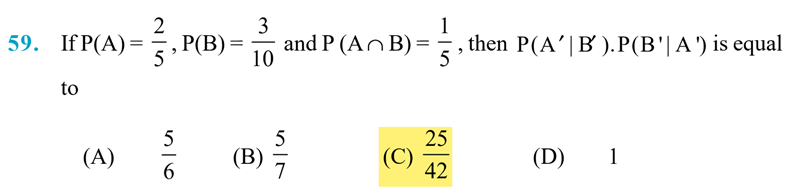
If \(P(\mathrm{A})=\displaystyle\frac{2}{5}, P(\mathrm{B})=\displaystyle\frac{3}{10}\) and \(P(\mathrm{A}\cap \mathrm{B})=\displaystyle\frac{1}{5}\), then \(P(\mathrm{A}'/\mathrm{B}')\cdot P(\mathrm{B}'/\mathrm{A}')\) is equal to:
Answer & explanation
Correct answer: option 3
The correct answer is Option (3) → \(\displaystyle\frac{25}{42}\)
Both conditional probabilities need \(P(A' \cap B')\). By De Morgan’s law, \(A' \cap B' = (A \cup B)'\):
\( \displaystyle P(A \cup B) = \frac{2}{5} + \frac{3}{10} - \frac{1}{5} = \frac{1}{2} \)
\( \displaystyle P(A' \cap B') = 1 - \frac{1}{2} = \frac{1}{2} \)
The complements:
\( \displaystyle P(A') = 1 - \frac{2}{5} = \frac{3}{5},\quad P(B') = 1 - \frac{3}{10} = \frac{7}{10} \)
By the definition of conditional probability:
\( \displaystyle P(A'/B') = \frac{P(A' \cap B')}{P(B')} = \frac{1/2}{7/10} = \frac{5}{7} \)
\( \displaystyle P(B'/A') = \frac{P(A' \cap B')}{P(A')} = \frac{1/2}{3/5} = \frac{5}{6} \)
So
\( \displaystyle P(A'/B')\cdot P(B'/A') = \frac{5}{7} \times \frac{5}{6} = \frac{25}{42} \)
Why the other options are incorrect
Option (1) \(\displaystyle\frac{5}{6}\) — Incorrect. This is \(P(B'/A')\) alone, the second factor of the product.
Option (2) \(\displaystyle\frac{5}{7}\) — Incorrect. This is \(P(A'/B')\) alone, the first factor of the product.
Option (4) \(\displaystyle\frac{27}{42}\) — Incorrect. The product is \(\frac{5 \times 5}{7 \times 6} = \frac{25}{42}\), not \(\frac{27}{42}\).
NCERT Exemplar:
Probability