
Which of the following shaded regions represents the solution to the inequation \( |x|+|y|\le 1 \)?
Answer & explanation
Correct answer: option 3
The correct answer is Option (3)
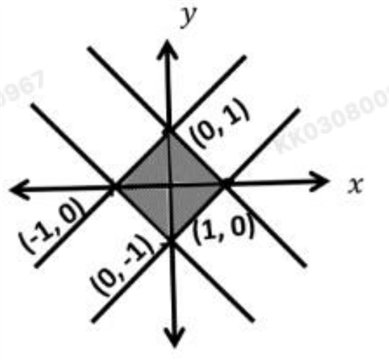
In each quadrant the moduli open as follows:
\( \displaystyle x\ge 0,\ y\ge 0:\ x+y\le 1 \)
\( \displaystyle x\lt 0,\ y\ge 0:\ -x+y\le 1 \)
\( \displaystyle x\lt 0,\ y\lt 0:\ -x-y\le 1 \)
\( \displaystyle x\ge 0,\ y\lt 0:\ x-y\le 1 \)
Each boundary is a line segment joining two of the points (1, 0), (0, 1), (−1, 0), (0, −1). Together they form a square with these four vertices.
The origin satisfies \( |0|+|0|=0\le 1 \), so the solution is the inside of this square, including its sides. Only Option (3) shades exactly this square.
Why the other options are incorrect
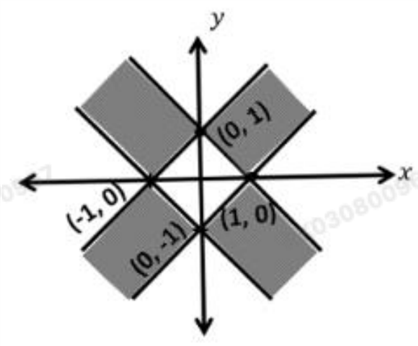
Option (1) — Incorrect. It leaves the square, including the origin, unshaded and shades the four strips outside it; a shaded point such as (1, 1) gives |x| + |y| = 2 > 1.
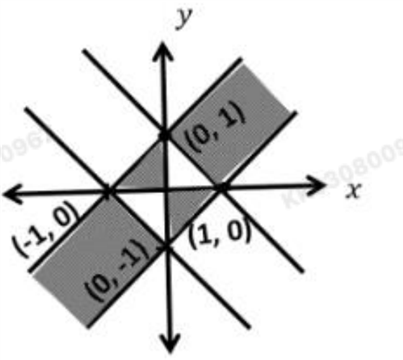
Option (2) — Incorrect. It shades a band running from the lower left to the upper right, which contains points such as (1, 1), where |x| + |y| = 2 > 1.
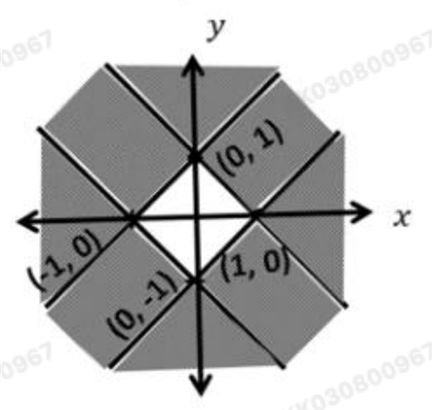
Option (4) — Incorrect. It leaves the square unshaded and shades the region outside it, which represents \( |x|+|y|\ge 1 \).