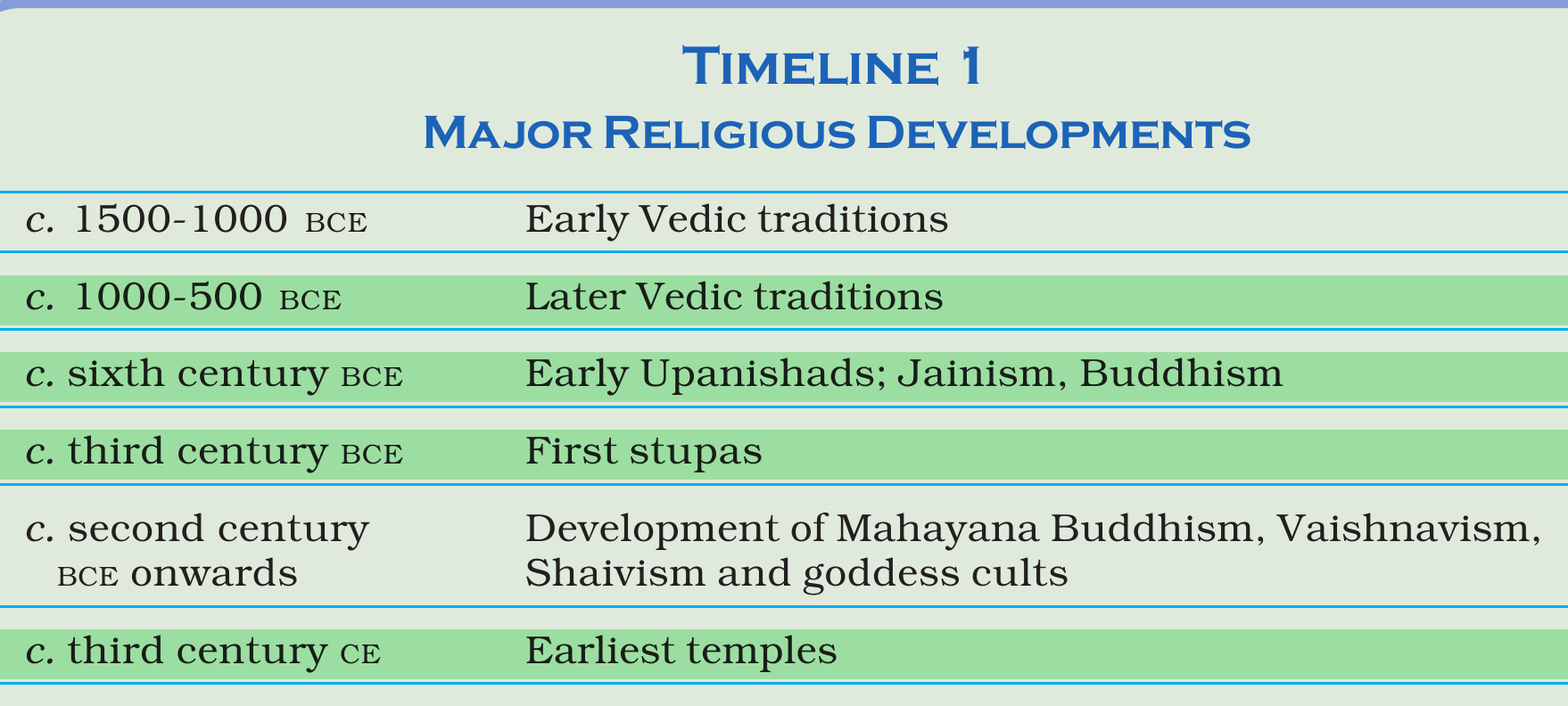
Match the LIST-I with LIST-II:
| LIST-I Years | LIST-II Major Religious Developments | ||
| A. | c. 1000-500 BCE | I. | Later Vedic traditions |
| B. | c. Sixth-Century BCE | II. | First stupas |
| C. | c. Third-Century BCE | III. | Early Upanishads |
| D. | c. Third-Century CE | IV. | Earliest temples |
Choose the correct answer from the options given below:
Answer & explanation
Correct answer: option 2
The correct answer is Option (2) → A - I, B - III, C - II, D - IV
(A) c. 1000-500 BCE — this matches (I) Later Vedic traditions. They followed the Early Vedic traditions of c. 1500-1000 BCE, when sacrifices were performed to gods such as Agni, Indra and Soma.
(B) c. Sixth-Century BCE — this matches (III) Early Upanishads. The Upanishads show people asking about the meaning of life, life after death and rebirth. The same century saw the rise of Jainism and Buddhism.
(C) c. Third-Century BCE — this matches (II) First stupas. Stupas were built over the relics of the Buddha, and by the second century BCE stupas stood at Bharhut, Sanchi and Sarnath.
(D) c. Third-Century CE — this matches (IV) Earliest temples. The early temples were small square rooms called the garbhagriha, with a single doorway for the worshipper to enter and offer worship to the image.
NCERT (2025-26): “2.2 New questions … Many ideas found in the Upanishads (c. sixth century BCE onwards) show that people were curious about the meaning of life, the possibility of life after death, and rebirth. Was rebirth due to past actions? Such issues were hotly debated.…”
|