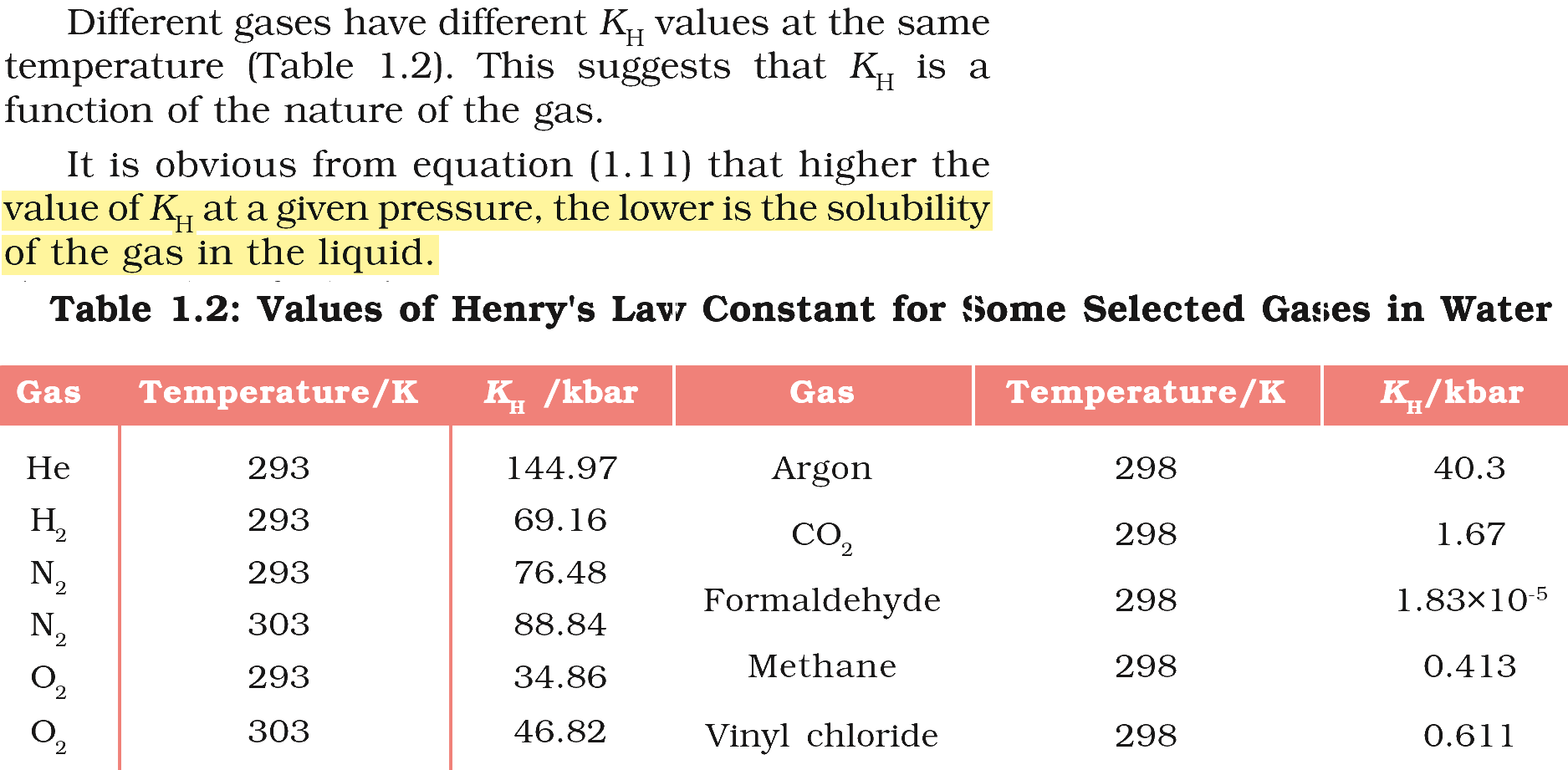
Henry’s constant (KH) for Argon, carbon dioxide, methane and vinyl chloride at 298 K are 40.3 kbar, 1.67 kbar, 0.413 kbar and 0.611 kbar respectively. Which gas has maximum solubility in water under atmospheric pressure, as per the values given?
Answer & explanation
Correct answer: option 2
The correct answer is Option (2) → Methane
Henry’s law states that the partial pressure of a gas above a solution is proportional to its mole fraction in the solution:
\( \displaystyle p=K_H\,x\quad\Rightarrow\quad x=\frac{p}{K_H} \)
Here x, the mole fraction of the dissolved gas, is a measure of its solubility. At the same pressure, the solubility is inversely proportional to KH: the lower the KH, the higher the solubility.
The given KH values at 298 K are:
\( \displaystyle \text{methane (0.413 kbar)} < \text{vinyl chloride (0.611 kbar)} < \ce{CO2}\text{ (1.67 kbar)} < \text{argon (40.3 kbar)} \)
Methane has the lowest KH, so methane has the maximum solubility.
NCERT (2026-27 edition):
Solubility of a Gas in a Liquid – …