Read the passage carefully and answer the questions based on the passage:
Aggregate Demand and Its Components
Consumption may denote not what people have actually consumed in a given year, but what they had planned to consume during the same period. Similarly, investment can mean the amount a producer plans to add to her inventory. It may be different from what she ends up doing. The planned values of the variables are called their ex ante measures. The most important determinant of consumption demand is household income. A consumption function describes the relation between consumption and income. The simplest consumption function assumes that consumption changes at a constant rate as income changes. Of course, even if income is zero, some consumption still takes place. Since this level of consumption is independent of income, it is called autonomous consumption. The induced component of consumption, cY shows the dependence of consumption on income.
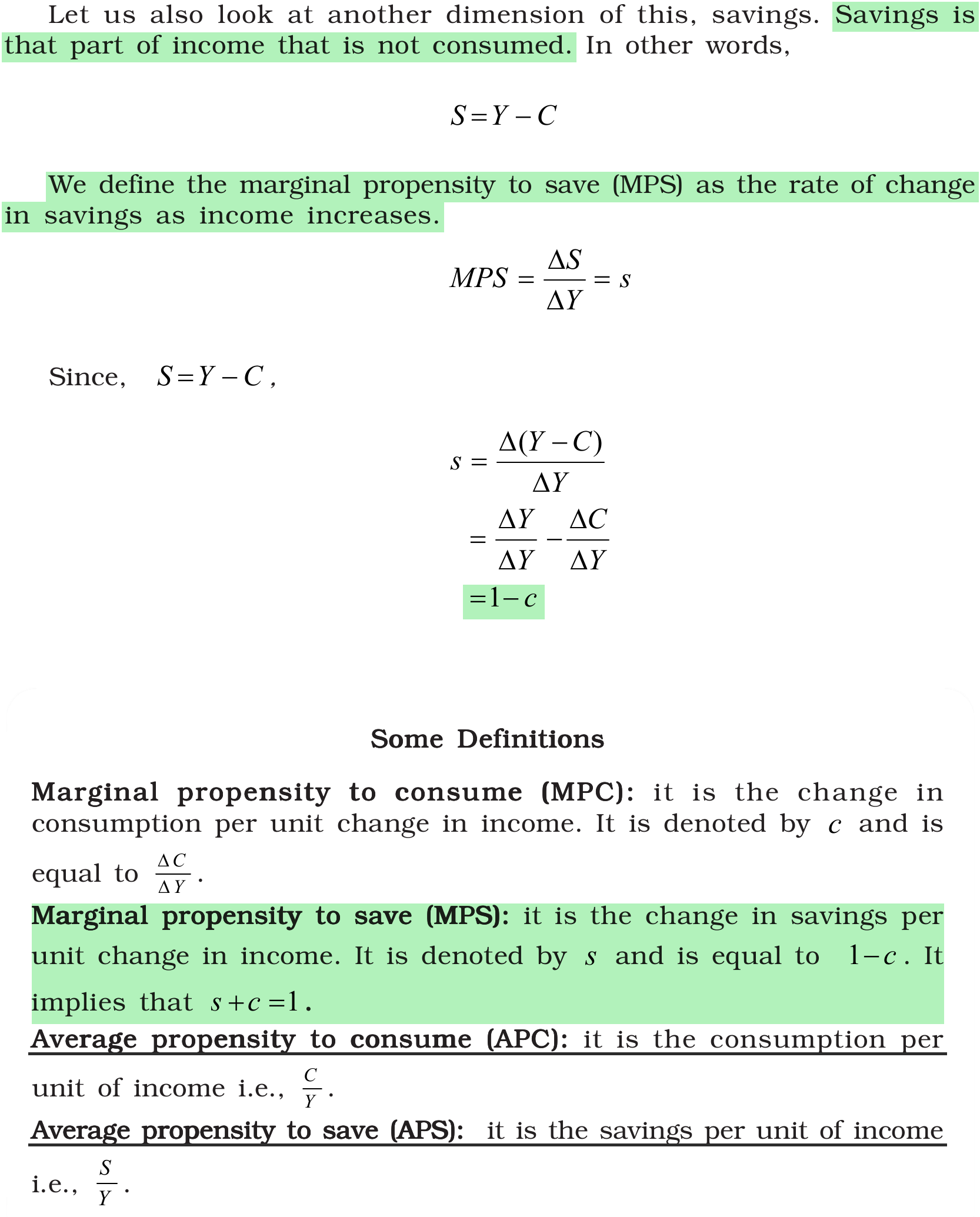
Savings are that part of income that is not consumed. What is the marginal propensity to save?
Answer & explanation
Correct answer: option 4
The correct answer is Option (4) → 1-c
The marginal propensity to save (MPS) is the change in savings per unit change in income. Each extra rupee of income is either consumed or saved. Out of it, the share c (the marginal propensity to consume) is consumed, so the rest, 1 − c, is saved.
Option (1) S/Y — Incorrect. This is the average propensity to save (APS), the savings per unit of income. It uses total savings and total income, whereas MPS uses the changes in them.
Option (2) C/Y — Incorrect. This is the average propensity to consume (APC), the consumption per unit of income. It tells how much is spent on average.
Option (3) ΔS — Incorrect. This is only the change in savings. MPS divides this change by the change in income, that is, ΔS/ΔY.
Option (4) 1-c — Correct. The two propensities add up to 1, so s + c = 1 and s = 1 − c.
NCERT (2026-27): Introductory Macroeconomics — Chapter 4: Determination of Income and Employment
|