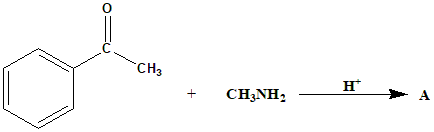
Identify A.
Answer & explanation
Correct answer: option 2
The correct answer is Option (2) → C6H5C(CH3)=NCH3 (N-methyl imine, a Schiff’s base)
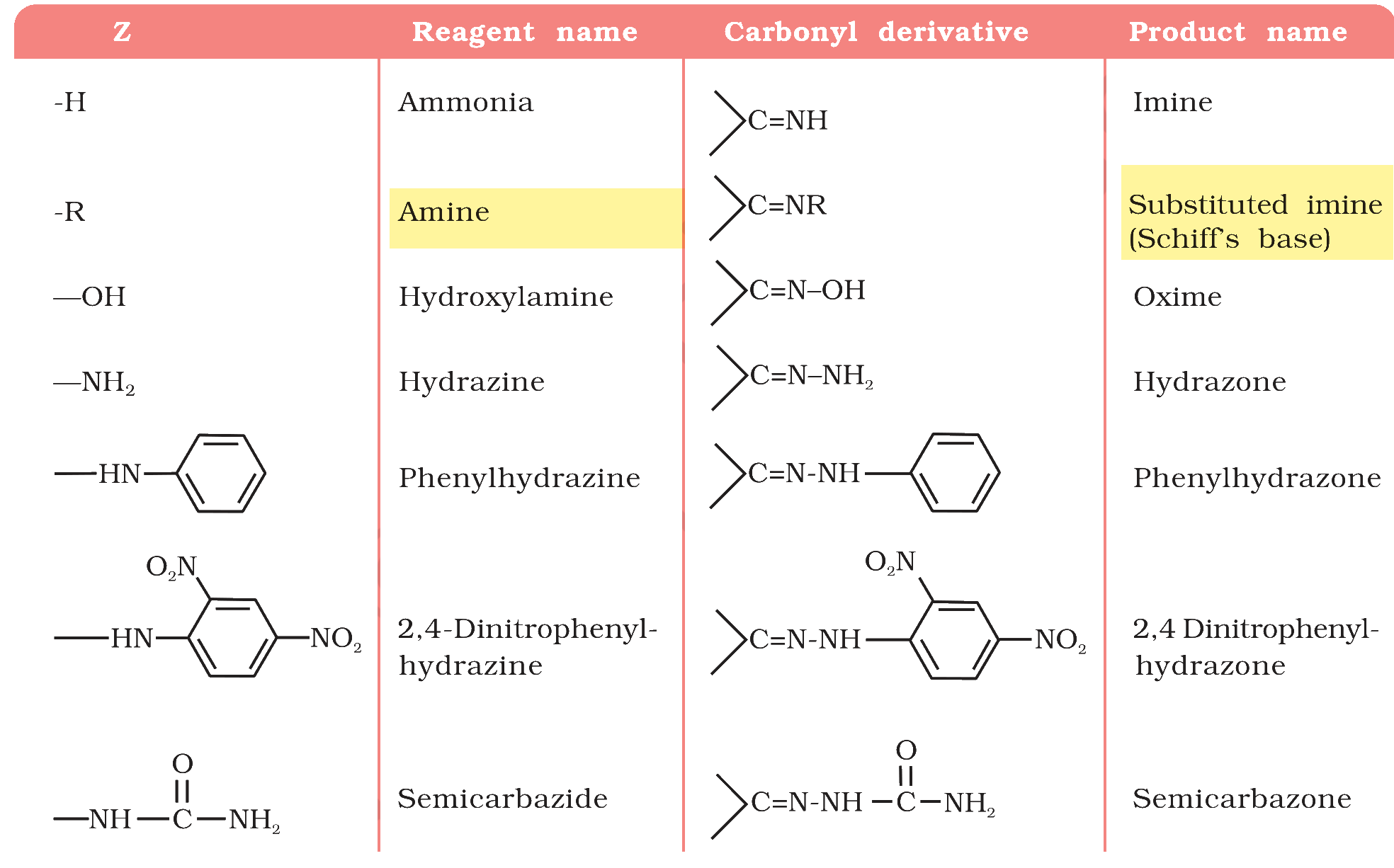
Ammonia and its derivatives H2N–Z add to the carbonyl group of aldehydes and ketones. The reaction is reversible and acid catalysed: the nitrogen of the amine attacks the carbonyl carbon (nucleophilic addition), and the addition product quickly loses water to form a C=N bond. With a primary amine (Z = R) the product is a substituted imine, or Schiff’s base.
Here acetophenone reacts with methylamine:
\( \ce{C6H5COCH3 + H2NCH3} \xrightarrow{\ce{H^+}} \ce{C6H5C(CH3)=NCH3 + H2O} \)
So A is the N-methyl imine of acetophenone, the structure in Option (2).
Why the other options are incorrect
Option (1) 2-(methylamino)acetophenone — Incorrect. The amine reacts with the C=O group, not with the ring; the carbonyl group is still present in this structure, so no reaction has taken place at it.
Option (3) 3-(methylamino)acetophenone — Incorrect. Again an –\( \ce{NHCH3} \) group on the ring with the C=O group untouched; amines do not substitute a hydrogen of the benzene ring.
Option (4) N-methyl-1-phenylethanamine, C6H5CH(CH3)NHCH3 — Incorrect. This amine forms only if the imine is reduced further (for example with \( \ce{H2} \)/Ni); there is no reducing agent here.
NCERT (2026-27 edition):
Addition of Ammonia and its Derivatives – …